Itinerary
Itinerary
Day 1: Gather in Tucson before your owl research expedition
Arrive in the Sonoran Desert, where saguaros rise beneath distant mountain ranges
Join your Field Guide and research team for dinner and an introduction to owl conservation
Learn how cavity cameras, GPS units and nighttime surveys support the fieldwork ahead
Arrive in Tucson, where you're met on arrival and transferred to our hotel. Here, the Sonoran Desert sprawls beneath distant peaks, with towering saguaros dominating the landscape—a mosaic of dry washes, cactus forests and desert grasslands that support an astonishing diversity of wildlife.
This evening, gather with your Field Guide, fellow travelers and research team for a welcome dinner. Get an orientation to all that lies ahead during our week in the Chiricahua Mountains, where flammulated owls, elf owls and northern saw-whet owls depend on nesting cavities hidden within pine-oak forests. You'll learn about owl conservation, nest monitoring, and the broader goals of the research project. You'll also be introduced to the tools and techniques used throughout the expedition, including cavity cameras, GPS units and nighttime owl surveys. Discover how researchers locate nest sites, assess habitat quality and monitor owl activity across the forests and canyons of southeastern Arizona. Depending on arrival times and project needs, the evening may also include a hands-on introduction to nest cavity monitoring methods.

Day 2: Explore a desert alive with nesting birds and giant saguaros
Visit Saguaro National Park and the Arizona-Sonora Desert Museum
Look for Gila woodpecker cavities, Harris’s hawks, Gambel’s quail and cactus wrens
Learn how saguaros provide nesting sites, food and shelter for desert wildlife
Our adventures begin today as we explore Saguaro National Park and the Arizona-Sonora Desert Museum where we learn about the region's climate and wildlife. Two annual rainy seasons support a wide range of plant and animal life, which distinguishes the Sonoran from other deserts that lack its biodiversity. Look for the nesting cavities of Gila woodpeckers in saguaros, Gambel's quail in the desert scrub, and Harris's hawks perched atop towering cacti. Depending on conditions, you may also encounter curve-billed thrashers, cactus wrens, roadrunners and a variety of hummingbird species. Learn how giant saguaros function much like trees, providing nesting sites, perches and food resources. Throughout the day, your Field Guide will help interpret the relationships between the desert's plants, birds and wildlife while drawing connections between these desert ecosystems and the mountain habitats you'll explore later in the week.
Return to our lodging this evening for dinner and continued field preparation. Additional training may include nest cavity identification, research methods briefings, and preparation for upcoming fieldwork in the Chiricahua Mountains. If conditions allow, enjoy the region's renowned dark skies, where minimal light pollution reveals spectacular views of the stars.
Day 3: Ascend from cactus desert to an owl research base in the Chiricahuas
Watch saguaros give way to oak woodland and pine forest on the drive into the mountains
Settle into Cave Creek Canyon at the Southwestern Research Station
Train with cavity cameras and begin checking potential owl nest sites
After breakfast, leave Tucson behind and drive about three hours into the Chiricahua Mountains of southeastern Arizona. As we ascend, observe the changes in the landscape as saguaro-studded desert gives way to oak woodland, pine forest and cooler mountain habitat. By early afternoon, arrive at the Southwestern Research Station in Cave Creek Canyon, a biological field station run by the American Museum of Natural History in New York, which will be our base for the next four days. The station provides scientists, educators and students from around the world the opportunity to work and study in one of the most biologically rich environments in the United States. Located at 5,400 feet above sea level, the station lies in the heart of the Madrean Sky Island Archipelago stretching from the tropical Sierra Madre Occidental all the way to the Rocky Mountains. Nearby habitats include an elevational gradient from low desert to alpine meadows, rich riparian areas, and a unique blend of Chihuahuan and Sonoran Desert species.
After we get settled in, begin training with cavity-monitoring cameras and other field equipment before heading into the surrounding habitat. Walk the station grounds with researchers, learn how cavity-monitoring equipment is used, and begin identifying the trees, snags and forest structures that create nesting opportunities for owls. You'll also conduct introductory cavity checks and gain your first hands-on experience evaluating potential nesting habitat. As the sun drops behind the canyon walls, we anticipate the nocturnal research ahead: Depending on conditions and research priorities, the evening may include an introductory nocturnal survey, offering a first opportunity to experience the forest after dark and learn how researchers search for species that are more often heard than seen.
Please note: Some departures will spend the next four nights at the Southwestern Research Station while others will stay nearby at nearby Cave Creek Ranch. Please check with an Adventure Specialist for accommodation specifics.
Accommodations


Day 4: Search hidden tree cavities for Arizona’s smallest forest owls
Use GPS units, cavity cameras and mirror poles to inspect trunks and snags
Look for flammulated, elf and northern saw-whet owls in the pine-oak forest
See owls at close range when researchers safely handle them for monitoring
Today, head into Cave Creek Canyon and the South Fork region, one of the most biologically rich corners of the Chiricahua Mountains where steep canyon walls, pine-oak forests and seasonal waterways create habitats that are home not only to owls and other birds, but white-tailed deer, coatimundi, black bear, coyote and myriad bats. With more than 20 bat species recorded, the Chiricahuas have the highest bat diversity in the United States. For us, the search for owls will begin with trees. Alongside the research team, visit active study sites and look for the natural cavities many owl species depend upon for nesting. Using GPS units, cavity cameras and mirror poles, investigate potential nest sites hidden high within trunks and snags. Learn how to evaluate a cavity's suitability by examining its size, depth, location and surrounding habitat.
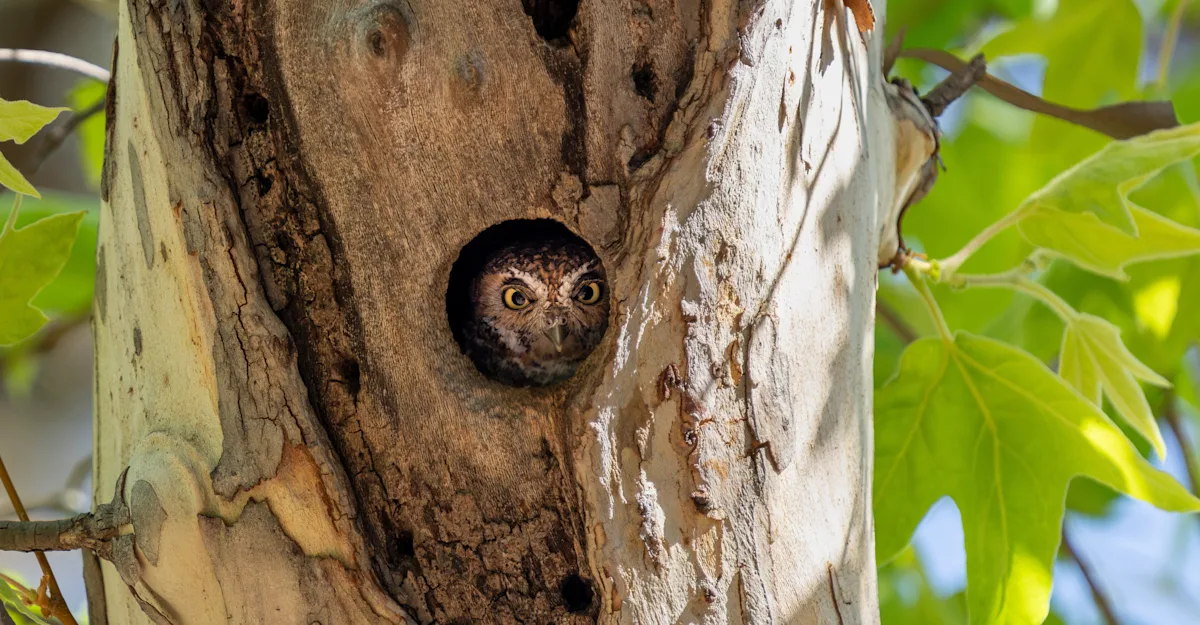
At first glance, the forest can appear uniform, but the reward for careful observation can be extraordinary. After hours of searching with researchers, the sudden discovery of an owl can send a jolt of excitement through the group—a tiny bird no bigger than your hand, staring back with luminous eyes from a hidden cavity or shaded branch. Participants may also have opportunities to assist researchers as they safely handle owls for monitoring and data collection, offering a rare chance to see these elusive predators up close. With practice, subtle details throughout the forest begin to stand out. An old woodpecker excavation, a lightning-scarred pine or a dead standing tree may provide critical nesting habitat for species that are otherwise difficult to study. Additional evening field activities may take place depending on research priorities and local conditions.
Accommodations
Days 5 to 6: Monitor owl nests across the changing mountain forest
Revisit known cavity trees and document changes in nesting habitat
Check remote cameras, survey vegetation and search for signs of owl activity
Learn how wildfire, drought and forest change affect cavity-nesting species
Over the next two days, travel with researchers across the Chiricahua Mountains, where owl habitat is monitored throughout the breeding season. One day may be spent revisiting known cavity trees, inspecting nest sites and documenting changes in forest conditions. The other may focus on checking remote cameras, surveying vegetation or searching for signs of activity around potential nesting locations. The work takes us through a variety of habitats, from pine-covered slopes and oak woodland to canyon bottoms lined with sycamores. Along the way, the observations we collect help build a clearer picture of owl habitat and nesting activity.
Wildlife remains a constant presence, with deer, coatimundi and a variety of bird species occasionally appearing along the trail. As the fieldwork becomes more familiar, individual observations begin to connect to larger patterns. Learn how wildfire, drought and shifts in forest structure can influence nesting opportunities, and how long-term monitoring helps researchers understand changes that unfold over years rather than seasons. Depending on weather and research priorities, nights may include additional fieldwork, offering opportunities to experience the forest after dark and learn how researchers survey for owl activity.
On our final evening, gather with our Field Guide, scientists and fellow travelers for a farewell dinner as we discuss the conservation implications of our research with the project leaders. Reflect on how information gathered from nest monitoring, habitat surveys and long-term field observations helps inform conservation strategies for cavity-nesting owls and the forests they depend upon. Depart with valuable insight into how field research contributes to wildlife management and conservation decision-making across the region.
Accommodations
Day 7: Depart Arizona with a firsthand understanding of forest owls
Descend from the Chiricahua Mountains into the Sonoran Desert
Transfer to Tucson for homeward flights
After breakfast, depart the Southwestern Research Station and drive back to Tucson. The route retraces our journey through southeastern Arizona, descending from the forests of the Chiricahua Mountains into the Sonoran Desert. Arrive at Tucson International Airport for homeward flights, reflecting on your valuable contribution to research on owl habitat, nesting ecology and the changing forests of southeastern Arizona.