Itinerary
Day 1: Arrive in Reykjavik, Iceland’s capital on the North Atlantic
Explore Iceland’s compact, walkable capital
Learn how glacial runoff supports coastal fish populations and the killer whales that follow them
Arrive in Iceland's capital of Reykjavik, where you are met and transferred to your accommodations. If time allows, explore this dynamic, highly walkable small city that is the commercial hub of this small island nation forged by fire and ice, with glaciers and volcanoes carving and building its unstable, shifting landscape. Rivers fed by glacial melt and nutrient-rich runoff feed coastal waters, determining where fish gather—and where killer whales follow. This relationship between land and sea is integral in the research to come.
Accommodations


Day 2: Horseback ride beneath Eyjafjallajokull and walk Iceland’s glacial coast
Cross open fields on a sure-footed Icelandic horse
Visit family-run Skalakot Farm to learn the breed’s Norse history and distinctive gaits
Walk among glaciers, waterfalls, lava fields and black sand beaches
Icelandic horses are compact, sure-footed and built for navigating rough ground. Brought to this harsh climate by Norse settlers more than 1,000 years ago, they’ve become both a symbol of Icelandic identity and a practical working animal still used on farms today. Learn about their unique stature, distinctive gaits and Iceland's strict breeding laws designed to protect them on a morning visit to Skalakot Farm, a family-run operation located beneath the Eyjafjallajokull volcano. Set out on a private guided ride across open fields at the volcano's base. The volcanic terrain is uneven and exposed, but these horses navigate it with ease. Many move in the tolt, a smooth gait unique to Icelandic horses that allows for a steady, gliding ride even over rough ground.
Afterward, we explore the South Coast in more detail. This stretch of Iceland is marked by contrasting geological features—glaciers winding down from the interior icefields, spawning rivers that flow to the sea, black sand beaches formed by volcanic eruptions, and waterfalls, fed by ice caps, that drop from sheer cliffs. Protected areas preserve these active systems where ice, flowing water and volcanic activity continually reshape the land. On a guided walk through this landscape, we move among river-cut valleys, moss-covered lava and open panoramas of the coastline. Glacial runoff carries sediment to the sea, feeding coastal waters that support dense fish populations and, in turn, the predators you’ll study later in the trip.

Day 3: Cross braided rivers into a Highland valley between three glaciers
Travel by high-clearance 4x4 through shifting waterways
Walk beneath steep ridgelines rising over broad gravel plains
Explore one of southern Iceland’s last remaining birch woodlands
Travel inland to the dramatic Thorsmork region, a protected valley set between three glaciers, including Eyjafjallajokull and Myrdalsjokull. To reach it, we travel in modified high-clearance 4x4 vehicles built for navigating rugged Highland terrain, crossing braided glacial rivers whose courses are constantly shifting with meltwater runoff. Once inside the valley, the imposing scale of our environs is on display on a guided walk through this magnificent landscape. River channels braid across wide gravel plains, carrying sediment from the ice caps above, while steep ridgelines rise above the valley floor. Explore one of the few remaining birch woodlands in southern Iceland, a rare pocket of green held within the otherwise raw and exposed Highland environment, where the elements have stripped the landscape to dark rock and ash.
Day 4: Reach the volcanic Westman Islands and begin your killer whale research
Cross by ferry to Heimaey, the archipelago’s largest and only inhabited island
See sea cliffs crowded with nesting seabirds, including one of Iceland’s largest puffin colonies
Meet the research team and learn how scientists identify and track individual killer whales
This morning we head to the ferry terminal at Landeyjahofn to cross to Vestmannaeyjar, or the Westman Islands—named for the Irish slaves, or "West Men," who were brought here from the British Isles by Norse settlers in the 9th century. This volcanic archipelago, which rises abruptly out of the North Atlantic, is known for its large seabird colonies and productive coastal waters. Heimaey, the largest of the 15 islands and the only inhabited town, will be our base.
As the islands come into view, steep sea cliffs rise from the water, packed with nesting seabirds, including one of Iceland’s largest puffin colonies. Offshore, nutrient-rich waters hold dense schools of fish, including herring, drawing whales and other predators into concentrated feeding areas. On arrival, meet the research team at the harbor and transfer to our accommodations nearby, as we eagerly anticipate the research fieldwork that lies ahead. This evening, the team’s Lead Scientist introduces the research program, the methods we'll use, and what to expect in the days ahead. We'll learn how scientists identify individual killer whales by their dorsal fins, tracking their movements across seasons, and we'll get an orientation to the work we'll be doing as we study their changing feeding behavior.

Days 5 to 7: Track killer whales and document their changing feeding behavior
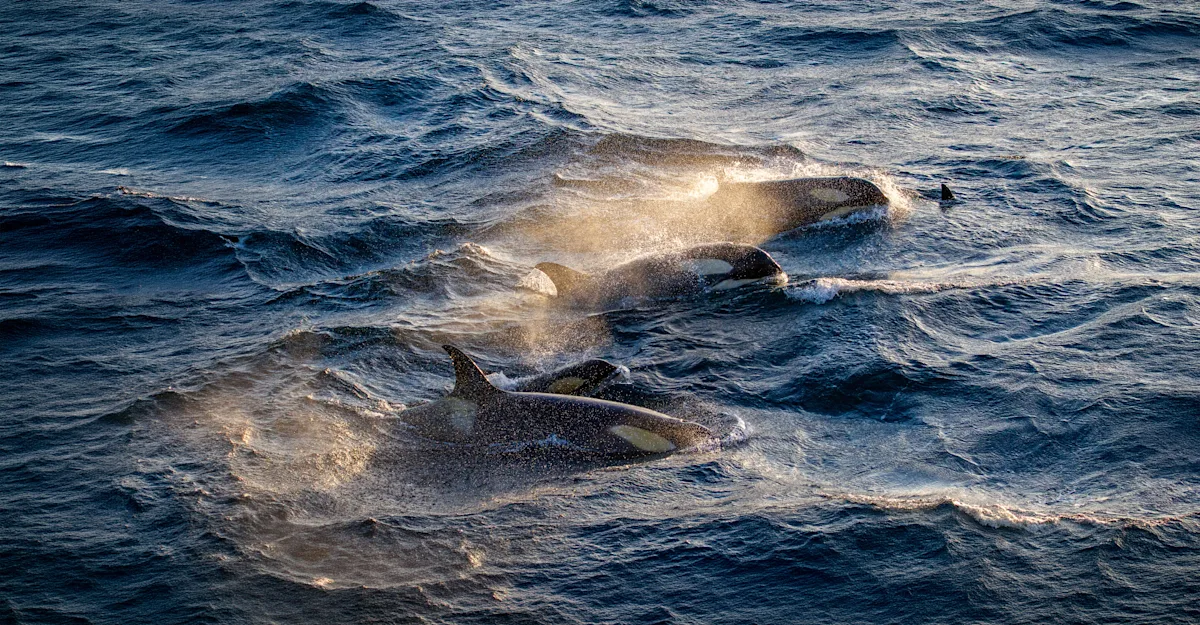
Scan from coastal lookouts and research boats for orcas hunting beneath feeding seabirds
Photograph dorsal fins and record whale movements, group behavior and underwater communication
Walk the 1973 Eldfell lava fields and visit the Beluga Whale Sanctuary
The next few days center on fieldwork in the waters around Vestmannaeyjar—the Westman Islands—where our work unfolds according to weather and whale activity. We split into two research teams: land-based and water-based. The land-based team helps those on the water find orcas—teams are in constant communication.
Killer Whale Research on Land and Water
From coastal lookouts or small research vessels, scan for activity on the water's surface—birds tightening into feeding flocks, fish breaking the water, or the brief arc of a dorsal fin. Once we locate whales, it's time to head out by boat to observe them at close range. Watch how they feed, noting changes in direction, group coordination and pauses as they hunt below the surface. Record what they do, how they assemble in groups, and where they are moving. When sea conditions limit boat work, continue surveys from elevated land stations, tracking whale movement along the coastline and recording sightings, direction of travel, and behavior.
Photograph dorsal fins to identify individuals and contribute to a long-term catalog tracking of orcas over seasons and years. Collect acoustic recordings to document their presence and communication below the surface. When conditions allow, observe or assist with drone surveys and biological sampling used to assess diet, body condition and long-term health.
Island & Ecosystem Exploration
Beyond whale surveys, we explore the island to gain a deeper understanding of the ecosystem from another angle. Heimaey’s cliffs host one of Iceland’s largest Atlantic puffin colonies, where thousands of the whimsical birds shuttle between sea and shore with beaks full of small fish. Their catch—size, species and frequency—offers a clear glimpse of what’s available in the surrounding waters, making seabirds a visible link to life below the surface. Walk across lava fields formed during the cataclysmic 1973 eruption of Eldfell volcano, where molten rock advanced toward the harbor and reshaped the island in a matter of days. We also visit the Beluga Whale Sanctuary, an open-water reserve for rescued belugas established by the Sea Life Trust, and learn how they are cared for in a natural setting.
Day 8: Depart Reykjavik with a firsthand understanding of killer whales
Return by ferry from Heimaey to the Icelandic mainland for homeward flights
Return by ferry to the mainland today, reflecting on all you have accomplished, and with a clearer understanding of the importance of killer whale research in the quest to protect the species' future in a changing North Atlantic. Our Iceland expedition comes to a close as we transfer to Keflavik Airport for departing flights.