Itinerary
Day 1: Meet Your Fellow Explorers in Johannesburg
Arrive in Johannesburg and transfer to your hotel
Meet your Expedition Leader and fellow travelers
Gather for a welcome dinner and introduction to the expedition
Arrive at Johannesburg’s international airport in South Africa’s largest city and transfer to your hotel.
This evening, meet your Expedition Leader and fellow travelers over a welcome dinner. Get acquainted and look ahead to ten days exploring two of South Africa’s distinct wildlife regions, with extended time observing wild rhinos and participating in their conservation.
An introduction to the research and veterinary work ahead provides context for your encounters in Greater Kruger, where the survival of rhinos depends on sustained protection from poachers.

Day 2: Enter the Wildlife Country of Greater Kruger
Fly to Greater Kruger and arrive at your accommodations
Meet the local conservation and research team
Set out on an afternoon game drive in search of the Big Five
Fly to the Greater Kruger region, where wooded savannas and bushveld shelter rhinos, elephants, lions, leopards and buffalo. After arriving at your accommodations, meet the local conservation and research team for an introduction to their work.
This afternoon, head into the bush on your first game drive. Watch for elephants feeding along the tracks, buffalo gathered in open ground and the outline of a leopard concealed in vegetation. Expert local guides interpret the encounters and signs of animal activity along the way.
Over the coming days, you’ll devote particular attention to rhinos, spending time with researchers whose observations help inform decisions about their protection.

Days 3 to 5: Get to Know Wild Rhinos & Participate in Their Protection
Spend extended periods observing rhinos with researchers
Record behavior, movements and habitat use
Participate in veterinary-led horn trimming and assist with approved measurements
Head into the bush with local guides and conservation professionals to search for wild rhinos. Once an animal is located, there’s time to stay and watch it feed, rest or interact with its surroundings. Notice where it chooses to linger, how it responds to another animal and when it moves on.
With researchers’ guidance, record these activities along with the animal’s location and habitat. Across repeated observations, such details help build a more complete picture of rhino behavior. Your contribution becomes part of that record, supporting investigations into how rhinos use protected landscapes and respond to conservation measures.
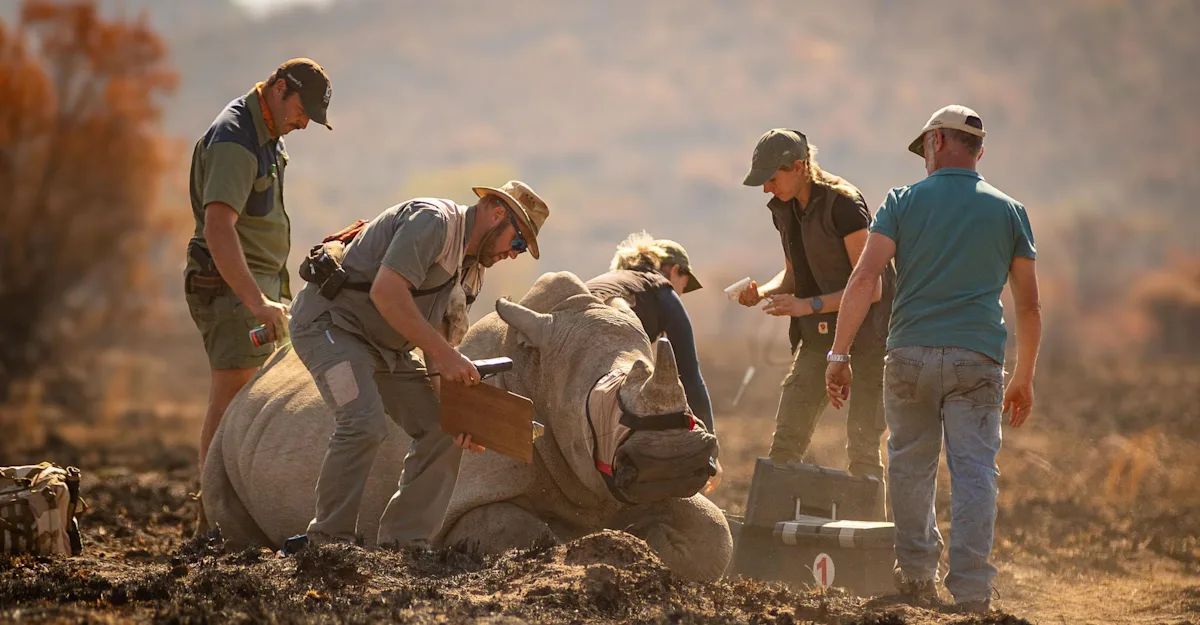
During this part of the expedition, participate in a veterinary-led horn trimming operation. The close encounter offers a powerful sense of the animal’s size and the expertise required to manage its care. Under professional supervision, assist with approved measurements and biological monitoring as directed by the veterinary team.
Trimming reduces the amount of horn a poacher could obtain, making the rhino a less valuable target. Learn how the procedure complements security and monitoring and discuss the questions researchers are investigating about its potential effects on movement and social behavior. The people making these decisions bring a candid perspective on the demands of protecting rhinos in the wild.
Between research activities, safari outings offer opportunities to encounter Greater Kruger’s other wildlife. Evenings at your accommodations provide time to share observations and continue conversations with your small group.
Day 6: Fly West into the Southern Kalahari
Enjoy a final morning safari in Greater Kruger
Fly by small aircraft to Tswalu Kalahari Reserve
Arrive at your accommodations and begin exploring
Rise early for a final game drive in Greater Kruger, searching for elephants, lions, leopards and buffalo, with another opportunity to encounter rhinos in the landscape you’ve been studying.
Later, fly by small aircraft to Tswalu Kalahari Reserve. Red dunes, open grasslands and rocky foothills introduce a striking change from the Lowveld bushveld.
After arriving at your accommodations, begin exploring this arid southern Kalahari reserve. Desert-adapted black rhinos extend your rhino encounters into a different habitat, while cheetahs, meerkats and elusive nocturnal species offer new possibilities for the days ahead.

Days 7 to 8: Explore the Kalahari on Safari, on Foot & After Dark
Search for desert-adapted black rhinos, cheetahs, oryx and other wildlife
Look for aardvarks, brown hyenas and other elusive animals after dark
Take guided walks, with possible visits to a meerkat colony and protected rock art site
Spend two days exploring Tswalu with an expert guide and tracker. Guided 4x4 drives cross dunes, grasslands and rocky foothills in search of oryx, springbok, giraffes, cheetahs and desert-adapted black rhinos.
Tracks in the sand help direct the search, and each sighting allows time to observe the animal’s behavior. Guides explain how wildlife finds food, water and shelter in a region defined by unpredictable rainfall and extremes of temperature.
Conditions and scheduling permitting, visit a habituated meerkat colony. Watching its members emerge from their burrows or gather nearby offers an intimate view of their social interactions.
After dark, venture out for species that often remain concealed during daylight hours. Search for aardvarks, aardwolves, brown hyenas and bat-eared foxes; a pangolin sighting is also possible, though it requires considerable luck. Activity varies with season and temperature, and cooler months may bring daylight encounters with some typically nocturnal animals.
A guided nature walk brings attention to smaller details—animal tracks, native plants and evidence of digging in the sand. If included in the schedule, a protected rock art site adds a human perspective to the landscape, introducing the lives of people who inhabited this country long before it became a reserve.
Day 9: Enjoy a Final Morning at Tswalu
Take a final wildlife outing as scheduling permits
Fly by small aircraft to Johannesburg
Transfer to your hotel for your last evening in South Africa
Enjoy a final morning in the Kalahari, with time for another wildlife experience if the flight schedule allows. Then fly by small aircraft to Johannesburg and transfer to your hotel.
This evening offers time to relax and reflect on the expedition’s encounters, from sustained observations of rhinos to the precision of a veterinary operation and searches for the Kalahari’s nocturnal wildlife. Conversations with fellow travelers bring together discoveries made across two very different landscapes.
Day 10: Depart South Africa
Enjoy breakfast at the hotel
Transfer to Johannesburg’s international airport
Connect with your flight home
Leave with firsthand experience of wild rhino research and veterinary conservation, having contributed observations and participated in a specialized field operation. Days spent with these animals and the people protecting them give lasting depth to your South African safari. After breakfast, transfer to Johannesburg’s international airport for your flight home.