Please note: Participants will take part in all listed activities; however, the timing of specific research tasks may vary based on team availability. As a result, the order of activities may shift, but all components will be included during the program.
Itinerary
Day 1: Gather in Winnipeg before your Arctic science expedition
Settle into the Fort Garry Hotel, a 1913 railway-era landmark
Join your Field Guide for dinner and learn about Churchill’s wildlife, landscapes and climate research
Your Churchill Arctic science expedition begins in Winnipeg, a former fur-trading outpost turned railway hub, now Manitoba’s cultural center set against the sweep of the prairie. On arrival, settle into the Fort Garry Hotel, a 1913 landmark from the golden age of rail. This evening, meet your Field Guide over a welcome dinner as the journey begins to take shape. You’ll be introduced to Churchill, where tundra, forest and Hudson Bay converge, and to the research ahead, from polar bears to the climate forces reshaping the Arctic today.

Day 2: Fly north to Churchill, Polar Bear Capital of the World
Reach a remote subarctic community where the tundra meets the Hudson Bay
Explore Inuit history and art at the Itsanitaq Museum before settling into the Churchill Northern Studies Center
Fly this morning to Churchill, a remote subarctic community accessible only by air or rail. Founded as a Hudson’s Bay Company outpost, it’s now known as the Polar Bear Capital of the World. Churchill sits at the convergence of tundra and the bay, offering a front-row seat to Arctic science in action. Your first bear sighting may even come on the drive from the airport.
Upon arrival, explore Churchill and its surroundings. Visit the Itsanitaq Museum, home to one of the most significant collections of Inuit artifacts in the world, and gain perspective on the region’s cultural and historical roots. Time in town offers a glimpse into daily life in this isolated northern outpost.
Continue to the Churchill Northern Studies Center, your home for the next five nights. Located just outside town along the Hudson Bay coast, this working research station places you directly within the landscapes you’ll be studying. After settling in, join your Field Guide and the research team for orientation, safety briefings and an introduction to the fieldwork ahead.

Day 3: Survey a changing Arctic landscape from the tundra and air
Explore the open tundra, watching for Arctic foxes, hares, migratory birds and polar bears
Fly by helicopter along the Hudson Bay coast where boreal forest gives way to tundra
Learn more about tundra ecology
Wake at the Churchill Northern Studies Center, surrounded by open tundra stretching to Hudson Bay. If conditions aligned overnight, you may have already seen the northern lights from the Center’s elevated viewing deck or dome, an early look at this active Arctic sky.
This morning’s plan is shaped by current wildlife activity and local insight. Based on recent sightings, your Field Guide will choose the best approach—by vehicle to a remote trailhead or directly onto the tundra. Out on the landscape, details come into focus: low shrubs, lichen and moss underfoot, tracks etched into the ground and subtle shifts in vegetation that signal a changing climate. You may encounter Arctic fox, hare and migratory birds, with the possibility of polar bears along the coast.
Midday, take a helicopter flight along the Hudson Bay coastline. From above, the structure of this transition zone becomes clear, where boreal forest gives way to tundra and land meets sea. Watch for polar bears, seals and moose while gaining a broader perspective on the systems you’ll study in the days ahead.
Day 4: Track polar bears gathering along Hudson Bay
Travel across the tundra by custom-built Polar Rover
Search for and photograph bears waiting along the coast for the sea ice to form
Discover how to measure permafrost thaw, survey vegetation plots and more fieldwork details
This morning, turn your focus to polar bears as you head out across the tundra by Polar Rover, a custom-built, high-clearance vehicle designed for travel along the Arctic coast. With oversized tundra tires and elevated platforms, it moves smoothly across the landscape, offering wide, unobstructed views.
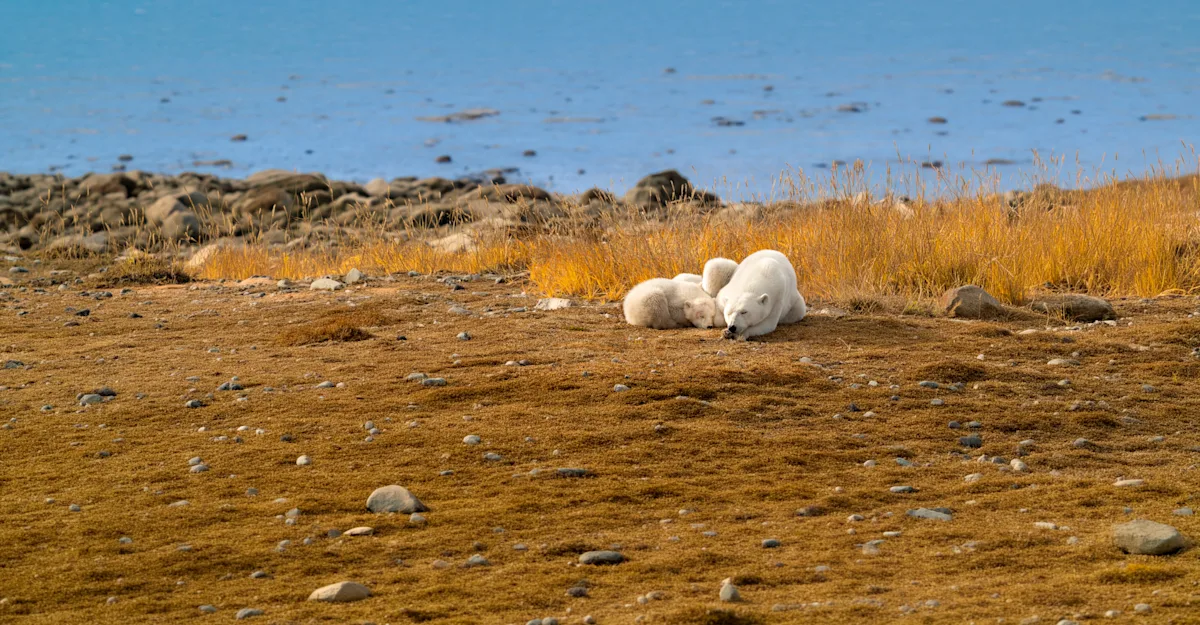
Search for bears gathering along Hudson Bay as they wait for the ice to form. From the elevated platform, watch them move across the tundra, rest along the shoreline or interact with one another in this open environment. At this time of year, the tundra is alive with color, and the bears’ white coats stand out sharply against the reds and golds of the landscape—creating exceptional opportunities for observation and photography.
Later, back at the Center, meet with scientists for a detailed research orientation. Learn how permafrost thaw is measured, how vegetation plots are surveyed and how your fieldwork contributes to long-term monitoring of Arctic change. As darkness returns, conditions may align for another chance to watch the aurora move across the sky.
Day 5: Measure the summer thaw above carbon-rich permafrost
Probe the ground to record the depth of the seasonally thawed active layer
Collect soil moisture, surface conditions and vegetation data alongside scientists
Learn how thawing permafrost can release carbon stored for thousands of years
The tundra appears still at first glance, but beneath the surface, change is underway. Beneath the surface lies permafrost, ground that has remained frozen for thousands of years and stores an estimated 1,400–1,600 billion metric tons of carbon, roughly half of all terrestrial carbon. When it thaws, microbes break down previously frozen organic matter, releasing carbon dioxide and methane into the atmosphere, accelerating global warming and reshaping ecosystems far beyond the Arctic.
Head today to field sites near the Churchill Northern Studies Center, where scientists have monitored permafrost for decades. These long-term plots reveal how warming temperatures are deepening the seasonal thaw and destabilizing the ground. We'll collect data alongside scientists, using metal probes to measure the active layer, the depth of soil that thaws each summer, and record soil moisture, surface conditions and vegetation cover. Compare sites and see how small shifts in terrain reflect larger environmental change. Each measurement adds to long-term datasets used to track how quickly permafrost is thawing and how those changes influence Arctic landscapes and global carbon cycles.
As evening settles in, gather at the Boreal Lounge. With darkness returning, conditions may align for a chance to watch the northern lights move across the Arctic sky.
Day 6: Document trees advancing into the warming tundra
Count black spruce and tamarack seedlings in long-term monitoring plots
Record plant species and ground cover across sites with different soil and moisture conditions
Help scientists track how the northward-moving treeline is changing Arctic ecosystems
Today, explore one of the most visible signs of a warming Arctic—the quiet advance of trees into the tundra. North of Churchill, the boreal forest gives way to tundra, marking one of the most climate-sensitive ecological boundaries on Earth. Here, average temperatures have risen by about 4–5°F in recent decades, lengthening the growing season and allowing tree species such as black spruce and tamarack to establish beyond their historic range. As this treeline advances, it alters snow retention, soil temperatures and carbon storage, reshaping the structure and function of Arctic ecosystems.
With your research team, visit long-term monitoring plots to study this transition. At first glance, the landscape may appear unchanged, but with closer observation, subtle patterns begin to emerge. Identify and count tree seedlings, record plant species and ground cover and compare sites with different soil, moisture and exposure conditions to understand where and why the treeline is advancing. These observations help scientists answer a critical question: how quickly is the Arctic landscape transforming—and what happens next? (Even small seedlings can signal large-scale ecological change, influencing wildlife habitat, soil conditions and the future structure of the tundra itself.)
Day 7: Ride behind a sled dog team before returning to Winnipeg
Meet a local musher and learn about the role of sled dogs in northern life
Travel through the boreal forest behind an eager dog team
Return to the Fort Garry Hotel for a farewell dinner with your Field Guide
Begin your final day in Churchill with one more connection to life in the North. Visit a local musher and their sled dog team to learn about this enduring form of transportation and its role in northern culture and history. Then climb aboard for a ride behind these powerful, eager dogs as they move across the landscape. Afterward, fly back to Winnipeg and return to the historic Fort Garry Hotel. This evening, gather with your team for a final dinner and a chance to reflect on everything you’ve experienced, from close encounters with belugas and polar bears to the hands-on science that brought deeper meaning to every experience.
Day 8: Depart Winnipeg with a firsthand understanding of the changing Arctic
Gather for a final breakfast before transferring to the airport for departing flights
After breakfast, our Arctic science expedition concludes. Transfer to the airport for departing flights.