

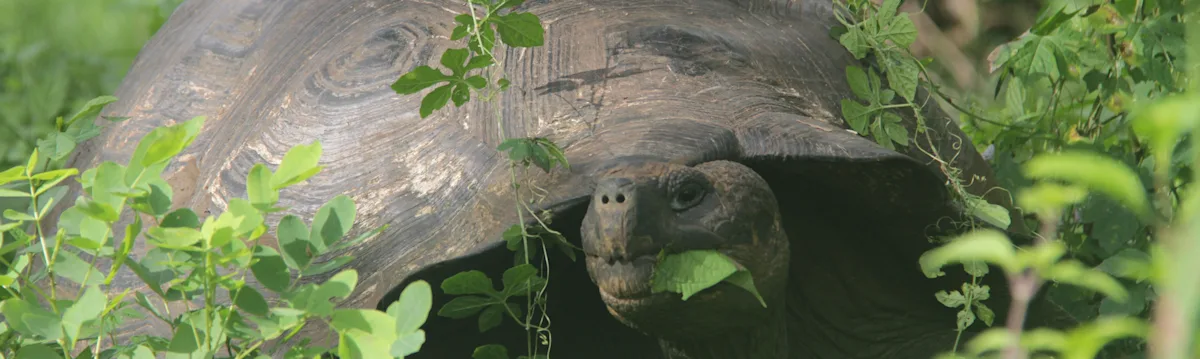
Know Before You Go
Galapagos Wildlife Trivia
Can you name which seal is found in the Galapagos Islands? Any idea how much a giant tortoise weighs or why a booby has blue feet? Take our Galapagos wildlife quiz below to put your knowledge to the test, then share it with your family and friends to see who knows the most about this stunning archipelago. When you're finished, scroll down to reveal the correct answers and explanations.
Answer Explanations:
Which reptile is not endemic to the Galapagos Islands?
Correct answer: Basilisk lizard
Explanation: The basilisk lizard is found from southern Mexico to Panama but not on the Galapagos Islands. Both land iguanas and marine iguanas live in the Galapagos. Marine iguanas are the only seafaring lizards in the world, using their crocodilelike tails to swim and forage for algae. Land iguanas are yellow and larger than their marine relatives. Because freshwater is scarce on the islands, they obtain most of their moisture from the prickly pear cactus, which makes up 80 percent of their diet. Lava lizards can be found throughout the Galapagos, warming themselves on lava rocks.
Fun Fact: Pink land iguanas were discovered in 1986 on Isabela Island and were classified as a separate species in 2009. These bright pink reptiles are critically endangered, native only to Wolf Volcano on Isabela.
Photo Credits—Land iguana: Cassiano Zaparoli; Basilisk lizard: Bruce Jones; Lava lizard: Chris Kassar
Header Credit—Joan Shaw
Do penguins live in the Galapagos?
Correct Answer: Yes
Explanation: The Galapagos penguin is the only penguin that lives north of the equator. They typically breed on the islands of Fernandina and Isabela, though colonies can be spotted on Bartolome, James and Floreana. These penguins are very swift swimmers. You might see them while snorkeling in the Galapagos!
Before his death in 2012, Lonesome George was the last surviving member of which subspecies of giant tortoise?
Correct Answer: Pinta Island Galapagos tortoise
Explanation: There are many subspecies of giant tortoise found on different islands of the Galapagos. Overhunting was thought to have completely wiped out the Pinta Island tortoise by the mid-twentieth century until the discovery of Lonesome George in 1971. Lonesome George became a symbol of conservation efforts in the Galapagos and worldwide, and over the years there were many attempts to find him a mate to ensure the subspecies survival. Unfortunately, all breeding endeavors were unsuccessful, and Lonesome George, the last known Pinta Island tortoise, passed away from natural causes in 2012.Photo Credit—Colby J. Brokvist
Pacific green sea turtles are the only sea turtle to breed and nest in the Galapagos. <br>What do adult Pacific green sea turtles eat?
Correct Answer: Algae and seagrasses
Explanation: Adult green sea turtles are strictly vegetarian, feeding on algae and seagrasses in shallow waters. Their beaks have serrated edges, which enable them to scrape algae off rocks and tear seagrasses. However, juvenile green sea turtles are omnivores, eating plants along with marine organisms such as jellyfish, crabs, sponges and snails. Other sea turtles have specialized diets. Leatherbacks use the pointed cusps on their jaws to pierce jellyfish. The hawksbill’s narrow head and beak enable it to eat sponges and anemones from the crevices of coral reefs. Loggerheads have powerful jaw muscles, allowing them to break open the shells of shellfish and mollusks such as conches, horseshoe crabs, clams, mussels and sea snails.
Thirteen species of famed finches on the Galapagos Islands helped shape:
Correct Answer: Darwin’s theory of evolution
Explanation: Charles Darwin arrived on the shores of the Galapagos in 1835 onboard the HMS Beagle. He was quickly fascinated by the striking animals, which had developed in isolation from the mainland. He noted the changes in characteristics across species on the different islands, which led to his theory that animals were gradually transforming. In the case of the thirteen finches, he discovered they had evolved from a common ancestor to exploit new and different ecological niches. Studying the finches’ different beak shapes and sizes, each adapted to take advantage of a particular food source, helped develop Darwin’s theory of evolution by natural selection.Photo Credit—Jane Whitney
Which of the following is not an amazing adaptation of Galapagos birds?
Correct Answer: A purple-footed booby that shows off its bright feet to attract a mate
Explanation: While there are red- and blue-footed boobies, there has yet to be a purple one! The booby does, however, use its bright feet to attract a mate. The vampire finch has adapted to use its sharp beak to drink the blood of birds such as the blue-footed booby. When the woodpecker finch can’t reach insects scuttling in the bark of trees with its long beak, it uses a cactus spine as a tool to impale insects. The flightless cormorant, found only in the Galapagos, is the only cormorant that can’t fly. The wings of the flightless cormorant have grown smaller over time, and their webbed feet have allowed them to swim to the seafloor to feast on fish and octopi. The theory of why these adaptions took place is that there were no large predators when cormorants first arrived in the Galapagos, making flight an unnecessary and metabolically exhaustive trait. Thus, those cormorants that were able to forage without flying were more likely to survive and reproduce.
Photo Credit—Patrick Endres
What is the largest bird in the Galapagos?
Correct Answer: Waved albatross
Explanation: The waved albatross has a whopping wingspan of 8 feet. It nests on the island of Espanola and can spend years at sea. The magnificent frigatebird’s wingspan is almost 8 feet long, coming in second to the waved albatross. These glossy black birds put on elaborate courtship displays, as scarlet gular pouches balloon from the males’ chests. The Galapagos hawk has a wingspan of 4 feet and is the only raptor to breed in the Galapagos. Though it has no natural predators, disturbances from humans have caused its numbers to drop. The Nazca is the largest of the Galapagos boobies, with a wingspan of 5 to 6 feet. Nazca boobies are white with a black mask surrounding their brilliant yellow eyes that extends into a pink-orange beak.Photo Credits—Magnificent Frigatebird: Patricia Potter; Galapagos Hawk: Michael Parnes; Nazca booby: Joseph Sina
Which crab is not found on the Galapagos Islands?
Correct Answer: Coconut crab
Explanation: The coconut crab is the largest terrestrial arthropod in the world and is found in Indonesia and on islands in the Indo-Pacific. True to its name, it climbs palms and cracks open coconuts with its incredibly strong pinchers. The bright red and blue Sally Lightfoot crab is instantly recognizable, scuttling on the rock beaches of the Galapagos. Hermit crabs, which carry seashells on their back, are found in tidepools, and pale ghost crabs also inhabit island shores.Photo Credit—Glen Bjerke
Which of the following are serious environmental threats in the Galapagos?
Correct Answer: All of the above
Explanation: Sadly, the fragile ecosystems of the Galapagos face many threats. Overfishing and the illegal fishing industry are detrimental to locals whose livelihood depend on fish, and these activities deplete the rich diversity of marine life found in tropical waters. Improper waste management harms the land, waters and wildlife, as animals ingest trash and become entangled in plastic. Invasive species such as quinine trees, fire ants and goats threaten native flora and fauna.
Photo Credit—Emily Kautz
Which species of seal is found in the Galapagos?
Correct Answer: Fur seal
Explanation:
Sea lions are seemingly everywhere in the Galapagos, sleeping on seaside benches, lounging in the sand at sunset and spiraling playfully through tropical blue waters. More elusive are the native seals found on rocky shores across the islands. Because of their luxuriant, dense fur, fur seals hunt during the night and spend the hottest hours of the day in secluded caves. Northern elephant seals range from the Gulf of Alaska to Baja California, Mexico, and southern elephant seals inhabit the icy waters of the Antarctic. Leopard seals are also found in Antarctic waters, while harp seals are found in the northernmost Atlantic and Arctic Oceans.Photo Credit—Greg Courter
While snorkeling or cruising in the Galapagos, which list of species would you definitely not see?
Correct Answer: Royal starfish, queen conch, elephant ear sponge, hedgehog seahorse and pygmy octopus
Explanation: The species listed above all live in the Atlantic and Indian Oceans. The other marine animals listed—sharks, whales, dolphins, rays, king angelfish, blue-barred parrotfish, rainbow wrasse, Pacific seahorse and concentric pufferfish—are found in the Pacific Ocean and the waters surrounding the Galapagos!Photo Credit—Rachel Kramer
How much can a giant tortoise weigh?
Correct Answer: 550 pounds
Explanation: A giant tortoise can reach up to 550 pounds and could quite easily carry a human on its backs! Hatchlings weigh less than half a pound, meaning that an adult giant tortoise weighs over 1,000 times more than a newborn.Photo Credit—Joan Spaw
Which of the following is not a conservation initiative of the Charles Darwin Research Station?
Correct Answer: Educating communities and schools about the dangers llamas pose to humans
Explanation: Though prevalent in the highlands of Ecuador, llamas are not found on the Galapagos Islands (nor do they pose much of a threat!). However, the Charles Darwin Research Station is involved in educational initiatives—its Shark Ambassadors Program seeks to teach local students about the importance of sharks in our oceans.
World Wildlife Fund has helped spearhead conservation efforts to preserve the unique wildlife of this fragile archipelago by doing which of the following:
Correct Answer: All of the above
Explanation: World Wildlife Fund supports many endeavors to protect the inhabitants of this stunning archipelago. It has funded the construction of the Charles Darwin Research Station and awarded Galapagos students with scholarships to pursue training in environmental management and ecotourism, inspiring the next generation of conservation leaders. The NGO has also supported the establishment of the Galapagos Marine Reserve and uses technological advancements in satellite, radio and radars to assist park managers with monitoring vessels in order to detect illegal fishing. In addition, it has helped the Galapagos implement an ecotourism-based model that protects wildlife and improves the livelihoods of locals on the islands, with the understanding that responsible ecotourism can be a powerful tool for both conservation and sustainable development.
See the beauty of the Galapagos Islands for yourself with WWF’s conservation travel partner, Natural Habitat Adventures.
Photo Credit—Dennis Ready