

Know Before You Go
Madagascar Wildlife Trivia
Is it true that lemurs the size of gorillas once roamed the forests of Madagascar? Any idea which predator preys upon lemurs, or what rare flora is found here? Take our quiz below to put your knowledge to the test, then share it with your family and friends to see who knows the most about the fourth largest island in the world! When you're finished, scroll down to reveal the correct answers and explanations.
Answer Explanations:
What is a native predator of the lemur?
Correct Answer: Fossa
Explanation: The Madagascan flying fox is a fruit bat, and the greater hedgehog tenrec feeds mainly on insects. Ocelots are small wild cats found in South America. The fossa, which can reach up to 6 feet in length, is the top predator on the island of Madagascar.
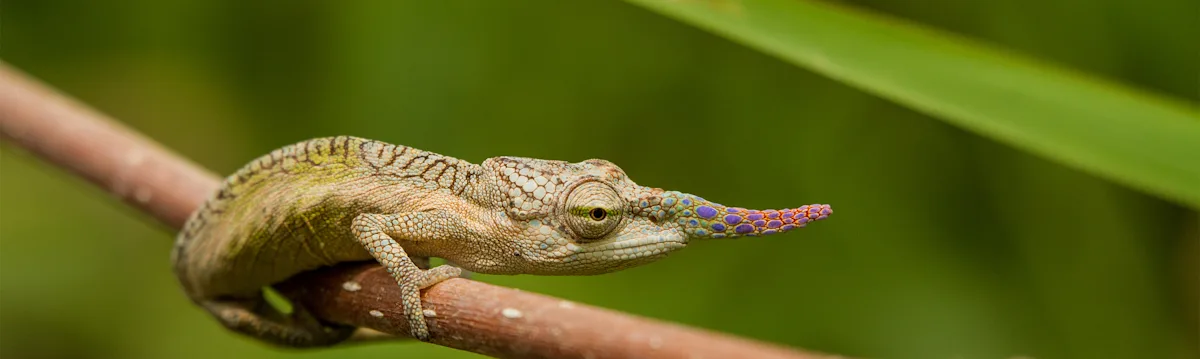
Header Credit: Mathieu Slmon
Many unique species, such as the mossy leaf-tailed gecko, evolved on Madagascar in isolation. Approximately how many years ago did the island split from the African continent?
Correct Answer: 160 million years
Explanation: Madagascar was once part of the supercontinent Gondwana. The Antarctica-India-Madagascar-Australia landmass broke off from the Africa-South America landmass roughly 160 million years ago. Madagascar later split from India 88 million years ago, leaving lifeforms to evolve in isolation on the island.Photo Credit: Court Whelan
Which of the following is a livelihood of Malagasy people?
Explanation: All of the above
Explanation: The Malagasy are divided into approximately 20 ethnic groups, and this diversity is reflected in their livelihoods, which includes growing cash crops such as vanilla, coffee, cloves and cocoa and cultivating food staples such as pink rice, maize, sweet potatoes, peanuts, oranges and cassava. The Malagasy mine precious stones including sapphires, rubies and emeralds, along with semi-precious stones and minerals such as gold and silver. Malagasy people also fish, raise zebu cattle, craft finely woven textiles and work in the tourism industry.
Photo Credit: Richard de Gouveia
All of the following megafauna once existed on Madagascar, except for the:
Correct Answer: Lion
Explanation: Lions have never lived on Madagascar. The largest native carnivorous mammal is the fossa (its larger relative, the puma-like giant fossa Cryptoprocta spelea, is extinct). Lemurs the size of gorillas once roamed the island along with the Malagasy pygmy hippopotamus, and the 900-pound elephant bird was the largest bird to have ever walked the earth. Evidence suggests that when settlers first came to Madagascar, these megafauna were hunted to extinction. Some also died out due to habitat loss from slash-and-burn agriculture.
Which plant is not a native flora of Madagascar?
Correct Answer: Koki’o flower
Explanation: Baobab trees have bulbous trunks that store large amounts of water. The rosy periwinkle is a flower that has cancer-curing properties. There are almost 1,000 species of endemic orchids on the island. The Koki’o flower is a rare hibiscus native to Hawaii.
Photo Credit: Baobab Tree—Maggie Kareus; Koki'o Flower— Cliff from Arlington, Virginia, USA [CC BY 2.0, opens in new tab] via Wikimedia Commons
In 1963, WWF launched its first project in Madagascar to protect the:
Correct Answer: Aye-aye
Explanation: WWF Madagascar’s first accomplishment was the creation of the Nosy Mangabe reserve as a sanctuary for the aye-aye, an endangered long-fingered lemur.
Fun Fact: The aye-aye is the world’s largest nocturnal primate!
Photo Credit: Malagasy kingfisher—Court Whelan; Comet Moth—Eric Rock
What percentage of Madagascar’s wildlife is found nowhere else on Earth?
Correct Answer: More than 80 percent
Explanation: About 89 percent of Madagascar’s flora, 92 percent of its mammals and 95 percent of its reptiles are found nowhere else on Earth.
This lemur is one of the rarest primates in the world, known as the “angel of the forest” due to its pure white fur:
Correct Answer: Silky sifaka
Explanation: Ring-tailed lemurs are gray with black-and-white banded tails, woolly lemurs are gray-brown, and ruffed lemurs are either black and white or rufous. The silky sifaka is critically endangered and restricted to a portion of northeastern Madagascar. WWF has been conducting fieldwork to assess the threats the silky sifaka faces, and this research helps organizations and scientists create management plans to conserve this beautiful species.
Photo Credit: Jeff Gibbs [CC BY-SA 3.0, opens in new tab] via Wikimedia Commons
Which crises does not pose a threat to Madagascar’s environment?
Correct Answer: Overgrazing by large mammals such as antelope and gazelle
Explanation: Antelope and gazelle are found only on the mainland of Africa. Deforestation is the greatest threat to Madagascar’s biodiversity. The toxic Asian common toad puts Madagascar’s predators at risk, as any who eat it soon die. Radiated tortoises are critically endangered and are one of the animals being exploited in the illegal pet trade. In 2018, 10,000 of these tortoises were discovered in a Toliara home, destined to be smuggled out of the country and sold as pets. The tortoises were rescued and brought to a wildlife rehabilitation facility. Photo Credit: Court Whelan
World Wildlife Fund is helping conserve Madagascar’s flora and fauna by:
Correct Answer: All of the above
Explanation: World Wildlife Fund is helping conserve Madagascar’s wilds by working with fishermen and the government to preserve the marine life along Madagascar's coasts. The NGO is also protecting Madagascar’s dry spiny forests and assisting people with managing natural resources more sustainably. Lastly, WWF is developing strategies to combat the predicted impacts of climate change that will affect both local communities and ecosystems.