Itinerary
Itinerary
Day 1: Arrive in Athens beneath the illuminated Acropolis
Join your Expedition Leader for a welcome dinner of Greek food and wine
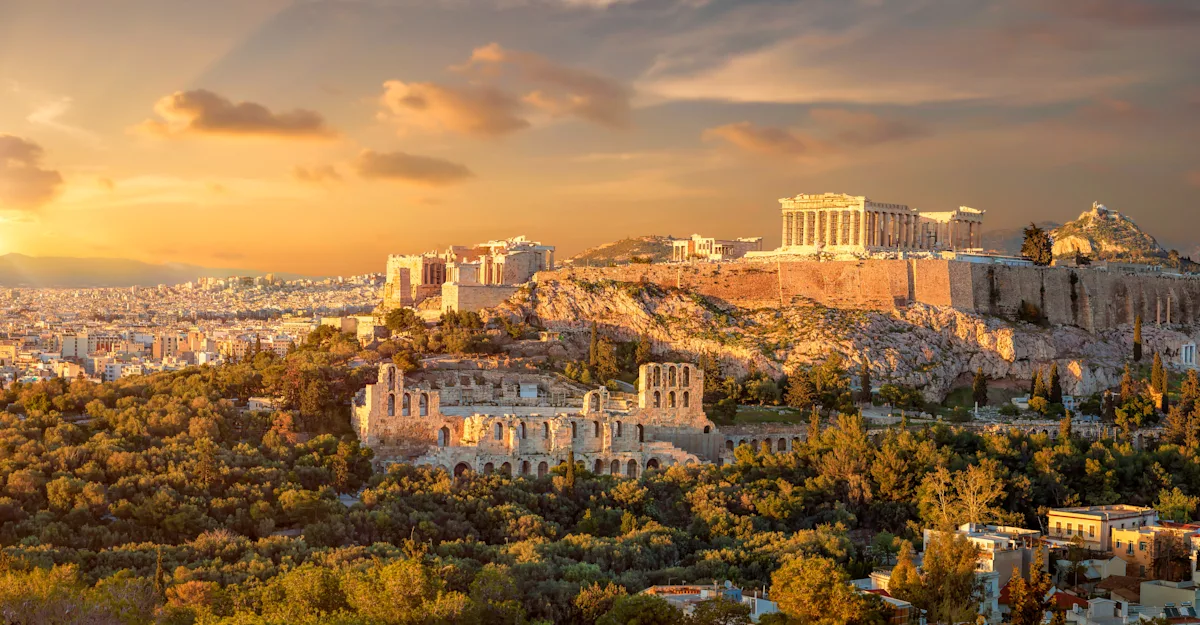
Take in rooftop views of the Acropolis and Parthenon glowing above the city
Arrive in Athens, the ancient capital of Greece, where you are met at the airport and transferred to our stylish contemporary hotel on one of the city’s most vibrant pedestrian streets. Just steps from Syntagma Square and the winding lanes of the Plaka, our hotel places you in the heart of Athens, with views from the rooftop terrace across to the illuminated Acropolis and Parthenon glowing above the city at night. This evening, enjoy a welcome dinner and orientation with our Expedition Leader as we get our first taste of the fabulous Greek food and wine that will be a highlight of our journey.

Day 2: Wander Athens’ historic neighborhoods before exploring the Acropolis
Walk the lanes of Plaka and Monastiraki past Byzantine churches, markets and hidden courtyards
Stand on Pnyx Hill, where Athenians gathered to debate and vote beginning in 507 B.C.
Explore the Acropolis and Parthenon with an expert local guide
While most visitors to Athens come by bus for a hurried visit to the Acropolis, we've got more in store. A morning walking tour offers an intimate revelation of local life in the old neighborhoods of Plaka and Monastiraki, where neoclassical homes, secret courtyards, lively cafes and a hidden Ottoman well are tucked at the foot of the Acropolis. Wander narrow pedestrian lanes lined with markets, small shops and centuries-old Byzantine churches as you gain insight into daily life in the heart of modern-day Athens. Get uncommon views on the Acropolis that most travelers miss, including from Pnyx Hill, the cradle of democracy. Here, Athenian citizens gathered beginning in 507 B.C., hosting popular assemblies to debate and vote on decisions that affected the entire populace. Our walking tour concludes with lunch at a traditional taverna popular with locals, followed by classic Greek desserts at another favorite location.
After free time to relax at our hotel or enjoy shopping on the famous Ermou thoroughfare, an expert local guide takes us on a 2-hour walking tour of the Acropolis. This ancient citadel overlooking the city of Athens is a UNESCO World Heritage Site, its monuments symbolizing the apex of classical civilization. Following the Athenians’ victory against the Persians and the establishment of democracy, the city-state of Athens flourished, ushering in the Golden Age of Greece in the 5th century BC, a period of tremendous cultural, artistic and philosophical growth. Best known among the buildings from this era is the Parthenon, a temple dedicated to the goddess Athena, which we reach via an ancient marble stone path ascending the hillside. As we wander the ruins, it’s easy to imagine walking in the footsteps of Pericles, Socrates and Plato. From this rocky vantage point, look across the sprawl of rooftops to the Aegean Sea in the distance. As evening settles over the city, gather for dinner at a traditional Greek restaurant.
Day 3: Cruise by private boat to the island of Aegina
Explore the Temple of Aphaia, where 25 original Doric columns still stand
Wander among the Byzantine churches of Aegina’s abandoned medieval capital
Sample PDO pistachios as nuts, butters, candies and liqueur
This morning, we're whisked by private speedboat to the island of Aegina in the Saronic Gulf. In classical antiquity, Aegina was a powerful city-state and a rival of Athens. Today, the island is a popular vacation getaway for Athenians. The main town is known for its colorful neoclassical homes, cafes and lively tavernas. A highlight is the Temple of Aphaia, an architectural wonder of ancient Greece with 25 of its original 32 Doric columns still standing. We also wander through Paleochora, an abandoned medieval city that was the capital of Aegina for nearly a millennium, with dozens of well-preserved Byzantine churches. We stop for lunch by the harbor in the fishing village of Perdika, then visit a farm producing Aegina’s most famous crop, pistachios. The island is world-famous for its prized green nuts, which have had PDO (Protected Designation of Origin) status since 1996. Their quality is attributed to the dry, chalky soil, a unique terroir contributing to their exceptional taste. At a traditional shop in Aegina town, we'll get to taste a sampling of pistachio products, including nuts, butters, candies and liqueur.
From Aegina, we board a boat once more, cruising past the island of Moni, a protected nature reserve renowned for its crystalline turquoise waters, pine forests and free-roaming wildlife including deer and peacocks. Disembark on the Peloponnese Peninsula in Epidaurus, then it’s a short drive to Nafplio, where we spend the next two nights. Once we’re checked in to our hotel, it’s time for a special aperitif at the Karonis Distillery: This 5th-generation family business has been crafting ouzo, Greece’s most famous spirit, in copper stills since 1869, and we enjoy a private tasting. It’s the perfect lead-in to dinner in Nafplio's charming Old Town,

Day 4: Explore ancient Nemea before cooking at a local vineyard
Walk the ancient stadium that hosted the Panhellenic Nemean Games
Prepare traditional Greek dishes with your hosts at a local vineyard
Join a guided walk through Nafplio’s Old Town and sample honey-drizzled loukoumades
This morning, head out to the countryside for a tour of the archaeological site at Nemea. Explore the ruins of the Temple of Zeus, and walk the length of the stadium that once hosted the Panhellenic Nemean Games in the 5th and 6th centuries BC. Nemea is where Hercules, according to Greek mythology, slew the Nemean lion with his bare hands. The deep red wines of Nemea, made from native grapes, became known as the "blood of Hercules," symbolizing both the strength of the hero and the bold character of the renowned wines from this region. We continue to a local vineyard for a private food and wine experience, learning about the grape varieties that thrive in Nemea’s red soils, before a tasting of estate wines and organic grape vinegar. Then, alongside our hosts, learn to prepare traditional Greek dishes for lunch, complemented by wine pairings.
Back in Nafplio, there's time to rest up at our hotel before our city tour this afternoon with a local guide. Nafplio was the first capital of Greece after independence in 1830, although it only held this status until 1834, when the capital was moved to Athens. The inviting port town is known for its marble streets, grand Venetian mansions, and three imposing castles that dates to the period of Venetian occupation in the 17th and 18th centuries. We’ll visit the oldest, Acronafplia, dating to the Bronze Age— the whole city of Nafplio once existed within its walls. In the Old Town, we wander cobbled lanes past lively squares, ornate churches and buzzing tavernas, pausing to sample golden loukoumades drizzled in honey. This evening, dine enjoy dinner on the seafront, sampling regional dishes paired with wines from the surrounding hills.
Day 5: Walk among the stone tower houses of the Mani clans
Visit Areopoli, where cobbled lanes wind among fortified family homes
Stop in Sparti, the modern city built on the site of ancient Sparta
Settle into a boutique hotel overlooking the Bay of Itilo
Enjoy free time in Nafplio this morning, with the option to join our Expedition Leader for a walk to some of the town's famous weaving workshops where artisans handcraft fine Greek textiles, including scarves and shawls made with traditional looms and natural dyes. We then drive to Sparti, about two hours away, where we stop for lunch at a local taverna. The route winds among rugged slopes, limestone gorges and tiny stone villages, shaded by black pines and stands of chestnut, cherry, apple, walnut and plane trees. Sparti is the modern Greek name for Sparta, and the contemporary city is built on the site of the ancient city-state famed for its military prowess.
Our drive continues to the Mani Peninsula in the southern Peloponnese, a rugged, sun-soaked region known for its wild beauty and timeless villages clinging to rocky hillsides. On a visit to a family-owned olive farm, learn how Greece’s most valued crop is cultivated and pressed into “green gold.” More than 80% of the country’s harvest is top-tier extra-virgin olive oil, and we’ll savor the nuances of this essential culinary ingredient. Then settle in for two nights at our boutique hotel in Mani, where private balconies command a dramatic view of the sparkling Bay of Itilo. This evening, dine in a traditional Maniot taverna where the menu is designed around local, seasonal ingredients, including fresh seafood.

Day 6: Sail the Mani coast by private catamaran and explore Kardamyli
Cruise past stone villages, rocky coves and the former home of Patrick Leigh Fermor
Swim from the boat in clear turquoise water
Walk from modern Kardamyli to its old village, first mentioned in Homer’s Iliad
Explore more of the Mani Peninsula today by boat and on foot, getting a feel for daily life in the rural Peloponnese. A coastal cruise aboard a chartered catamaran reveals the rugged shoreline, dotted with stone villages above the coves and rocky promontories. On a peninsula outside the seaside village of Kalamitsi, we view the celebrated home of renowned British travel writer Patrick Leigh Fermor and his photographer wife, Joan. Surrounded by olive, citrus and cypress trees, the stone house overlooking the Messenian Gulf was designed by a famous Greek architect in the 1960s and became a creative magnet for authors and artists who visited until Fermor’s death in 2011. We'll also have a chance to swim off the boat in the clear, turquoise waters Greece is so famous for.
At Kardamyli, we leave the boat and join a local guide for a walk from the new town up to the old village, with a picnic lunch en route. The sleepy fishing hamlet, well off the tourist track, enjoys a picturesque setting at the end of a rocky point, backed by forested peaks and surrounded by clear turquoise waters. First mentioned in Homer's epic poem the Iliad, written about 1200 BC, Kardamyli was offered to Achilles by Agamemnon to tempt him back to the siege of Troy. Stone tower houses still overlook the sea, and at the back of the Old Town, we find tombs where the mythical twin gods Castor and Pollux are reputedly buried. A short drive takes us on to Limeni, where we enjoy afternoon refreshments on the waterfront, featuring strong Greek coffee and a sweet treat, before returning to our hotel. There's time to relax this afternoon at the spa and pool, surveying grand views of the bay. This evening, gather for a seaside barbecue dinner and drinks as the sun sinks into the sea.
Day 7: Taste olive oil and enter Arcadia’s medieval mountain villages
Visit a family farm to learn how olives are pressed into extra-virgin oil
Walk through Karytaina beneath its medieval castle and take in views of the river valley
Dine on the owner’s home cooking at a stone guesthouse reserved for your group
This morning, join our Expedition Leader for a walk through Areopoli, a charming stone village where cobbled lanes wind between the stone tower houses that once protected Mani’s fiercely autonomous clans. Then depart the coast and head inland to Arcadia, a wild, mountainous region of thick forests, deep gorges and ancient stone villages. Arcadia has long been a storied place in Greek literature, described as an idyllic paradise home to shepherds and the Greek fertility god Pan, half-man, half-goat, and his nymphs, whose names have been given to the rivers, lakes and waterfalls of the region. Arcadia’s unspoiled landscape has been an inspiration to poets and artists over centuries who have celebrated its serene pastoral beauty.
In Karytaina, a mountain village crowned with a medieval castle, we stop for dessert and tea at a typical local taverna. Afterward, stroll the town with our Expedition Leader, admiring its medieval churches, 13th century arched stone bridge, and the grand views across the river valley below. Then continue to Dimitsana, where we spend the next three nights. Our intimate stone guest house, reserved exclusively for our group, was originally a cobbler’s workshop, and the views overlooking the Louisios Gorge are magnificent. During our stay, the owner himself prepares many of our meals, welcoming us into a setting that feels more like a family home than a hotel.

Day 8: Hike the Lousios Gorge to Moni Prodromou
Follow forested trails to a 16th-century monastery built into a sheer rock face
Share coffee with members of the monastery’s religious community
Try traditional silversmithing in Stemnitsa and craft a small piece to keep
With a local guide, hike downhill to Moni Prodromou, a 16th-century monastery built into the side of a sheer cliff above the Lousios Gorge. Share coffee with members of the monastic community, gaining insight into daily life within these stone walls. During the Greek War of Independence in the 1820s, fighters sheltered here, finding a natural stronghold in the steep surrounding terrain. Continue down the forested slopes to Gortyna, the Lost City of Arcadia, where we stop for a picnic lunch at the end of our hike. Only scattered temple ruins remain at this evocative location, where mineral springs and thermal baths made Gortyna one of the most important healing centers in the ancient Greek world. The Louisios River flows nearby, and myth holds that fairies bathed the baby Zeus in its waters.
This afternoon we visit Stemnitsa, one of the most beautiful villages in Arcadia and an important silversmithing center, where generations of artisans have supplied ecclesiastical objects such as icons and candlesticks for use throughout Greece and beyond. At a local silversmithing school, try your hand at time-honored techniques, crafting a small piece of jewelry or other ornament to take home. Enjoy a guided walk through the stone lanes of the village, built among four ravines filled with pine, plane, walnut and chestnut trees. View the colorful red tile roofs and the clock tower of St. George’s Orthodox Church, then take a break for coffee and dessert in a village cafe. Next, we visit the Open-Air Water Power Museum, where restored pre-industrial mills reveal how water was traditionally used to produce various products, including flour, leather and secretive gunpowder supplied to independence forces in the early 19th century. Return to our guesthouse in time to relax for a bit before dinner.
Day 9: Forage Arcadia’s oak woods for a field-cooked lunch
Search for mushrooms, truffles or herbs with a local guide and trained dog
Gather around an outdoor meal prepared from your foraged finds
Meet a honey producer and taste highland honey with regional cheeses
Arcadia’s mountain landscape has sustained local people with its natural bounty for centuries. Beneath the oak trees in the Elati region, mushrooms flourish and truffles grow hidden in the roots, and in season, we’ll head into the woods with a local guide and trained dog to search for them. At other times, we’ll gather fragrant herbs used in cooking. What we forage via traditional practice will become part of an outdoor lunch prepared in the field.
In the village of Vytina, we sample some of the local herbal tea before meeting a honey producer who shares all the details of what goes into making honey with the bees that thrive in this highland environment. We’re rewarded with a taste of his exceptional product, accompanied by regional cheeses. Return to En Dimitsani, where a special farewell dinner awaits this evening, prepared by the owner, featuring fresh regional ingredients and traditional Arcadian recipes. All too soon, our Greek odyssey is nearing a close, as we reflect on our rich sojourn that has followed Greece’s story from its archaic foundations to modern independence and the enduring traditions that continue today.
Day 10: Depart Arcadia for Athens
Transfer from Dimitsana to Athens for homeward flights
Depart Dimitsana after breakfast this morning and transfer to Athens for homeward flights home or onward travel, carrying with you the stories, scents, vistas and flavors of Arcadia and the Peloponnese.