

2027 Itinerary
Itinerary
Day 1: Panoramic views from Canada's easternmost point
Arrive in St. John's, North America's easternmost city
Join your Expedition Leader and fellow travelers for a welcome dinner
Enjoy dramatic views of the Atlantic coastline from Cape Spear Lighthouse, where a beacon has stood since 1836
Arrive at St. John’s International Airport where you’re met and transferred to our downtown hotel. Situated on the eastern tip of the Avalon Peninsula on the island of Newfoundland in Atlantic Canada, St. John’s is North America’s easternmost city and one of the continent’s oldest municipalities. Its rich cultural heritage blends Indigenous, English and Irish influences, some of which are on view on the downtown Quidi Vidi Trail, a series of interpretive panels and artwork. If time permits, explore on your own before gathering this evening for a welcome dinner and orientation with our Expedition Leader. Afterward, take in panoramic views from historic Cape Spear Lighthouse on Canada’s most easterly point of land, where a lighthouse has operated here continuously since 1836.

Day 2: Search for whales along the Newfoundland coast
Travel to Trinity, a coastal village and your base for exploring the Bonavista Peninsula
Head to sea on a private safari aboard an agile rigid-hull inflatable boat
Look for humpback, fin, sperm and minke whales in the nutrient-rich waters of Trinity Bay
A scenic three-hour drive takes us from St. John’s to Trinity, the coastal village where The Shipping News was filmed, and our destination for the next three nights. After lunch, head to sea in search of Newfoundland’s abundant whales on a two-hour private marine safari aboard an RHIB—a Rigid Hull Inflatable Boat, offering agility that bigger vessels lack. The largest annual whale migration in the northern hemisphere begins off the Newfoundland coast in early June, with various species attracted to the nutrient-rich waters present until September or later. With our boat’s low profile, we hope to get close enough to observe whales as they breach, feed and play. Following the coastline of Trinity Bay, passing scattered islands and remote seaside communities, scout for humpback, fin, sperm and minke whales, orcas, dolphins and porpoises, seals, basking sharks, eagles, and seabirds, including puffins, gannets and more. Return to Trinity to enjoy some free time this afternoon before dinner in town.

Day 3: See Atlantic puffins at close range along the Bonavista coast
Walk to a nesting colony for some of North America's closest land-based puffin viewing
See The Dungeon, a sinkhole formed when two sea caves collapsed
Watch Rising Tide Theater bring Newfoundland's history and contemporary stories to the stage
Today’s focus is the dramatic coast of the Bonavista Peninsula, home to hundreds of nesting pairs of Atlantic puffins. From Elliston, take a short walk to a colony that roosts on a rocky outcrop, offering a close vantage for the best land-based puffin viewing in North America. Exploring the geology and natural history of the area, we witness the power of the ocean to relentlessly erode and reshape the soft sedimentary rock shoreline. This phenomenon is vividly demonstrated by a dramatic feature at Discovery UNESCO Global Geopark called The Dungeon. A large sinkhole formed by the collapse of two adjacent sea caves, The Dungeon will one day erode to become a single pillar known as a sea stack. We also visit Cape Bonavista Lighthouse, one of the most photographed in Newfoundland. Built in 1843 and painted in the classic red-and-white style of the region, the lighthouse contains a rare 19th-century catoptric lamp system that once burned seal oil.
Return to Trinity for a fun evening at Rising Tide Dinner Theater, a renowned drama company in operation since 1978. Producing plays that celebrate the province’s storied past and contemporary voices, the company’s performances are equally entertaining and educational. When weather permits, many performances take place outdoors.
Day 4: Return to sea for whales along Trinity's coast
Head out on a private half-day whale-watching cruise
Walk through 500 years of Trinity history with a local guide
Or join a hike past sea stacks and rock arches before a seafood boil at Fort Point
Return to the sea this morning on a private half-day whale-watching cruise. After lunch, choose between a guided walking tour of historic Trinity and a hike on the Skerwink Trail. Trinity's rich heritage dates back more than 500 years, and we learn about the history of its many inhabitants over the centuries, including the Beothuk Indigenous people, and French, Irish and English settlers. Experience Trinity's magnificent cultural heritage through stories, photos, burial records, shipwrecks and disasters as we time-travel through Newfoundland with our acclaimed local guide, a Trinity native whose ancestors arrived in the "New Founde Land" from Dorset, England in the early 1800s. The Skerwink Trail route offers striking views of the rugged coastline, sea stacks, rock arches and beaches. Scan the deep blue ocean for humpback and minke whales, and watch seals bask on the rocks at the base of cliffs. Seabirds abound, and we frequently see bald eagles soaring overhead. This evening, depart for Fort Point where we gather for a classic Newfoundland summer dinner: a seafood boil by the ocean.
Day 5: Reach car-free Battle Harbour on the Labrador coast
Fly by private charter to Blanc-Sablon on the Gulf of St. Lawrence
Ferry through narrow channels to Battle Island, watching for seals and whales
Settle into remote, car-free Battle Harbour, a restored cod-fishing outpost
From Gander—a small town that gained international recognition after the 9/11 attacks when it welcomed stranded passengers whose planes were diverted due to the closure of American air space—we board a private flight to Blanc-Sablon, Quebec on the north coast of the Gulf of St. Lawrence. Here, we transfer to a small bus and cross the nearby border into Labrador. While Labrador comprises one province with its neighbor Newfoundland, it is distinctly different in geography and culture. On the Canadian mainland, Labrador is twice the size of the island of Newfoundland and significantly larger than Great Britain, though home to just 27,000 residents—a mere 5% of the provincial population. While Newfoundlanders are largely descendants of English, Irish, and Scottish settlers, much of Labrador’s population is Indigenous, mostly Inuit and Metis.
We follow the coast to Mary's Harbour where we board a ferry for Battle Island, weaving among narrow channels and islands while watching for seals, whales and other marine life. As we approach Battle Island, brightly painted cottages come into view, scattered along the hill overlooking the historic settlement. Ashore, step back in time as we explore this restored former fishing outpost. For centuries, it served as an economic and cultural stronghold for Labrador’s sparsely populated southeast coast, sustaining a thriving fishing community until the 1990s when the cod fishery crashed and the permanent settlement was abandoned. Restored by the Battle Harbour Historical Trust, today it is a car-free island without cell service or reliable Wi-Fi, offering overnight visitors a sanctuary from modern distractions. From the shoreline, scan the horizon for whales or look for Arctic fox as you traverse the small island on one of the many hiking trails that wend among Arctic vegetation and quirky rock formations.

Days 6 to 7: Explore Labrador's restored salt-fishing outpost
Learn how Battle Harbour grew from an 18th-century fishery into a thriving coastal community
Walk to Cape St. Charles for views across Labrador's eastern coast
Enjoy a private boat tour, with the chance to see icebergs early in the season
Over two days, delve into Battle Harbour’s origins as a fishery in the early 1770s, where fishermen would salt and preserve their catches. Witness its evolution into a thriving 19th-century fishing community and its modern incarnation as a living museum. Through interactive experiences and guided tours, gain insight into the resilience and determination that allowed this isolated community to thrive in the face of harsh conditions as it relied on the bounty of the sea. Battle Harbour’s well-preserved buildings, including its red-and-white striped lighthouse, salt fish and merchant’s premises, offer a tangible link to the island’s heritage.
On a popular short hike, wander through once-thriving communities, now abandoned, which offer a glimpse into the past. Stroll to Cape St. Charles, the easternmost point in North America, for views that have remained virtually unchanged for centuries. Discover Battle Harbour’s maritime heritage on a private boat tour along the island’s shoreline, with the chance to see icebergs early in the season.
Day 8: Trace 9,000 years of history along the Labrador coast
See the remains of a 16th-century Basque whaling operation at Red Bay
Visit L'Anse Amour, the site of North America's oldest known burial mound
Cross the Strait of Belle Isle by ferry, watching for whales and other marine life
An early morning ferry ride returns us to Mary’s Harbour, as we scout for whales along the way. Ashore, we follow the Labrador coastline southward, passing Red Bay National Historic Site. With UNESCO World Heritage status, Red Bay encompasses the remains of a major 16th-century Basque whaling operation, attracting nearly 2,000 Basque whalers from Spain and France. They hunted bowhead and right whales, both currently endangered species, for their oil, used primarily as fuel for lighting in Europe at the time. Today, the archaeological remains include shipwrecks, rendering ovens, cooperages, and a cemetery containing the remains of 140 whalers.
L’Anse Amour, our next stop, is the oldest known burial mound in North America. Located in one of the largest and longest-used Aboriginal habitation sites in Labrador, occupied by the Maritime Archaic people between 9,000 and 2,000 years ago, the low circular mound of large stones measures about 25 feet in diameter. We also see Atlantic Canada’s tallest lighthouse at Point Amour, rising 109 feet above the Strait of Belle Isle. Then it’s time to return to Newfoundland as we board another ferry this evening, watching for more marine life as we cross the strait.

Day 9: Enter Gros Morne's glacier-carved landscape
Search for caribou around the fishing village of Port au Choix
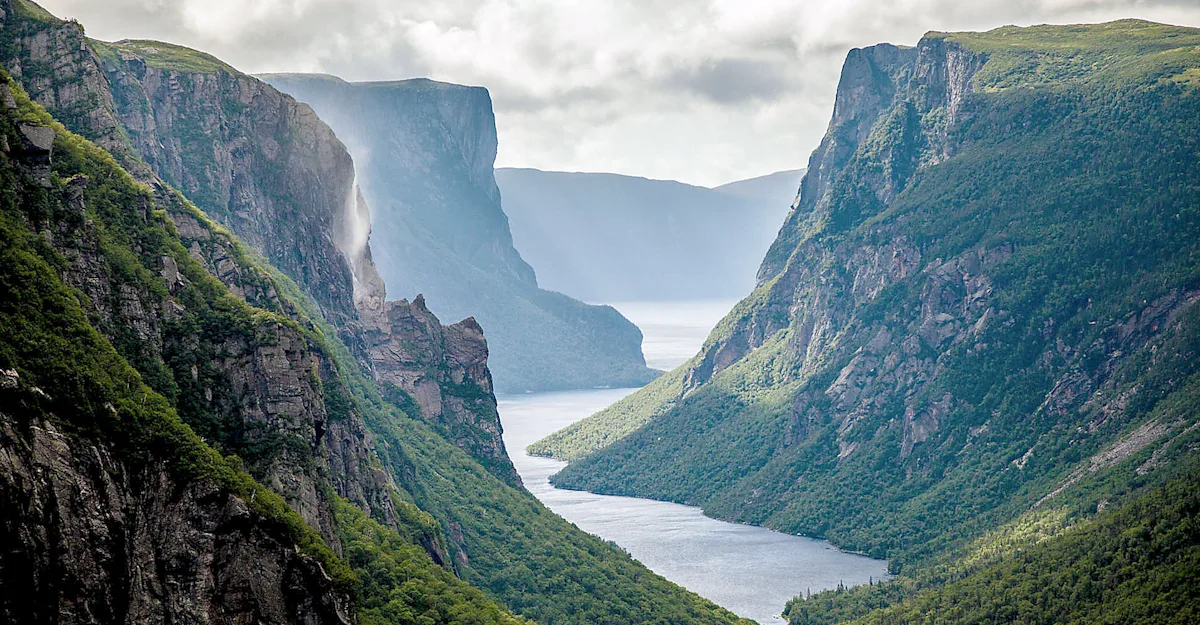
Hike to views over Western Brook Pond and its 2,000-foot cliffs
Settle into Gros Morne Inn, your base near Bonne Bay
The fishing village of Port au Choix is home to a small resident caribou herd accustomed to human presence, which we go in search of this morning. While sightings are never guaranteed, we often have a chance for close observation and photo opportunities.
Continue to Gros Morne National Park, acclaimed for its dramatic geology that provides a rare visible illustration of plate tectonics and the process of continental drift. A UNESCO World Heritage Site, the park contains exposed rocks from the earth’s mantle and oceanic crust, which were thrust to the surface of the earth through a process called subduction around 500 million years ago. The geology also showcases events that occurred around 1.2 billion years ago when the ancient continental margin of North America collided with another continent and formed a vast mountain range. Explore this fascinating phenomenon this afternoon on a guided hike overlooking Western Brook Pond. Steep rock walls rising 2,000 feet high surround this spectacular fjord created by receding glaciers. Fed by Stag Brook and refreshed with numerous waterfalls, the pond formed when land rebounded following the melting of the glacier, creating a natural dam. Continuing to Bonne Bay, we transfer to Gros Morne Inn for three nights. The remainder of the afternoon is free to enjoy the cedar sauna or hot tubs, or relax on the patio by the fire pit before dinner.

Days 10 to 11: See Earth's mantle exposed at the Tablelands
Explore the barren Tablelands, where carnivorous plants grow among exposed mantle rock
See nearly 500 million years of geological history in the layered cliffs at Green Point
Follow coastal trails to Lobster Cove Head Lighthouse above the Gulf of St. Lawrence
Gros Morne is a living laboratory for the study of geology, and we visit several intriguing sites over the next two days. Tablelands is an otherworldly expanse of exposed mantle rock, scoured by glaciers, typically found deep within Earth’s interior. Orange-brown in color, the rock, called peridotite, creates a barren landscape in stark contrast to the surrounding verdant hills. It is devoid of vegetation due to a heavy concentration of metals that are toxic to most, but not all, plants. We'll view several carnivorous plants thrive in this otherworldly setting, surviving mainly on insects. Green Point Geological Site is one of the world’s most important geological landmarks and the international reference point marking the boundary between the Cambrian and Ordovician periods. Along the shoreline, discover layered rock formations that reveal nearly 500 million years of Earth’s history, providing remarkable evidence of ancient oceans and continental drift.
We also explore some of the park's dramatic coastal landscapes. Trails hugging the rugged shoreline offer sweeping views of Bonne Bay, stark cliffs and the Long Range Mountains. A highlight is Lobster Cove Head Lighthouse, a historic beacon overlooking the Gulf of St. Lawrence from a high, rocky promontory.
Day 12: Depart from Deer Lake after exploring Newfoundland and Labrador
Transfer to Deer Lake for homeward flights
Our adventure on Canada's northeast coast comes to a close today. Transfer to Deer Lake Regional Airport, an important transportation hub in western Newfoundland, to meet departing flights.
Our goal is to provide you with an exceptional, life-enhancing adventure. In order to achieve that goal, our Expedition Leaders are empowered to make reasonable changes to itineraries while a trip is underway. These decisions might be made to more closely follow the movements of wildlife, to accommodate extreme weather, to take advantage of unexpected opportunities, or generally to improve overall guest experience. For this reason, the above itinerary should be considered a general outline of your trip, but it is subject to change. After all, the very definition of adventure is “an exciting or remarkable undertaking involving the unknown.”