

The Galapagos offers close wildlife encounters—from blue-footed boobies and sea lion colonies to giant tortoises that move slowly across arid highlands.
But the islands are only part of the story. The Galapagos Marine Reserve spans an area nearly six times larger than the landmass of all 21 islands combined. Most of the region’s wildlife lives beneath the surface, making the surrounding ocean one of the most dynamic places to observe animals in their natural habitat.
Since no visit is complete without getting in the water, here are 10 notable underwater wildlife encounters in the Galapagos.
1. Pacific Green Sea Turtle
Pacific green sea turtles breed and nest in the Galapagos. Conservation efforts have helped sustain stable populations here, making it one of the more reliable places to see them year-round. In the water, they move with ease, often gliding past snorkelers and divers in shallow bays.

© Antonio Busiello / WWF-US
2. Chocolate Chip Sea Star
Several sea star species inhabit the reefs and rocky seafloor, but the chocolate chip sea star stands out for its bright yellow body and dark, raised spines. These spikes act as a defense against predators. Often overlooked, these invertebrates add detail and color to the underwater landscape.
3. Galapagos Penguin
The Galapagos penguin is the only penguin species found north of the equator. On land, they appear awkward, but underwater they move with speed and precision. This endangered species is endemic to the islands, meaning it occurs nowhere else on Earth.
4. Manta Ray
Several ray species are found here, including spotted eagle rays and golden rays. Manta rays draw particular interest due to their size and behavior. They have one of the largest brain-to-body ratios among fish and have demonstrated self-recognition. Sightings occur year-round, though they are more common from December through May.
5. Pacific Seahorse
Also called the “giant seahorse,” this species is small and difficult to spot. It anchors itself to coral and seagrass in shallow areas. While seahorse populations are declining globally due to harvesting and habitat loss, protected waters in the Galapagos provide more stable conditions.

© Daniel Versteeg / WWF
6. Marine Iguana
Marine iguanas are the only lizards in the world that forage in the sea. Descended from land iguanas that arrived from the South American mainland millions of years ago, they adapted to feed on algae. Snorkelers can watch them graze underwater along rocky shorelines—an experience unique to the Galapagos.

© Antonio Busiello / WWF-US
7. Scalloped Hammerhead Shark
Scalloped hammerheads are among the most recognized species in the region. Large schools gather near the remote islands of Wolf and Darwin. Researchers have also identified a nursery site near Santa Cruz Island, offering insight into their life cycle and supporting conservation efforts for this endangered species.
8. Galapagos Sea Lion
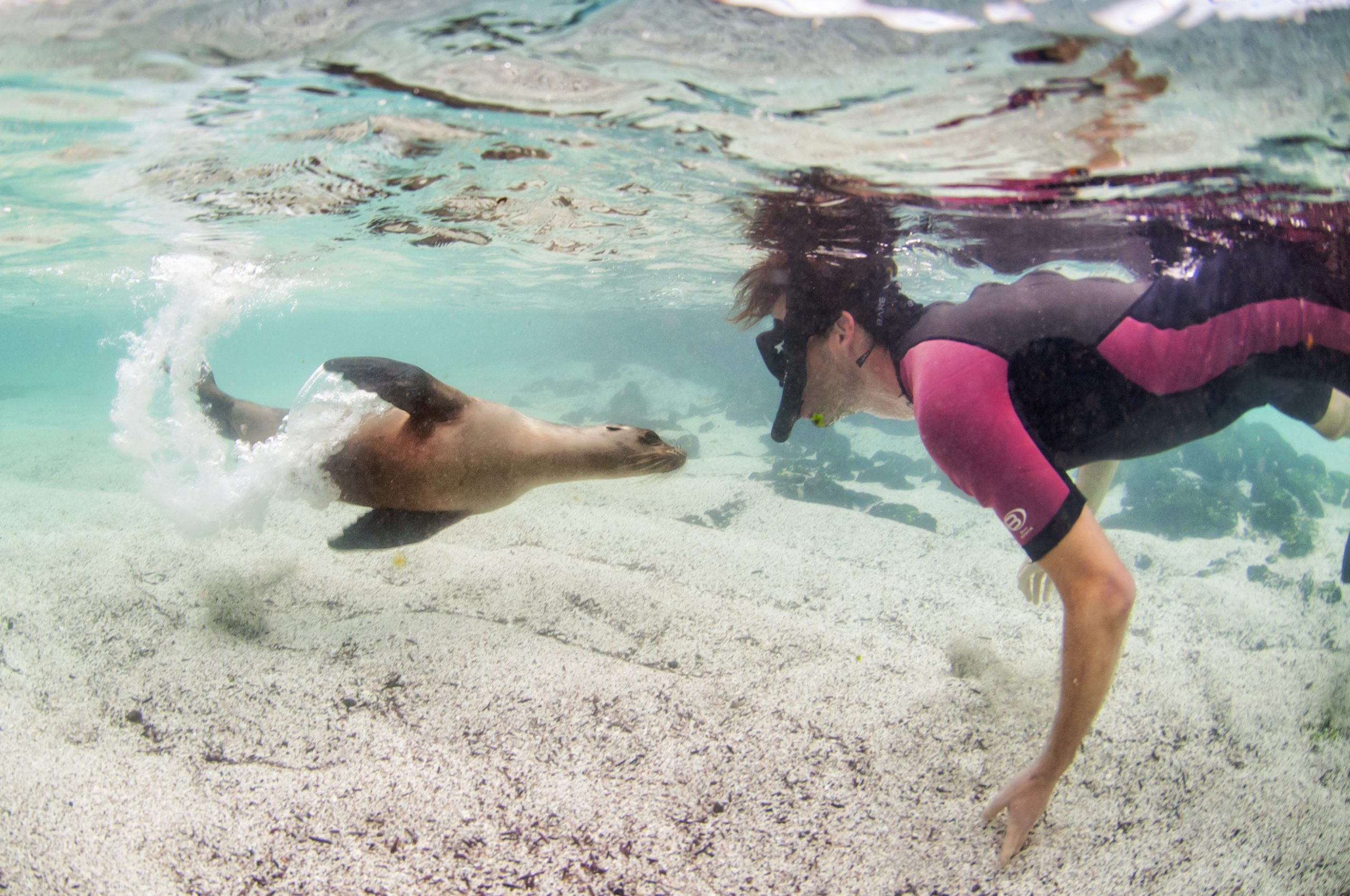
Sea lions are common along the coasts, often resting on beaches or even benches in town. In the water, they are highly active—circling snorkelers, darting through bubbles, and approaching cameras with curiosity. Encounters are frequent and often interactive.
9. Bottlenose Dolphin
Bottlenose and common dolphins are present year-round. They are often seen from boats traveling between islands. In some cases, guides may allow guests to enter the water. Their echolocation clicks are often heard before they come into view, adding another layer to the encounter.
10. Whale Shark
Whale sharks are the largest fish in the ocean. Despite their size, they are filter feeders, consuming plankton and small fish. From June through November, they are most often seen near Wolf and Darwin islands. A high percentage of individuals observed here are pregnant females, though the reasons for this remain under study. The Galapagos remains one of the most consistent places to see this species in the wild.
Travel to the Galapagos
Travelers can experience these remarkable underwater encounters firsthand on a Nat Hab expedition to the Galapagos, guided by experts who know where and when to look. With small groups and a focus on conservation, each outing offers a chance to observe these species responsibly in their natural habitat.
By Hallie Sacks, WWF