

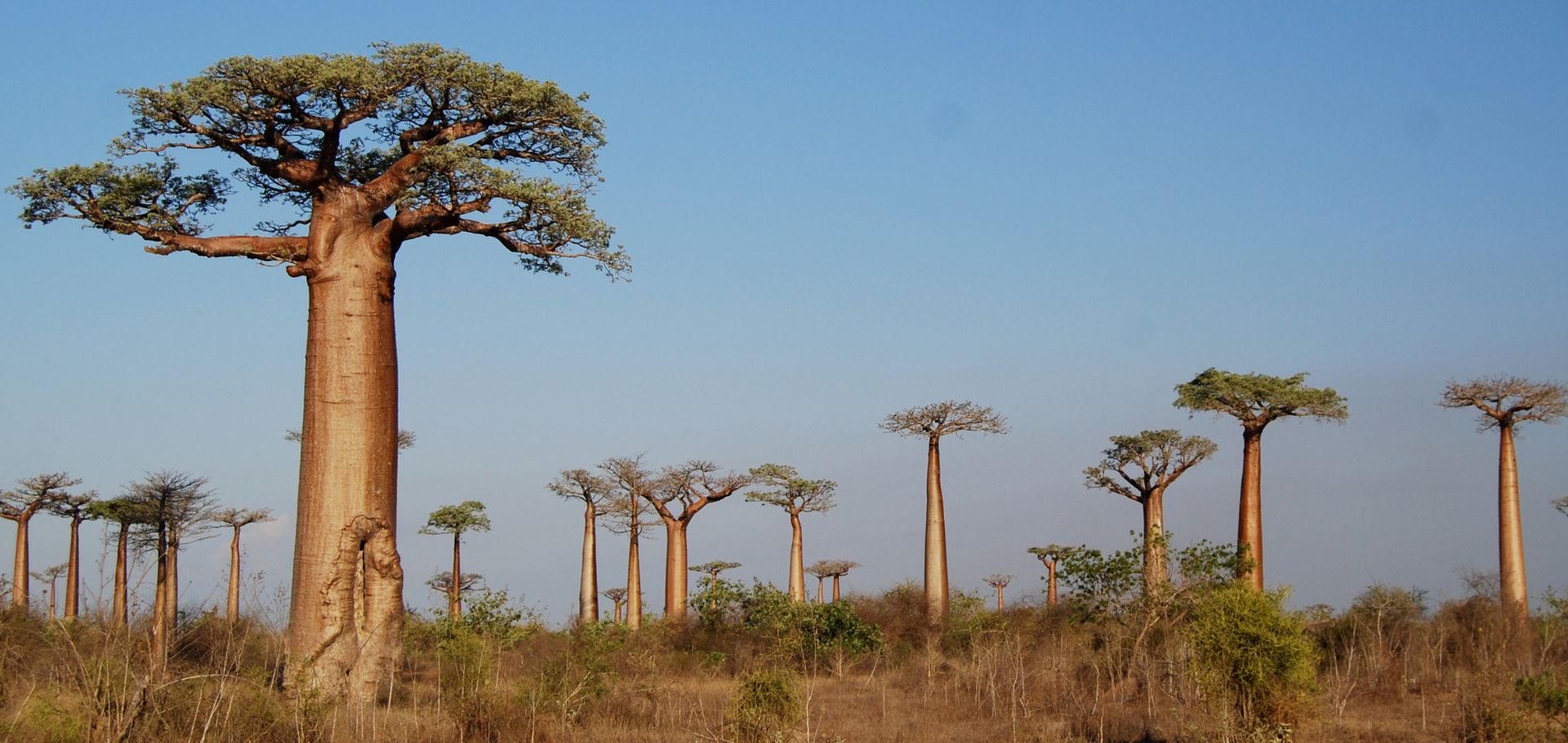
With its bulbous shape and canopy resembling an upside-down root system, the baobab tree symbolizes the African continent. Its origins are also the stuff of legend…literally. Along the Zambezi River, some tribes believed that one day their gods became angry, ripped the baobab from the ground, and tossed it up into the air, resulting in its inverted appearance. In another tale, God gifted the baobab to a hyena. However, the hyena felt so repelled by the tree’s already unusual exterior that he shoved it to the ground, upturned.

© Justin Jin / WWF France
Whatever way the baobab came to be, it’s undoubtedly a remarkable specimen. Baobabs can grow up to 100 feet tall, have a circumference of up to 165 feet, and live as long as 3,000 years. These solitary trees are also incredibly resilient, thriving in dry, open areas such as the savannas of Southern Africa and western Madagascar, and surviving by storing water in their massive trunks.
Their thick bark protects them from bushfires, while their massive root systems slow soil erosion and help recycle nutrients. Baobabs may depend on pollinators like fruit bats and bush babies to reproduce, but the trees themselves are incredibly regenerative. They can even create new bark when needed, healing wounds that would fell other trees.
Then there’s the baobab’s fruit: a woody, round or egg-shaped pod that can grow up to a foot long and hangs from the tree’s branches courtesy of a long, thick stalk. Its pulpy interior is loaded with seeds and brimming with nutrients, including tartaric acid—a natural antioxidant—and loads of Vitamin C.

© James Morgan / WWF-US
Native to sub-Saharan Africa, the southern Arabian Peninsula (Yemen, Oman), and Australia, baobabs consist of 9 species. The African continent is home to two kinds, six are endemic to Madagascar, and Australia has one baobab species. The latter is commonly known as the ‘boab’ among Aussies and thrives in both Western Australia’s Kimberly region and the country’s Northern Territory.
The Importance of the Baobab Tree
Baobab trees are nicknamed “The Tree of Life,” and for good reason. From the bark to the fruit, baobabs offer more than 300 vital uses. Elephants quench their thirst in the tree’s water-rich interior, snack on its fruit and fertilize the soil with their droppings. Baboons crack open the fruit’s hard exterior and fill up on its pulpy seeds (earning the baobab its other moniker, the ‘monkey bread tree’).
Marabou storks and red-billed buffalo weavers nest in their branches, and fruit bats and bush babies—as well as lemurs in Madagascar—sip up the nectar from their blossoms, pollinating one flower to the next as it goes. These large white blooms spread their petals at night and flower for no more than 24 hours. They typically spring to life during or after the rainy season.

© Justin Jin / WWF France
As much as wildlife depends on the baobab tree (and vice-versa), so do humans. Not only is the fruit’s sour brown pulp edible and nutritious, but soaking it in water turns it into a refreshing drink. People who live around baobab trees roast and grind the fruit’s seeds to make a beverage akin to coffee, or boil the tree’s leaves and eat them like spinach. These leaves are loaded with potassium and magnesium, and people often use them in traditional medicine to treat ailments such as insect bites and asthma.
The tree’s bark is used to make everything from paper and cloth to ropes and baskets. People also used it to make waterproof hats and strings for musical instruments. By mixing the flower’s pollen with water, you can even create a form of glue.
The older a baobab tree gets, the more impressive it becomes. An ancient Baobab can support an entire ecosystem, from the bees and stick insects that reside among its branches, to the antelope and warthogs that delight in its fruit. In fact, baobabs are considered a keystone species, meaning they play an essential role in local biodiversity.
Threats to Baobabs
Despite their enormous size and longevity, baobabs are not immune to threats. Here are just some of the challenges they face (as well as some possible solutions).
Climate Change
Many scientists believe climate change is killing Africa’s oldest and largest baobab trees, driven by more frequent weather anomalies like floods and lightning storms. Elephants often damage baobabs during extreme droughts to reach water, sometimes digging so deeply into the wood that the tree collapses.
WWF’s assessment of African elephants’ vulnerability to climate change shows that their biggest concern is having enough fresh water. Creating safe wildlife corridors is one way to increase an elephant’s options and relieve pressure on individual baobab trees.
Deforestation
Madagascar, home to six of the world’s 9 baobab species, has experienced massive deforestation, losing about 235,000 hectares of tree cover from 2010 through 2021. This includes the loss of baobab habitats.
WWF’s Forest Landscape Restoration (FLR) in Africa is an initiative helping to restore forests and forest landscapes across 9 African countries, including Madagascar. One action involves working with local communities to develop commercially viable landscape restoration projects, then connecting these community enterprises with investors and commercial partners so they can scale up.

© WWF / Martina Lippuner
Agriculture
With their smooth bark, thick, cylindrical trunks, and flat-topped crowns, Grandidier’s baobabs are one of Madagascar’s most recognizable baobab species. They are also highly threatened by the conversion of local forests into agricultural land. Forest loss can lead to severe soil erosion, and slash-and-burn farming and overgrazing can inhibit proper baobab regeneration.
WWF’s work in sustainable agriculture includes creating financial incentives that can encourage biodiversity conservation in places where baobab trees grow.
Legendary Baobabs
Here are a few of the most beloved baobabs:
Kondanamwali, Zambia
This especially large baobab in Zambia’s Kafue National Park is known as “the tree that eats maidens.” According to local legend, Kondanamwali fell in love with four beautiful women, who decided that they all wanted human husbands instead. The tree became jealous, so it opened its trunk and pulled the women inside, where they’re said to remain to this day.
The Avenue of the Baobabs, Madagascar
More than two dozen towering baobabs line an 853-foot dirt stretch in western Madagascar’s Morondava. In 2007, it became the country’s first “Natural Monument.”

© Justin Jin / WWF France
Sagole Baobab, South Africa
South Africa’s stoutest baobab is located within Limpopo, the country’s northernmost province, and is recognizable by its humongous trunk and gnarled branches. Although researchers carbon-dated the tree at around 1,200 years old, many residents believe it’s more than twice that. It’s home to a breeding colony of mottled spinetails, a bird species most common along the West African coast.