

Itinerary
Itinerary
Day 1: Begin in Jackson, gateway to Grand Teton and Yellowstone national parks
Explore Old West Jackson on foot, photographing its boardwalks and elk antler arches
Join your Photo Expedition Leader and fellow travelers for a welcome dinner
Arrive in Jackson, where our Yellowstone Country photo safari begins. Ringed by the Teton, Gros Ventre and Snake River ranges, historic Jackson is a ranching town turned luxury outpost that still holds onto its dungaree and work glove vibe. The town's Western heritage is on full display here, from the saddle-seat bar stools at the Million Dollar Bar to the elk antler arches on the town square. With a local ski hill on the edge of town and rodeo grounds nearby, it’s typical to see mountain athletes alongside working cowboys and well-heeled hobby ranchers. The southern gateway to Grand Teton and Yellowstone national parks, Jackson is surrounded by vast wild terrain home to apex predators like grizzly bears and wolves, plus plenty of hoofed herbivores, some of which occasionally wander through town. Despite its growing opulence, Jackson retains a hardy character, emblematic of the Old West, with a deep reverence for all things wild. If time permits, explore the town with a stroll along its wooden boardwalks, camera in hand—you're sure to find some appealing shots.
At our welcome dinner this evening, meet your Photo Expedition Leader, who offers an overview of the adventures ahead. Your guide is both a professional nature and wildlife photographer, skilled at sharing tips and techniques to improve your images, and a seasoned naturalist, whose intimate knowledge of area’s natural history will help you get the shots you covet.

Day 2: Photograph wildlife and golden light beneath the Teton peaks
Search the valley floor for elk, pronghorn, mule deer, bison and eagles
Float the Snake River beneath the Tetons, watching for moose, beavers and ospreys
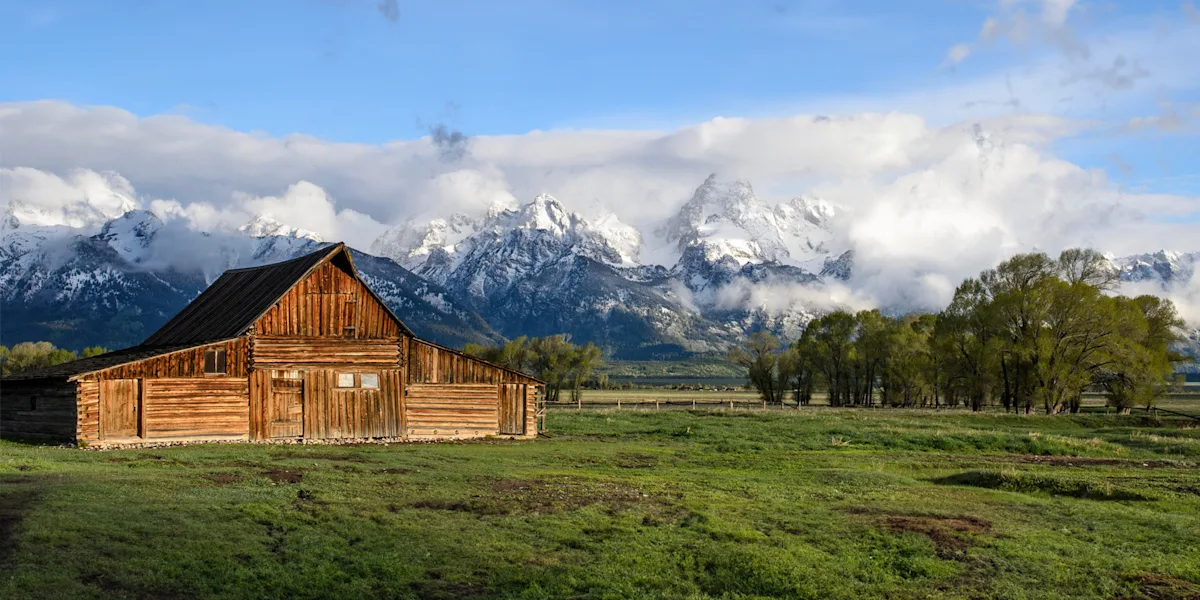
Frame the T. A. Moulton Barn at Mormon Row against the Teton Range
Nothing quite prepares you for the drama of the Tetons, which rear up in a row of pointed peaks from the floor of Jackson Hole. Protected forever in one of America’s most treasured national parks, the range is an icon of the West’s wild grandeur, and Grand Teton National Park's animals are as magnificent as its mountains. Our focus this morning is wildlife photography as we look for elk, pronghorn, mule deer, bison and eagles. This afternoon, float the placid Snake River beneath the jagged backdrop of the Tetons. From the raft, we may get eye-level shots of moose, beaver, osprey or even a bear near the river’s edge. We also visit Mormon Row, site of early 20th century pioneer homesteads, for photos of the famous T.A. Moulton Barn backed by the Teton spires—a quintessential image for any western portfolio. As the day draws to a close, we linger at golden hour to capture the sun setting behind the famous range before returning to Jackson for a second night.
Day 3: Capture Teton alpenglow before entering Yellowstone
Photograph sunrise on the Teton peaks while refining depth of field and exposure
Search Oxbow Bend for moose, river otters and pelicans beneath Mount Moran
Frame Old Faithful's eruptions with guidance from your Photo Expedition Leader
Rise early to experience daybreak on the Tetons as we capture the sunrise alpenglow on the crags. Mountain landscapes take center stage this morning as we focus on depth of field and proper exposure. Traversing Jackson Hole through some of the park's most photogenic areas today, keep watch for elk, moose, bears and eagles. We often see moose in the willow-covered bottomlands of Oxbow Bend east of Jackson Lake. Made famous by Ansel Adams in a 1942 shot of the Snake River in the foreground and Mount Moran in the background, this special spot features dramatic leading lines for artistic compositions. The slow-moving water provides habitat for fish that are food for other wildlife, and our subjects may include river otter, beaver, muskrat, osprey, bald eagles and American white pelicans.
Exiting Grand Teton National Park, we continue north to enter Yellowstone, the world’s first national park, established in 1872. From bubbling mud pots and hissing springs to plumes of boiling water rocketing skyward, Yellowstone’s geothermal features captivated early explorers like John Colter and Jim Bridger and prompted conservationists like Teddy Roosevelt to champion the park’s natural assets. We spend two nights at Old Faithful, with easy proximity to the famous geyser, and our Expedition Leader offers tips for getting exciting shots of its reliable eruptions.

Day 4: Photograph Yellowstone's geothermal basins, wildlife and canyon
Walk the Firehole River Basin boardwalks through Earth's densest concentration of geothermal features
Photograph bison and elk grazing across Hayden Valley
Capture Yellowstone Falls plunging into the thousand-foot-deep canyon
Today, multiple opportunities await to photograph Yellowstone's fascinating geothermal features, enhanced with insight into the park’s geology from our Expedition Leader. Have your wide-angle lens ready to embrace vast landscapes, and experiment with macrophotography as you observe intricate crystal formations in silica crusts and layers of color in mineral-laden pools. Learn about fire ecology as we drive through recovering areas once ravaged by wildfires, capturing the contrast between green new growth and blackened snags. The Firehole River Basin, which boasts the highest density of geothermal features on Earth, is a highlight. As we wander the boardwalks among simmering hot springs and fumaroles, capture photos of geysers, mud pots and other dynamic phenomena.
More of Yellowstone awaits this afternoon, including Hayden Valley, a favored grazing area for large herds of bison and elk. Yellowstone is home to some 4,000 bison, the largest land mammal in North America, and we expect good chances to photograph some of them today. Bighorn sheep may be on view near Mount Washburn, and we may also spot coyotes and bald eagles. Next up is the park’s most inspiring vista: the Grand Canyon of the Yellowstone River, where Yellowstone Falls pours off a sheer cliff into a thousand-foot deep gorge. Return to Old Faithful for a second night.
Day 5: Reach Yellowstone's remote Northern Range for wolf photography
Scan for wolves and bears across one of the park's best wildlife-viewing regions
Use high-powered spotting scopes and updates from park researchers to follow wolf activity
Base near Yellowstone's northern entrance for early and late wildlife outings
Today we travel to the northern edge of Yellowstone for access to the Northern Range, one of the park's most remote sectors that is also one of its best locales for wildlife viewing. Using high-powered spotting scopes, we have our first chance to look for wolves, and the odds to spy these elegant predators are better than anywhere else in the area. Though Yellowstone’s famous gray wolves are elusive and almost always viewed at a substantial distance, the Northern Range is the best place in North America to find and photograph them. We have the added advantage of working closely with wolf researchers in the park, who follow their movements and locations closely and help us track them. We will spend the next three nights near the park's northern entrance, our base for extensive photography in this region.
Accommodations


Days 6 to 7: Track wolves across the Lamar Valley
Search for wolves at dawn and dusk, when chances for sightings are best
Look for grizzly bears and large herds of elk and bison across the Northern Range
Meet award-winning wildlife photographer Dan Hartman at his Cooke City gallery
Over these next two days, we delve deep into the wildlife-rich northern corridor of Yellowstone National Park, crossing the Lamar Valley—prime wolf and grizzly habitat—and the broader Northern Range environs. Wolves were reintroduced here to their native ecosystem amid much controversy in 1995, after a 70-year absence following their government-sanctioned eradication. With large herds of elk and bison abundant in the broad meadows of the Lamar to support them, wolves have flourished since, and their presence has helped right imbalances in the ecosystem. Although pack movements are unpredictable and the impact of hunting outside the park has made wolves shy in the presence of people, our Expedition Leaders are experienced trackers and teach us how to search for them, often with local knowledge from scientists who follow them daily. Keep your telephoto lens always ready, but we'll also learn the process of digiscoping, which is the best means of capturing images of wolves at a distance. Our Expedition Leaders carry high-powered spotting scopes on board our vehicles, and if we are fortunate to spot wolves, they will teach you how to get shots and video on your smartphone using the scope’s magnification.
In Cooke City, Montana, we visit the Hartman Gallery for a presentation by award-winning wildlife photographer and videographer Dan Hartman, whose work has been featured in National Geographic and on the BBC. Dan shares images and insights about wolves and wildlife photography that will inspire your visual storytelling. Return to Yellowstone’s Northern Range early this evening for more wolf tracking, knowing our chances to photograph them are best at dawn and dusk.
Accommodations
Day 8: Capture Yellowstone’s geothermal landscapes before crossing Paradise Valley
Photograph Mammoth Hot Springs' travertine terraces, colored by heat-loving thermophiles
Look for resident elk roaming among the geothermal features
Follow the Yellowstone River through Paradise Valley between the Absaroka and Gallatin ranges
This morning, we head west to Mammoth Hot Springs, one of Yellowstone's best-known geothermal features. Scalding water spills over white travertine terraces that have been described as a “cave turned inside out,” and heat-loving organisms called thermophiles add colors to the mineral-laden formations. The textures and steam create intriguing abstract images, and the leading lines along the geothermal pool edges offer interesting framing. Mammoth’s resident elk herd is almost certain to be in the vicinity, too, offering unique images of wildlife along village streets.
Leaving the park through the north entrance at Gardiner, Montana, we follow the Yellowstone River through Emigrant Canyon and into the aptly named Paradise Valley, flanked by the Absaroka and Gallatin ranges. Cresting Bozeman Pass, we drop into the city of Bozeman, where we recount our adventures over a farewell dinner this evening.

Day 9: Depart Bozeman with a Greater Yellowstone photo portfolio
Opt to visit the Museum of the Rockies on your own, home to Montana's mounted T. rex skeleton
Transfer to Bozeman Yellowstone International Airport for homeward flights
Although it's time to leave the Greater Yellowstone Ecosystem today, you are taking vivid memories of it home with you. Anticipate the enjoyment of reviewing, editing and sharing your images as our Western safari concludes. A transfer to the airport is included. For those with extra time to spend in Bozeman, there's plenty to explore in this historic Old West/New West town. With a rich mining, trapping and ranching heritage, Bozeman boasts 40 individual properties on the National Register of Historic Places. Home to Montana State University, the rapidly growing city has also become a hub for tourism and technology. A highlight is the Museum of the Rockies, a Smithsonian Affiliate and important repository for dinosaur fossils, including the mounted Montana's T. rex skeleton.
Natural Habitat Adventures is an authorized permittee of Grand Teton and Yellowstone national parks.