

Know Before You Go
Costa Rica Wildlife Trivia
Can you name the world's largest sea turtle or guess how small a hummingbird egg is? Any idea which national park is nicknamed "the Amazon of Costa Rica"? Take our quiz below to put your knowledge to the test, then share it with your family and friends to see who knows the most about the wildlife of Costa Rican. When you're finished, scroll down to reveal the correct answers and explanations.
Answer Explanations:
How much of the Earth's biodiversity is found within Costa Rica?
Correct Answer: 5 percent
Explanation: Costa Rica has one of the highest densities of plant and animal species on Earth. The country is located at the bottleneck between North and South America, bordered by both the Pacific and Atlantic oceans. Species traveling north from South America, or south from North America, all had to pass through Costa Rica. When they arrived, they found an incredible diversity of habitats, resulting in the biodiversity of species we see today.
Photo Credits—Purple-throated mountaingem: Joseph C Boone [CC BY-SA 3.0, opens in new tab] via Wikipedia; Baby sea turtle: Keith Arnold
What is Costa Rica's national bird?
Correct Answer: Clay-colored Thrush
Explanation: While one may think a brilliantly-plumed bird would take this prestigious title, it is the clay-colored thrush that is given the honor of being Costa Rica's national bird. Also called the yigüirro, it is known for its beautiful song and prominence in Costa Rican literature.
Fun Fact: Costa Rica's national animal is also a surprise—it's the white-tailed deer!
Photo Credits—Hummingbird & Scarlet Macaw: Patrick Endres; Red-legged Honeycreeper: Eric Rock; Resplendent Quetzal: Alex Arias; Clay-colored Thrush: Becky Matsubara (CC by 2.0, opens in new tab) via Flickr; Blue-crowned motmot: Francesco Veronesi [CC BY-SA 2.0, opens in new tab] via Flickr
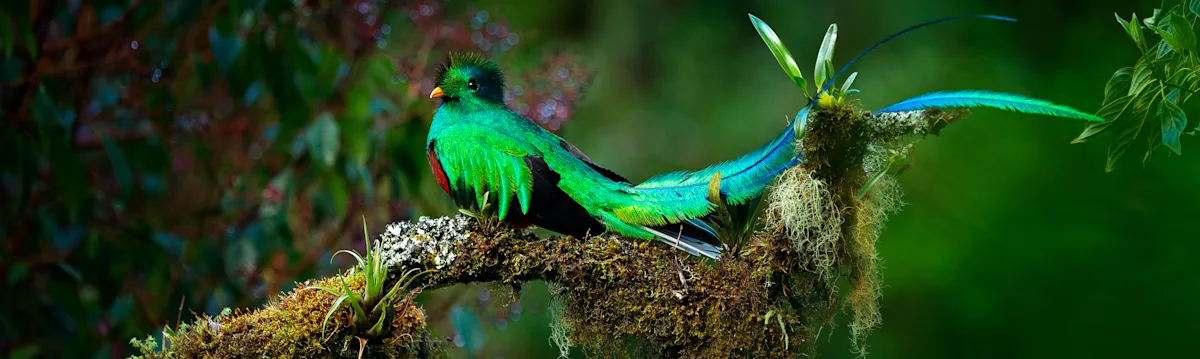
The resplendent quetzal is primarily:
Correct Answer: Frugivorous
Explanation: The resplendent quetzal primarily eats fruits, such as those from the avocado family, supplementing its diet with insects and lizards.
Photo Credit—Francesco Veronesi from Italy [CC BY-SA 2.0, opens in new tab] via Wikipedia
Monteverde Cloud Forest Reserve was the only known home of this amphibian, which is now extinct:
Correct Answer: Golden toad
Explanation: Monteverde Cloud Forest Reserve was the only known home of the golden toad, a 2-inch, brilliantly colored amphibian that was last seen in 1989. Discovered in 1964, it helped spur the creation of Monteverde Cloud Forest Reserve.
Photo Credits—Golden toad: Charles H. Smithvergrößert von Aglarechderivative via Wikimedia Commons; Glass frog: Geoff Gallice [CC BY 2.0, opens in new tab] via Wikimedia Commons; San Jose Cochran frog: Brian Gratwicke [CC BY 2.0, opens in new tab] via Wikimedia Commons; Mexican burrowing toad:Greg Schechter from San Francisco, USA [CC BY 2.0, opens in new tab] via Wikimedia Commons
Which monkey is Costa Rica's smallest primate?
Correct Answer: Squirrel monkey
Explanation: The smallest Costa Rican primate, the squirrel monkey, or titi, is restricted to the rainforests of the southern Pacific lowlands.
Costa Rica has been hailed as a pioneer of ecotourism, having doubled its forest cover from 24 percent in 1983 to 52 percent today. What percentage of the country is protected in national parks, wildlife refuges, and reserves?
Correct Answer: More than 30 percent
Explanation: More than 3 million acres of land in Costa Rica have been deemed more valuable in their natural state than the resources, scuh as timber, that could be extracted, benefiting the thousands of species that live there. In the 1950s, 70 percent of Costa Rica was covered in forest. By 1983, forest cover had been reduced to 24 percent, and the country had one of the highest deforestation rates in the world. Environmental groups began working with the government to set up a fund to pay landowners to protect existing forests and plant new trees. Today, Costa Rica has more than 50 percent forest cover, representing one of the very few countries where forest cover has increased in recent decades.
Fun Fact: Costa Rica produces more than 90 percent of its electricity from renewable resources!
Photo Credit—Alex Arias
All five of these sea turtle species nests in Costa Rica. Which one is the world's largest sea turtle?
Correct Answer: Leatherback
Explanation: Costa Rica is home to five different species of sea turtles—olive ridley, green, hawksbill, leatherback and loggerhead—and they are more easily viewed here than any other place in the world. Leatherbacks can reach 1,200 pounds and while nesting lay an average of 100 eggs, each the size of a billiard ball.
Nicknamed "the Amazon of Costa Rica," this biologically intense region is the country's largest national park and has 13 ecosystems.
Correct Answer: Corcovado
Explanation: Situated on the Osa Peninsula in southwest Costa Rica, Corcovado National Park is the largest park in Costa Rica. Encompassing 103,000 acres, this remote park is located in one of world’s most biologically diverse regions and is widely considered the crown jewel in the extensive system of national parks and biological reserves spread across the country. Famous for being “the Amazon of Costa Rica,” Corcovado was declared a protected area in 1975, and since 1978, Corcovado National Park has been designated exclusively for conservation, scientific investigation, environmental education and eco-tours.
Fun Fact: Corcovado is home to the only remaining old growth wet forests on the Pacific coast of Central America and the tallest tree in the country—a kopak, which soars to 230 feet. Photo Credit—Keith Arnold
All of these animals can be found in Corcovado except:
Correct Answer: Kemp's Ridley Sea Turtle
Explanation: Corcovado protects coral reefs, lagoons, rivers and estuaries. There are 23 miles of beaches that are dotted with coconut palms. Crocodiles, whales and dolphins can be found within the surrounding waters and four species of turtles—olive ridley, leatherback, hawksbill and Pacific green—are known to lay their eggs along the sandy coastal shores. Kemp's ridley sea turtles are not found in Costa Rica—most females nest on Rancho Nuevo Beach in Tamaulipas, Mexico. They are critically endangered, and they are the world's rarest sea turtle.
Corcovado is believed to have the largest concentration of macaws in Central America and herds of white-lipped peccaries have at times greeted visitors along the trails. In addition, Corcovado harbors species such as sloths, squirrel monkeys, Baird’s tapirs, jaguars, ocelots, silky anteaters and harpy eagles. More than 40 species of frogs including red-eyed tree, rain, glass and poison arrow varieties, dozens of snakes including a variety of boas and the dreaded bushmaster, as well as 28 species of lizards, more than 100 species of butterflies and at least 10,000 other insects inhabit Corcovado.
Photo Credits—Sloth: Ben Hulsey; Ocelot & Macaw: Alex Arias; Silky Anteater: Quinten Questel [CC BY-SA 3.0, opens in new tab] via Wikimedia Commons
Costa Rica has 2,000 species of butterflies—10 percent of the world total! What is the term for someone who studies butterflies?
Correct Answer: Lepidopterist
Explanation: Costa Rica is home to an amazing array of colorful butterflies, from the blue morpho and malachite to the delicate glasswing butterfly.
There are 51 hummingbird species in Costa Rica. Hummingbirds lay two eggs, each approximately the size of a:
Correct Answer: Coffee Bean
Explanation: Male hummingbirds defend territories rich in flowers in order to attract females to breed. After forming a nest no larger than a thimble lined with silky plant down, the females lay two eggs, each the size of a coffee bean. Photo Credit—Megan Koelemay
Which of the following conservation facts about World Wildlife Fund are true?
Correct Answer: All of the above
Explanation: World Wildlife Fund (WWF) supported the establishment of the Forest Stewardship Council, which advocates for the responsible management of forests and addresses social issues, such as protecting the rights and resources of the people that rely on this landscape for their livelihoods. In 1975, WWF helped create Corcovado National Park, which is recognized as one of the most biologically intense places on Earth. the nonprofit also promotes responsible observation of marine turtle nesting beaches in Costa Rica, with the knowledge that ecotourism and education are powerful contributors to conservation.Photo Credit—Keith Arnold