

Know Before You Go
Frequently Asked Questions
Click on a question below to open the answer.
When is the best time of year to visit Antarctica?
Though it is cold in Antarctica year-round, the Antarctic summer is more temperate. November through March are some of the warmest months, and during this time a wide array of wildlife can be seen.
What will the weather be like in Antarctica during this trip?
Weather in Antarctica is very unpredictable and often cold, dry and windy. The average temperature in November on the Antarctic Peninsula is 26°F, December is 21°F, January is 34°F, February is 32°F and March is 29°F.
What wildlife will I see in Antarctica?
Antarctica is home to prolific wildlife. During your time in this southern polar wonderland, you may encounter Adélie, chinstrap and Gentoo penguins, humpback whales, fin whales, Antarctic fur seals, leopard seals, crabeater seals, Weddell seals, dolphins and many species of seabirds.
What birds live in Antarctica?
Antarctica is home to various species of penguins including Adélies, chinstraps and Gentoos. There is also an abundance of seabirds, including wandering albatrosses, storm and diving petrels, cormorants, sheathbills, skuas, gulls and Arctic terns.
How close will I get to Antarctic wildlife?
You will have intimate encounters with wildlife in Antarctica. You’ll be on the ground with penguin colonies, and you will likely come into contact with whales while you are in the Zodiacs or the boat. You’ll also kayak along the shoreline in small groups, keeping an eye out for seabirds and seals.
Will we view wildlife from land, or only from the ship?
You’ll be able to search for wildlife from the motorsailor and on kayaks, as well on walks from land. We also take Zodiacs—small motorized vessels—that hold three to seven guests, depending on which ship you are on.
What clothes should I pack for Antarctica?
Weather in Antarctica is extremely variable, so come prepared with many layers. You’ll experience cold temperatures, so pack a warm fleece, a down jacket, thermal under layers, and a warm hat and gloves. Waterproof rain gear is essential for keeping you warm and dry in windy and wet conditions. Nat Hab will provide all adventure activity equipment, including Mustang suits for Zodiac excursions and dry suits for kayaking (Australis only). Guests on board the Ocean Tramp will be provided with muck boots in Punta Arenas. For further details of what to bring, check out Nat Hab’s online Gear Store for some of the key items recommended for your adventure.
What adventure activity equipment is provided on this Antarctica expedition?
Sea kayaking equipment and dry suits, Mustang suits for Zodiac excursions, camping gear, and dry bags will be provided on the Australis. Sea kayaking equipment, camping gear and muck boots are provided on the Ocean Tramp.
How physically active is this Antarctica trip?
This trip is rated as an extreme adventure due to the incredible remoteness of the destination. The days are long and full of activities in rugged and sometimes harsh polar settings. Antarctica experiences cold temperatures, frequent high winds, rough seas and weather that can change at any moment. All guests must be in good health with substantial physical stamina to participate in adventurous activities such as hiking, camping and kayaking. Please click here for the explicit physical requirements of this Antarctica adventure. Due to the extremely remote nature of this adventure, we also require all travelers to submit a medical form signed by your primary care physician prior to departure.
What is camping like in Antarctica? Is all the camping equipment provided?
Nat Hab holds special permits which enable us to spend up to three nights camping ashore in some of the most remote places on the planet. While this is an optional activity, and you may choose to sleep on the ship instead, camping on land amid penguins and seals is a highlight for many travelers. All camping equipment is provided.
What are your motorsailer yachts in Antarctica like?
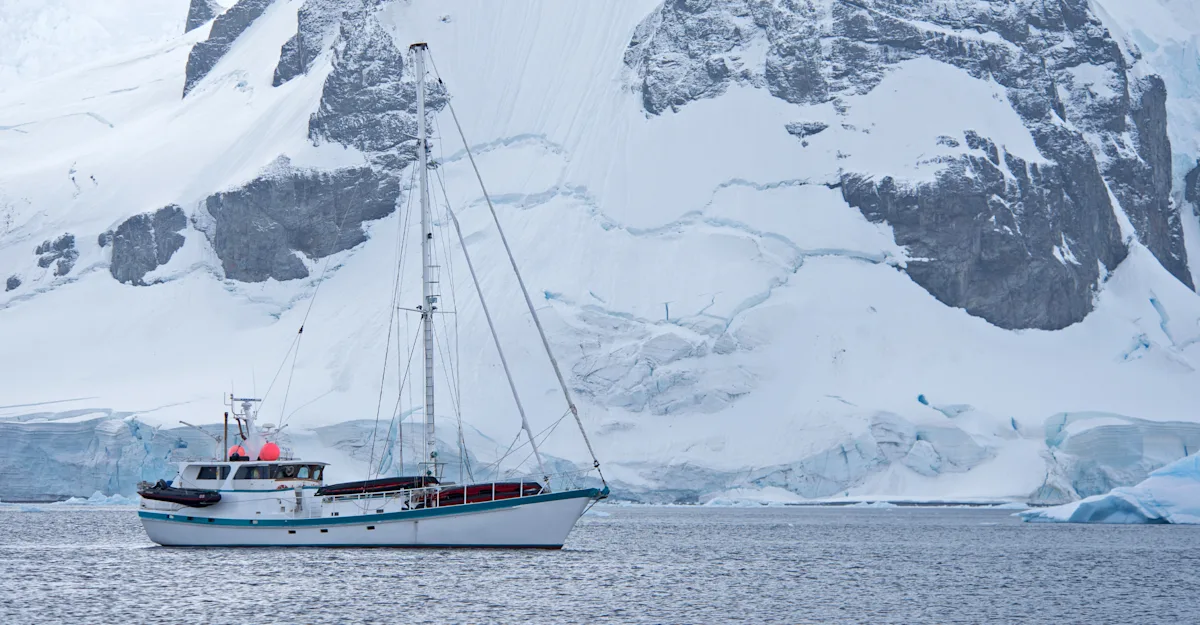
S/V Australis is a 75-foot ice-strengthened motorsailer designed for polar exploration and equipped with two motorized Zodiacs and kayaks for remote coastline cruising. Four cabins accommodate a maximum of seven passengers plus one Expedition Leader. One bathroom is shared among all guests and the Expedition Leader. The expedition yacht includes a common area with a communal dining table, small kitchen, outdoor cockpit area with a removable sun shade, and a crow’s nest with ladder access that offers 360-degree views. Though quarters are compact, the vessel is comfortable, and because of the motorsailer’s small size, it allows us access to remote coves and inlets in Antarctica that travelers on larger ships cannot reach. The fully rigged motorsailer is equipped with a state-of-the-art navigation system, full safety rails and a steel hull, which means it can maneuver safely in ice.
S/Y Ocean Tramp is a 66-foot aluminum ketch-rigged motorsailing yacht designed for polar waters, carrying Zodiacs and kayaks for close-up exploration. The yacht can accommodate eight guests (and up to three crew), although we travel with no more than seven. Ocean Tramp's length and profile ensure swift passage across open seas, though her nimble size also permits intimate exploration of the rugged coastline and secluded bays of the Antarctic Peninsula that are inaccessible to larger cruise ships. Very large forward and aft decks facilitate superb whale watching, and keep an eye out for leopard seals slinking below the surface in the crystal-clear water. In fine weather, we can even dine on deck. The dining space inside is likewise roomy, with ample padded banquette seating around a generous table in a well-lit space ringed with windows.
What is it like living in close quarters with other guests on an expedition yacht in Antarctica?
Even though the yachts are compact and cabins are small, both ships are surprisingly comfortable. There is space for relaxing on deck or in the common area, which is well-equipped with various entertainment options.
What are the advantages of choosing a smaller motorsailor as opposed to a larger cruise ship?
Our small motorsailors allow Nat Hab travelers exclusive access to places in Antarctica larger boats simply cannot visit. In addition, we have more flexibility with our schedule since we are a small group, allowing you more time to explore and experience Antarctica instead of rushing back to the ship to keep on schedule.
What are the meals like on the ship?
Our chef on the expedition yacht makes simple but hearty and tasty meals prepared in the ship’s kitchen to fuel you for long, activity-filled days. There is a barbecue on deck of the Australis for scenic outdoor dining and wildlife viewing in nice weather.
What is it like sailing from South America to Antarctica via the Drake Passage?
Sailing from South America to Antarctica (or vice versa) takes approximately three days and is a uniquely rewarding experience. The intrepid voyage across the Drake Passage is thrilling, and it is not for the faint of heart. The Drake is notorious for its fierce gales and strong swells, but our premier vessel and expert captain are well qualified to ensure guest safety during the crossing. It is not uncommon to get seasick while crossing the passage, so it is important to consult with your physician for the most effective medication before you leave. Rough seas aside, our crew is incredibly experienced sailing in polar waters, and many travelers look back on the crossing as a somewhat strenuous, but ultimately worthy journey.
Do many people get seasick while crossing the Drake Passage?
The Drake Passage has some of the roughest water in the world due to its location—it is subject to intense, circumpolar westerly winds and sharp climatic changes. Quite a few people do get seasick while crossing the passage, and we recommend consulting your physician for the most effective seasickness medicine. There are precautions you can take to lessen the effects of seasickness including lying down, closing your eyes and staying hydrated.
Is it possible to fly both ways to and from Antarctica, rather than sailing one way?
We do offer a fly-both-ways itinerary. We fly from Punta Arenas, Chile, explore the Antarctic Peninsula aboard the motorsailor the Ocean Tramp, then fly back to Punta Arenas from King George Island.
Will we have a chance to do a “polar plunge,” that is, take a quick dip in the ocean?
Yes, if weather conditions allow, guests will have the chance to do a polar plunge!
What currency is used in Antarctica? And can I use a credit card on the ship?
There is no currency in Antarctica and nothing to buy on board, so you will not need cash or a credit card while on the expedition yacht. If time and weather permit, we may stop at a research station or similar, where credit cards are accepted. You will need to exchange money to Argentine pesos or Chilean pesos if you wish to make purchases in Ushuaia or Punta Arenas, but major credit cards are generally accepted in both countries.
Will there be phone or Internet access on the ship?
There is no phone service on the ship except for emergency situations. Wi-Fi on board the Ocean Tramp is available- each guest will receive a voucher for 5G of data. Any additional vouchers will be $100 USD each, paid on site. Australis has Wi-Fi at no cost.
Before you embark on the trip, it is best to pre-download any movies, shows or podcasts so you do not rely on streaming or data. Wi-Fi can be very unreliable and unpredictable in this area of the world and given the constant movement of the ship. As always, we encourage guests to stay present and savor the rare opportunity to completely disconnect from the busy world!
Can children go on this trip?
The minimum age required on this adventure is 18 years old because the Drake Passage crossing requires mental fortitude, and the group will be in close quarters during this time. The cold weather while camping can also prove challenging for youngsters under 18. If you’re looking for a trip designed specifically for children, teens and families, check out our collection of Family Adventures to Churchill, the Galapagos Islands, Africa and more.
Can Nat Hab take our family or group on a private version of this Antarctica adventure?
Yes! Families or friend groups can reserve entire departures on a private basis. Please call our office at 800-543-8917 for details on group size and pricing.
How do I get to Punta Arenas or Ushuaia to meet the group?
Guests are responsible for booking flights from their home city to Punta Arenas or Ushuaia and back home from the opposite city, depending on the direction of your trip. We recommend booking through Natural Habitat Adventures’ Travel Desk, as our Air Travel Specialists are intimately familiar with the requirements of our trips and can arrange the most efficient and cost-effective travel into Punta Arenas or Ushuaia. Please check the Getting There & Getting Home section on the Dates, Prices & Info page for details on required arrival and departure times for this adventure.
Can Nat Hab help me book a hotel in Punta Arenas or Ushuaia if I want to arrive early?
Nat Hab is happy to reserve a hotel room for you in Punta Arenas or Ushuaia before your Antarctica tour begins, but please note that pre-nights are subject to availability at the time of booking. Please speak with our Travel Desk if you’re interested in booking extra nights.