Itinerary
Itinerary
Day 1: Arrive in Hoi An and stroll its Old Town
Stroll the Old Town's tile-roofed merchant houses, pagodas and lantern-hung lanes
Join your Expedition Leader and fellow travelers for a welcome dinner
Arrive in Hoi An and check into our riverside hotel. After a welcome briefing with our Expedition Leader, head out together on a short stroll to get acquainted with the city’s Old Town, a jumble of tile-roofed merchant houses, weathered pagodas and hanging flower baskets, with bikes and cyclos weaving among the foot traffic while sampans come and go from the old ferry quay. This evening, we gather for a welcome dinner.

Day 2: Cook, wander and dine along the Thu Bon River
Walk Hoi An's 15th-to-19th-century Ancient Town, a UNESCO World Heritage Site
Pick market ingredients and cook regional dishes with a local chef
Dine aboard drifting bamboo rafts as lanterns light the Thu Bon River
For early risers, an optional dawn visit to the local fish market offers a lively look at an important element of daily life for many Hoi An residents. Return to the our hotel for breakfast, then join a local guide on a walking tour of Hoi An Ancient Town, a UNESCO World Heritage Site. More than 800 well-preserved buildings from the 15th to 19th centuries sustain the historic ambience of this one-time trading port on the Thu Bon River, featuring a unique fusion of Vietnamese, Chinese, Japanese and European architectural influences.
Outside the city, narrow roads weave through green rice fields, and we follow them into the countryside to Thanh Dong Organic Farming Village, an innovative agritourism enterprise. This collaborative effort of local farmers showcases sustainable agricultural practices while immersing guests in a slice of rural life. As part of our experience, we visit a local market to select fresh ingredients, then join a local chef for a cooking class focused on regional specialties, followed by lunch featuring the dishes we have created. We'll also take a ride in a traditional round basket boat along the river’s coconut palm-lined waterways. As dusk falls, Hoi An’s narrow streets are illuminated with lanterns, their glow reflected in the Thu Bon River. Enjoy a special dinner on the river this evening as we dine aboard drifting bamboo rafts.
Day 3: Ancient Cham temples and a private chef's table
Walk among 70-plus brick and sandstone Cham temples at UNESCO My Son
Brew Vietnamese coffee with a phin filter and craft egg coffee
Dine privately at the Hoi An home of renowned Chef Duc
In the forested hills outside Hoi An, explore the UNESCO World Heritage Site of My Son, a sacred Hindu temple complex built by the Cham civilization between the 4th and 13th centuries. With a local expert, walk among the ruins of more than 70 red brick and sandstone temples as we learn about the sophisticated design involved in their construction. Although the Champa Kingdom declined centuries ago, and the structures suffered substantial bombing damage during the Vietnam War, many of the temples were reconstructed after the French uncovered the site in 1899, and its spiritual and architectural legacy endures.
Back in Hoi An, we have a hands-on introduction to Vietnam’s famous coffee traditions, introduced by the French in the 19th century; compare Arabica and Robusta beans; learn to brew with the phin metal drip filter that creates a bold, thick brew; and craft three signature drinks, each with its own Vietnamese twist, including a classic egg coffee and an iced coffee with condensed milk. And while coffee and cafes remain vital to social life at home, Vietnam is also the world’s second-largest coffee exporter, behind Brazil.
This evening, savor more of Vietnam’s food culture with a private dinner at the home of renowned Chef Duc, a former Vietnam War refugee who found his way around the world, cooking in multiple countries and sharing a commitment to generous hospitality—a gift modeled by his mother, a duck farmer who fed her family of 10, plus constant guests. Twenty years later, Duc returned to Vietnam and opened three restaurants in Hoi An, featuring the freshest of ingredients gathered each morning from field and sea.
Day 4: Coastal drive to imperial Hue past ancestral tombs
Climb the winding Hai Van Pass along mountains fronting the East Sea
Explore An Bang's elaborate ancestral tombs in the City of Ghosts
Try weaving palm and bamboo into Vietnam's conical hats in Hue
Set out for Hue this morning, ascending dramatic Hai Van Pass as we follow a winding coastal corridor along the spine of lush mountains fronting the South China Sea (or, as it's called in Vietnam, the East Sea). At Lang Co, stop for a walk in this scenic fishing village spanning a pristine white sand beach on the turquoise ocean. Continue to An Bang, a seaside village known for its elaborate tombs. Nicknamed the City of Ghosts, this fishing town was transformed in the 1990s in an exuberant display of wealth when residents who had emigrated to the U.S. and Europe after the reunification of Vietnam in 1975 sent money back to relatives to build lavish homes and monumental tombs. Honoring ancestors is an important part of Vietnamese culture, reflecting the worldview that the dead remain an active presence in family life. As we wander the village cemetery, crowded with mausoleums adorned with intricate spires and filigreed facades, learn about the Vietnamese belief that meticulously decorating and caring for tombs will bring good fortune to the family.
Eventually we reach Hue. Set along the Perfume River, Hue was Vietnam’s former imperial capital under its last royal dynasty, the Nguyen kings. The Nguyen reign lasted from 1802 until 1945, weakened under French colonial influence in its latter decades before falling to the Viet Minh, led by Ho Chi Minh, in the August Revolution. Hue today is celebrated as the intellectual, spiritual and cultural heart of Vietnam. It retains its many layers of historic imprints, with Chinese-inspired pagodas, bridges built by Gustav Eiffel, and French colonial art deco mansions. This afternoon, visit a traditional workshop to observe how Vietnam's distinctive conical hats are made, and try your hand at the process of weaving together the palm fronds and bamboo. Historically used by farmers and laborers, these hats—a familiar emblem of Vietnam—provide excellent protection against both intense sun and tropical rain.

Day 5: Imperial citadel, Zen tea and a garden recital
Tour the Nguyen Dynasty's Imperial Citadel, modeled on Beijing's Forbidden City
Discuss Buddhist philosophy over tea with a monk trained by Thich Nhat Hanh
Enjoy a private dinner and chamber recital at Ben Xuan Garden House
Our day begins at Dong Ba Market, the oldest and largest market in the city. Dating to 1887 in its current location, the market is a lively onslaught for the senses, with 2,600 registered vendors selling everything from exotic fruits and fermented anchovy paste to shiny lacquerware and silk pajamas. Next up is a guided tour of the Imperial Citadel, seat of the Nguyen Dynasty, now a UNESCO World Heritage Site. Emperor Gia Long unified Vietnam and established its feudal capital here in 1802, constructing a massive fortress modeled after Beijing’s Forbidden City, which became the site of royal administration and a locus for Confucian study. Inside the fortified walls of this architectural masterpiece, trace a path through the sprawling complex of palaces, pavilions, shrines and courtyards that embody the city’s royal past. After a private lunch in an ancient garden in Hue, spend time with a monk who studied under Zen Master Thich Nhat Hanh. Over tea, discuss Buddhist philosophy and contemporary spiritual life in Hue. The afternoon concludes with a visit Thien Mu Pagoda, a beautiful seven-story octagonal temple that is an icon of Hue.
This evening, enjoy a private dinner and cultural experience at Ben Xuan Garden House along the Perfume River. Built in Nguyen dynasty period style using ancient bricks, tiles, porcelain and wood, the romantic setting offers an evocative venue for this intimate artistic immersion, hosted by the home's owners. The performance features storytelling, live chamber music, folksongs performed by a traditional instrument ensemble, and an overview of the home's architecture on a tour of the residence.
Day 6: Ceramic craft in Bat Trang, karst country in Ninh Binh
Shape clay with a Bat Trang artisan in a thousand-year ceramic village
Lunch with family hosts in a restored villa in Bat Trang
Reach Ninh Binh's limestone peaks rising from rice paddies and marshes
Fly to Hanoi, then continue into the Red River Delta, one of the most fertile regions in Vietnam, where rice cultivation dates back nearly 5,000 years. The river flows 700 miles from Yunnan in southwest China through northern Vietnam to the Gulf of Tonkin, and we cross it en route to Bat Trang, a bankside village famed for its thousand-year history of ceramic production. Based in family tradition and using the abundant white clay in the region, Bat Trang pottery was renowned early on, gifted to the Chinese Emperor in the 11th and 12th centuries. The village still holds about 80% of the 1,200 kilns that have fired ceramics since Bat Trang was established, and accomplished potters take pride in passing down their skills to new generations. Following lunch with family hosts in their beautifully restored villa, take a guided walk through Bat Trang village, wandering narrow lanes lined with ceramic walls and workshops. Stroll through the market and visit Van Chi Temple, an important cultural site honoring the ancestors and masters of the ceramic craft. Then meet join a local artisan for a hands-on pottery experience under expert guidance.
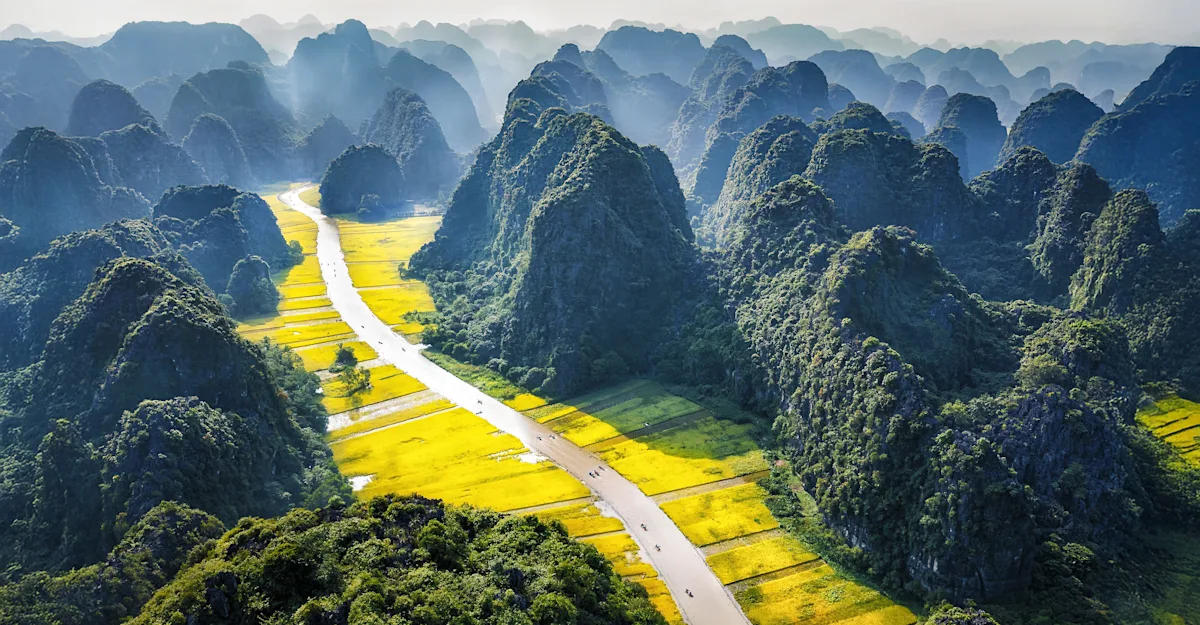
Continue to Ninh Binh, an entrancing tower-karst landscape where sheer limestone mountains rise from rice paddies and emerald marshes—sometimes called “inland Ha Long Bay." The region, which was the capital of Vietnam in the 10th and 11th centuries, has been recognized as a dual-status UNESCO World Heritage Site, holding both outstanding cultural and natural value. By late afternoon, arrive at Jiva Hoa Lu Retreat in a tucked-away forested valley, where low-slung villas reflect traditional Vietnamese architecture and gardens are woven into the natural limestone landscape. With views across rice fields and karst cliffs, the retreat offers a serene setting for relaxing before dinner at the fine restaurant on site, set within a 125-year-old church that has been carefully preserved and repurposed.

Day 7: Search for rare langurs in the Van Long marshes
Drift by sampan through Van Long Wetlands, watching for rare Delacour's langurs
Learn Vietnam's alphabet history with church leaders at Hao Nho Parish
Explore Bich Dong Pagoda's cave temples set into the hillside
A peaceful nature experience awaits on an early-morning visit to Van Long Wetland Nature Reserve, one of the last refuges of the critically endangered Delacour’s langur and the only place the species is seen in the wild. Look for this rare monkey from a traditional sampan as we drift quietly through calm channels in one of the last intact lowland marshes in the Red River Delta. As the oars slip silently through the water, the imposing peaks, draped in dense green vegetation, are reflected in the still surface.
Continue to Hao Nho Parish, which traces its roots to 1627 when the French Jesuit missionary Alexandre de Rhodes brought the Catholic faith to Vietnam. Conversing with local church leaders, learn about Rhodes’ role as a major contributor to development of the first Vietnamese alphabet, with previous experience in linguistics as an academic in France. Adopting a Vietnamese name, he learned the language, ultimately publishing a dictionary that used Latin script as well as diacritics, or accents, to denote tones and sounds. At Non Khe village, join a local guide for a walk through the community and a chance to learn about its basket weaving traditions, before lunch hosted in a private home.
Our next stop is Bich Dong Pagoda, originally built in 1428 and rediscovered in the early 18th century by two traveling Buddhist monks after it was lost to the jungle earlier. The pagoda, expanded to become a series of cave temples set into the hillside, is a picturesque symbol of the harmony between ancient Vietnamese architecture and the landscape of mountains, rivers, and water within the Trang An Landscape Complex—recognized by UNESCO as a dual World Heritage Site for both nature and culture. Here, and across Vietnam, landscapes like this where water, stone and cultivated land converge are regarded as naturally sacred, deeply connected to animism and folk religion, where the boundary between the natural and spiritual worlds is blurred.
Day 8: Into the Mai Chau Valley and its hilltribe villages
Walk past bamboo-stilt houses and rice paddies worked with water buffalo
Share a home-hosted lunch at Cam Thu with traditional music and dance
Arrive at Avana Retreat, secluded in the forested hills above the valley
Leave Ninh Binh this morning and drive west through a tranquil landscape of rivers, terraced farmland and tiny villages. Around midday, we arrive in the Mai Chau Valley, ringed by the steep mountains of Hoa Binh. Relative isolation has allowed ethnic hilltribe communities, including White Thai and Hmong, to retain their distinct identities, expressed through locally unique architecture, regional dress, traditional cuisines, and distinctive cultural arts including weaving and batik. In the afternoon, set out on an easy walk through nearby villages, passing bamboo-stilt houses, rice paddies worked with water buffalo, and everyday scenes of life in the valley. We stop for a home-hosted lunch at Cam Thu, accompanied by traditional music and dance shared by members of a local ethnic community. Late in the day, arrive at Avana Retreat, where individual suites are secluded in the forested hills above the Mai Chau Valley amid waterfalls and dense vegetation.

Day 9: White Thai families and a veteran's living memory
Meet White Thai families in Xom Cum and learn their herb traditions
Hear a Vietnam War veteran's personal account of the conflict
Learn traditional Thai crafts practiced by the local community
Begin the day with a gentle walk through the Mai Chau countryside, following paths through rice fields and bamboo-shrouded hills. A short scenic transfer provides access to more remote areas, including the hill village of Xom Cum, where we meet local White Thai families and learn about their close-knit community, subsistence agricultural practices, and medicinal herb traditions. One of the oldest Indigenous ethnic groups in Vietnam, the Thais came to this region between the 7th and 13th centuries. They are known for their colorful woven textiles featuring intricate decorative patterns. We also visit with a Vietnamese veteran of the Vietnam War, who offers a personal perspective on the traumatic conflict and its lasting imprint on the region. Return to our hotel for lunch, followed by an opportunity to learn about traditional Thai crafts practiced by the local community. The remainder of the afternoon is at leisure before we gather again for dinner in our secluded sanctuary at Avana Retreat.
Day 10: Hanoi's Old Quarter and its living artisan trades
Walk Hanoi's Old Quarter, its 36 lanes named for the trades sold there
Visit Tan My Design, where four generations preserve silk hand embroidery
Gather for a farewell dinner of Vietnam's celebrated cuisine
Drive back to Hanoi this morning to explore Vietnam’s capital, a vital, modern city with a layered history shaped by centuries of Chinese and French influence. Off tree-lined boulevards abuzz with countless scooters, narrow lanes shelter hidden homes and traditional shops where commerce is conducted unchanged over generations. Outdoor markets, flower stalls and street food vendors do a brisk business among sophisticated hotels and trendy cafes. And Hanoi’s sacred heritage is evident in the 600 temples and pagodas found throughout the city.
Join a guided walk this afternoon through the Old Quarter, the cultural and historic heart of Hanoi and its most beguiling neighborhood. Antique brick houses and skinny storefronts line the maze of alleyways, while stalls heaped with fresh fruits and vegetables add a rainbow of color to the jumbled street life collage. Thrumming with energy, the tight grid of twisting lanes reflects the names of the particular product historically sold on each of the 36 streets. The area’s history of artisanship dates back more than a thousand years, when Emperor Ly Thai To moved his capital to Hanoi in 1010. Craftsmen followed the imperial entourage, setting up shop outside the new palace and forming guilds. Still today, silversmiths, potters and mat weavers ply their trades alongside more contemporary vendors hawking a host of practical wares. We make a stop at Tan My Design, a boutique craft shop that showcases a living legacy of Hanoi artistry. Here, four generations of women have preserved the art of silk hand embroidery, reimagining it for contemporary fashion and home goods. This evening, gather for a farewell dinner, a last chance to enjoy Vietnam’s celebrated cuisine.

Day 11: Farewell to Hanoi and homeward flights
Transfer to Hanoi International Airport with your Expedition Leader's help
Say farewell to Vietnam and connect with homeward flights
Enjoy a final breakfast as our Vietnam journey comes to a close. Check out of our hotel and transfer to Hanoi International Airport. Your Expedition Leader assists with departure formalities as you say farewell to Vietnam, carrying with you a deeper understanding of its complex history, living culture and vibrant communities.