Itinerary
Itinerary
Day 1: Arrive in Tokyo for a journey into Japan’s living traditions
Settle into a central hotel overlooking the Imperial Palace gardens
Join your Expedition Leader for a welcome dinner of seasonal Japanese cuisine
Arrive in Tokyo, Japan’s dynamic capital, where centuries-old traditions persist within one of the world’s most contemporary cityscapes. Transfer to The Kitano Hotel, a Relais & Châteaux property overlooking the Imperial Palace gardens—a quiet vantage that offers a sense of calm amid the capital’s constant motion. With the journey behind us, there is time to rest, refresh and begin adjusting to Tokyo’s rhythm from a vantage point that feels both central and removed from the city’s bustle.
This evening, gather with our Expedition Leader for a welcome dinner at a local restaurant overlooking the city. Featuring seasonal ingredients and thoughtful preparation, the meal offers a first introduction to Japanese culinary traditions and the attention to detail that shapes daily life here. Over dinner, we begin to orient ourselves to the journey ahead, setting a relaxed, unhurried tone before exploration begins in earnest the following day.

Day 2: Practice sumi-e painting with a Japanese ink master
Pass through 90 red torii gates to Hie-jinja, a hilltop Shinto shrine
View Japanese ink paintings, ancient bronzes and tea ceremony objects at the Nezu Museum
Learn how brush pressure, ink dilution and speed shape each deliberate stroke
This morning, enjoy an introduction to Tokyo at Hie-jinja Shrine, a hilltop sanctuary in the city center that is one of Tokyo's major sites honoring the practice of Shinto, Japan's indigenous faith focused on worshiping divine spirits found in nature. Passing through a corridor of 90 bright-red torii gates to enter the shrine, we move from the metropolitan hustle into a quieter space. Workers pause here before offices open, caretakers tend the grounds, and serenity prevails above the glass and steel cityscape below. Continue to the Nezu Museum, showcasing masterworks of Japanese and Asian art. National treasures include Japanese ink paintings and ancient Chinese bronzes, plus a special gallery exhibiting an elaborate tea ceremony collection. The museum’s garden is an extension of the collection, with stone paths, water features and plantings that comprise their own aesthetic.
This afternoon, we are welcomed by a sumi-e master who introduces us to this meditative ink-painting tradition rooted in Zen philosophy. With a limited palette and a single brush, each deliberate stroke embodies years of training as the artist seeks to capture the essence of nature using ink and wash. We have a chance to try our own hand at the exacting practice, discovering how the precise art uses controlled brush pressure, ink dilution and speed to create varying shades of black and gray, different textures, and emotional depth. In the evening, enjoy dinner at a discreet restaurant surveying the city. The intimate enterprise highlights seasonal cuisine, introducing us to Japanese culinary culture through its careful preparation. Afterward, return to the hotel for a quiet evening at leisure.
Day 3: Explore Tokyo’s food culture with a renowned sushi chef
Walk Tsukiji Outer Market with fourth-generation sushi chef Yoshi Tezuka, meeting longtime vendors and favorite suppliers
Watch for a goma fire ceremony at Fukagawa Fudodo Temple
Learn the fundamentals of sushi-making in a restaurant kitchen
Early this morning, discover Tsukiji Outer Market, Japan's "Food Town," alongside Yoshinori Tezuka, a fourth-generation sushi chef whose family has worked with vendors here for decades. In this mecca for culinary pros and the public alike, we find a lively mix of specialty shops, restaurants and food stalls. As we explore the narrow lanes with Chef Yoshi, he introduces us to longtime vendors, points out the shops where he sources ingredients and the specialized tools of his trade, and selects fish and other ingredients with guests' preferences in mind. Along the way, he shares how generations of relationships with Tsukiji vendors help him judge seasonality, quality and the best ingredients for his restaurant.
Leaving the bustle of the market behind, step into the serene environs of Fukagawa Fudodo Temple, established in the 18th century where it serves an esoteric branch of Shingon Buddhism. If our timing is right, we may witness a goma fire ceremony—an ancient Buddhist practice marked by monks chanting sutras, drumming, and controlled flame. Office workers, local residents and temple caretakers move in and out, with ceremonies unfolding not as a performance, but integral to daily spiritual life in modern Tokyo.
Later, we learn the fundamentals of sushi-making in a restaurant kitchen. The chef demonstrates the techniques that reveal a culinary craft shaped by precision and discipline. Conclude the afternoon with an immersion in everyday Japanese life in Kagurazaka, a neighborhood defined by narrow lanes and daily routines. Here, small restaurants, artist studios and family-run shops reflect continuity at human scale.
Day 4: Meet a woodcarver in the center of Japan’s woodcarving tradition
Ride the bullet train west across the Japanese Alps to Toyama
Visit an Inami craftsman carrying forward the town’s centuries-old carving techniques
Soak in indoor and outdoor hot springs overlooking the Jinzu River at art-filled River Retreat Garaku
Leave Tokyo’s sprawl behind as make the swift and scenic journey west across the country by bullet train to Toyama. Apartment blocks thin, light brightens and the view widens as we glide across the Japanese Alps toward the Sea of Japan. Along the way, our Expedition Leader offers insight into how geography, climate and natural resources have influenced local life in Japan for centuries. Once we arrive in Toyama, we disembark the train and continue to the picturesque town of Inami, the center of Japan’s woodcarving and woodcraft traditions. After lunch at a local restaurant, we stop to visit with a local craftsman to learn about his work and his deep ties to the enduring practices that have made Inami a hub for artisan woodcarving over time.
Eventually we arrive at River Retreat Garaku, a small luxury resort where nature, tradition and art converge in harmony. The serene property embodies classic ryokan style, with woven tatami floor mats, sliding shoji paper doors and minimalist decor for a peaceful, rejuvenating atmosphere. In this mountainous region of flowing waters and hot springs, our ryokan features an exclusive, art-focused onsen experience overlooking the Jinzu River, with both indoor and outdoor baths, a red rock-lined hot spring, saunas and a jacuzzi. Dinner is a highlight, too, with the hotel’s Michelin-starred restaurant showcasing seasonal ingredients in its French and Japanese menu.

Day 5: Walk with a monk through Tateyama’s sacred foothills
Visit Ashikuraji Temple and Oyama Shrine, rooted in Japan’s mountain-worship tradition
See how monks maintain forest paths, stone steps and water sources
Taste sake brewed with mountain water and locally grown rice
Accompanied by a local monk who has spent years walking and maintaining these grounds, enter the forested foothills of Tateyama, where we find an enduring tradition of spiritual pilgrimage rooted in mountain worship. At Ashikuraji Temple and Oyama Shrine, religious practice is sustained through acts of caretaking alongside formal ritual. Paths are cleared, stone steps repaired, water sources tended. Moving slowly through the forest, we observe how such responsibility is interwoven with ancient beliefs, carried forward season after season.
Drawn from sacred mountains, the region’s pure waters also underpin its local sake production. This afternoon, we’re welcomed inside a local brewery to learn about the sake-making process, learning how mountain water, locally grown rice and careful timing shape each stage of production. A tasting accompanies the presentation, enjoyed at a slow pace that allows us to uncover the intricate layering of flavors in the rice wine samples we sip. Return for dinner and a quiet evening at our ryokan hotel, where we unwind in stillness and simple, attentive hospitality.
Day 6: See how fishing families live and work along Ine Bay
Walk among funaya, traditional boathouses with boat storage below and living quarters above
Ride a sea taxi for a waterside view of the village and its working harbor
Settle into a traditional seaside ryokan with coastal views and onsen hot spring baths
Travel by bullet train and coach to the Sea of Japan and arrive in Ine, a picturesque fishing village in the northern part of Kyoto Prefecture known for its historic funaya—distinctive boathouses built directly over the water. Serving a dual function, boats are stored below with living quarters above, a design that has served the livelihoods of local fishing families on Ine Bay for generations. Household routines are closely tied to harbor rhythms, with boats departing and returning according to tides and weather. About 230 funaya front the bay, preserved not as artifacts but working homes, maintained and adapted as each new generation continues to fish these coastal waters. On a walk through the village, we observe the cadence of daily life, then board a sea taxi for a closer view of the boathouses from the water. Look, too, for abundant birds, including sea hawks. This evening, we arrive at our seaside ryokan, where dinner incorporates local ingredients drawn from land and sea.

Day 7: Savor the seasonal dishes of a Japanese Blue Zone
Learn regional recipes with a Kyotango host in her coastal home kitchen
Meet two craftspeople preserving endangered Japanese traditions through the DENTO project
Walk to Yuhigaura Beach or soak in private open-air hot springs
In the northernmost part of Kyoto Prefecture, Kyotango lies on the Sea of Japan coast, famous for its sandy beaches, spectacular sunsets and spring cherry blossoms. Along the Tango Peninsula, small farming and fishing communities have long relied on local harvests over imported goods. This region is a part of Japan’s famous “Blue Zone,” celebrated for its inhabitants’ healthy, long lives that are closely linked to everyday habits focused on fresh, seasonal food, physical activity, moderation, and strong community relationships. Home gardens, adjacent fields, and clean, coastal waters supply much of what appears on the table—integral elements of a food culture focused on seasonal availability and uncomplicated preparation. A local host welcomes us into her kitchen to share cooking practices rooted in regional ingredients and traditions. Meals are prepared simply, at an unhurried pace that defines everyday life and embodies a way of eating long associated with the area’s exceptional longevity.
Later today, we meet with two innovative craftsmen whose work is supported by DENTO, an organization devoted to sustaining endangered craft traditions. We witness how inherited skills are adapted to contemporary needs, which often means the difference between continued use and gradual disappearance. Late this afternoon, there’s time to walk to Yuhigaura Beach, famous for its long stretch of white sand, just a few minutes from our roykan, or enjoy the private open-air hot springs before dinner, and again after our meal.
Day 8: Explore Kyoto’s cedar forests and tea-growing hills
Walk among carefully cultivated Daisugi cedars prized for straight, knot-free timber
Join a tea master in Wazuka’s fields before taking part in a traditional tea ceremony
Arrive in Kyoto, Japan’s imperial capital for more than 1,000 years
This morning, we enter the forested hills outside Kyoto to explore the timeless craft of working with Kitayama cedar, the official tree of Kyoto prefecture. The use of Kitayama cedar dates back to the end of the Muromachi period when the renowned tea master Sen no Rikyu introduced the tea ceremony in Kyoto. Craftsmen carefully cultivate these tall, ultra-straight, knot-free cedar trees for 30 to 50 years before harvesting them. Widely used in pillars, alcoves and tea rooms, as well as for ornamental landscaping, their use demonstrates centuries-old techniques, including Edauchi pruning and Honjikomi drying. Stroll through the Daisugi cedar forest and scenic landmarks that incorporate these majestic trees, such as the Nakagawa Hachimangu Shrine and traditional wooden warehouses. If time permits, we may get to try polishing cedar logs, an important part of the process that is a calming and meaningful ritual cherished by local artisans.
Continue to the tea-growing region of Wazuka, where verdant plantations blanket the rolling hills in precise, straight rows of Camellia sinensis. Walking through the carefully tended fields with a tea master, gain insight into how weather, terrain and seasonal timing affect each harvest. A traditional tea ceremony follows, distilling centuries of cultivation expertise into a classic Japanese ritual.
Leaving behind a rustic landscape defined by small-scale agriculture, we reach a city celebrated for its imperial court culture and formal traditions as we arrive in Kyoto this evening. Kyoto served as Japan’s imperial capital and cultural heart for over 1,000 years, from 794 until the capital was moved to Tokyo in 1868. Founded by Emperor Kanmu, it was designed on a grid pattern modeled after ancient Chinese capitals. It remained Japan’s center of power and culture, escaping major destruction during World War II to preserve thousands of temples and shrines. Protected as a UNESCO World Heritage Site, Kyoto today remains a premier destination for traditional Japanese heritage. Our peaceful hotel is next to the temple gardens in Kyoto's Okazaki quarter, with hidden paths through lush foliage offering a quiet space for contemplation.

Day 9: Move from Zen stillness to the thunder of taiko drums
Practice guided Zen meditation with a Buddhist monk
Learn to play taiko drums, long used in Shinto and Buddhist ritual
Visit a Kyoto textile artisan whose work reflects generations of refined technique
Our day begins at a temple where a Zen Buddhist monk welcomes us for an encounter with monastic life. During a guided meditation, time slows. Breath, posture and stillness take precedence, offering a glimpse into contemplative practice sustained through close attention and disciplined routine.
A vivid contrast is in store this afternoon as we take part in a taiko drumming experience, a 2,000 year-old art form used historically in Shinto and Buddhist ceremonies to communicate with the gods, and in battlefields to intimidate opponents. Today, taiko drumming is often part of festivals and rituals, featuring huge, thunderous drums that symbolize Japan's cultural, musical and spirital soul. Drumming ensembles present high-energy, choreographed performances that mesmerize audiences with their synchronized power and theatrical energy.
Later, we visit with a textile artisan whose intricate work reflects Kyoto’s longstanding role as a center of refined technique in fabric production. Learn about the materials, tools and process for producing exquisite cloth as we witness how tradition is perpetuated through diligent practice.
Day 10: Learn about historic geisha rituals in a private performance
Spend the morning with a family entrusted with the care of a Shinto shrine
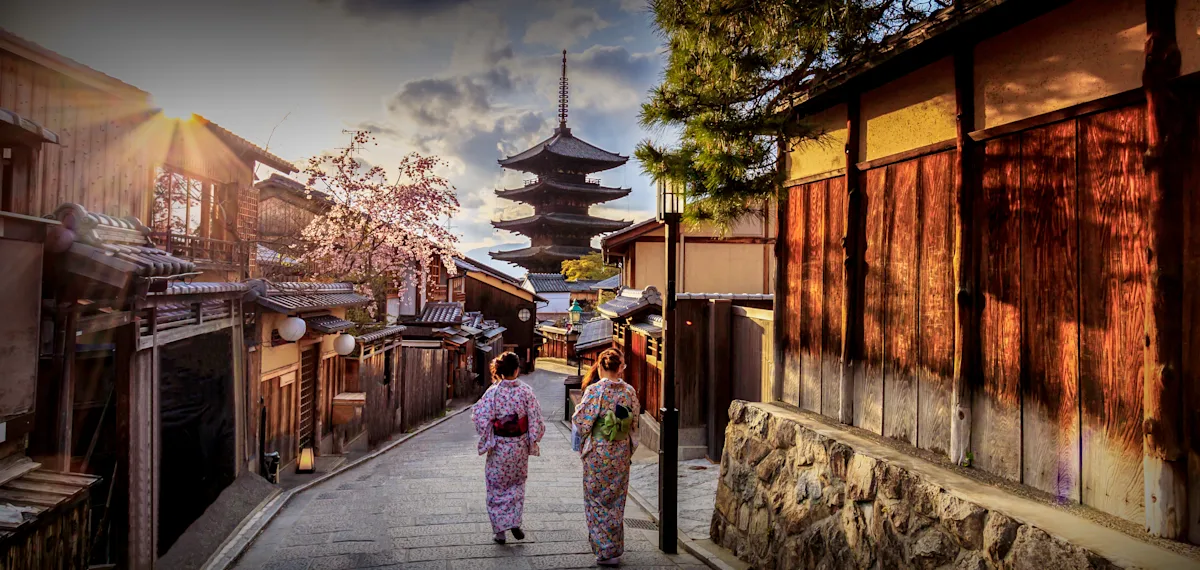
Walk Gion’s lantern-lit lanes of wooden townhouses and traditional tea houses
Gather for a farewell dinner with a geisha trained in music and dance
Head south of Kyoto to spend the morning with a local family entrusted with the care of a Shinto shrine, learning from our hosts how spiritual responsibility is carried forward generationally. This afternoon, our focus is Gion, the cultural heart of Kyoto—a setting little changed over the centuries, with wooden townhouses, traditional tea houses and lantern-lit flagstone lanes. Gion, Kyoto’s most historic sector, is also its premier entertainment district, a status that arose when artistic endeavors flourished for religious pilgrims traveling to Kyoto’s sacred shrines. Today, Gion is known as the center of geisha culture, where these “women of the arts,” highly trained in music and dance, perform for visitors and locals alike. At our farewell dinner this evening, we’re joined by a geisha whose artistic talents reflect years of training, mentorship and discipline.
Day 11: Depart Kyoto after an intimate look at Japanese daily life
Transfer to the airport for homeward flights
Transfer to the airport this morning for departing flights, leaving Japan with a deep appreciation for all that is tended, prepared and shared each day.