Itinerary
Itinerary
Day 1: Dublin, Ireland
Arrive in Dublin, where our Emerald Isle journey begins. Over the next two days, we explore both history and contemporary life in Ireland’s urban capital. This afternoon, the past unfolds as we walk with a local guide through Glasnevin Cemetery, where the graves of political leaders, revolutionaries and generations of Dubliners are testament to nearly two centuries of Irish history. Hear the stories behind the names and monuments, from figures central to the struggle for independence to citizens whose lives are woven into the enduring social fabric of the city. Afterward, we stop for a pint at the nearby Gravediggers Pub, so named for the cemetery workers who once drank here after their shifts. Then it’s time to head to the coastal village of Malahide, just outside the capital, where our Georgian period hotel awaits. Here, we gather with our Expedition Leader and fellow guests for dinner and an introduction to all that lies ahead.

Day 2: Irish Language Lesson / Dublin Walking Tour
Begin the day with an informal introduction to the Irish language, learning words and expressions we’ll hear again when we reach the Gaeltacht—the Gaelic-speaking district— in the west. It’s an early reminder that Ireland’s cultural identity lives not only in its history, but in oral tradition and the traditional language still spoken today. Another portal into Irish culture opens as we step inside a Georgian townhouse whose rooms chart nearly 200 years of Dublin life. Built for an affluent family in the 18th century, the house was later divided into tenements. Our private visit traces the changing city through the generations of people who lived here. The afternoon winds up with a walk led by a local guide who shares the city from personal experience. Rather than a conventional landmarks tour, we meet present-day Dublin through personal observation and places that carry meaning for our host. Return to Malahide for dinner.
Day 3: County Clare / Storytelling Performance / Inis Mor
Leave Dublin this morning to head west across Ireland toward County Clare and the Atlantic coast. In Ennistymon, meet storyteller and performer Aindrias de Staic, who draws on Ireland’s bardic tradition through storytelling, music and the Irish language. He offers us a private performance, connecting old forms of oral expression with stories of life in the west of Ireland today. Continue on the Glen Walk, a serene woodland trail passing waterfalls along the River Inagh, then travel to the coast to catch the ferry across Galway Bay to Inis Mor, largest of the three Aran Islands. As we approach, fields divided by dry stone walls come into view. We land at Kilronan, the main town on Inis Mor, where we spend two nights. Once ashore, we begin to hear conversations in lilting Gaelic, rarely spoken in Ireland anymore other than in Gaeltacht pockets in the West.

Day 4: Traditional Life & Culture in the Aran Islands / Dun Aonghasa / Goat Farm & Cheese Tasting
This morning, choose among relaxing activities that give you a feel for life on this island outpost of 800 residents. Wander the white sand beach on your own or follow one of the nature trails, spend time exploring Kilronan, the picturesque port village that is the main hub of Inis Mor, or join our Expedition Leader for a guided walk.
In the afternoon, join a local guide—a farmer and cheesemaker—who leads us through small settlements and fields enclosed by the island’s characteristic stone walls, learning about rural life in one of Ireland’s most traditional regions. A highlight is the UNESCO World Heritage Site of Dun Aonghasa, a late Bronze Age stone fort perched on the edge of a sheer 300-foot-tall Atlantic cliff. More than 3,000 years old, the Celtic fort’s massive dry stone walls comprise the largest such prehistoric fortification in the Aran Islands. Conclude the afternoon at a working goat farm, where our farmer-guide explains how cheese is made with local ingredients. Taste cheeses flavored with seaweed from the island, and meet the goats that supply the milk.
This evening, enjoy an opportunity to hear traditional Irish music in one of Inis Mor’s classic pubs, accompanied by the sound of the spoken Irish language as we join locals in this convivial setting.
Day 5: Inis Mor / Connemara National Park / Letterfrack / Renvyle Peninsula
Spend a final morning on Inis Mor before our ferry departs for Rossaveel. Take a last stroll through Kilronan, stop for coffee with a view of the harbor, or join our Expedition Leader for a morning outing. Back on the mainland, travel north through County Galway into the glacier-carved Inagh Valley, one of the most scenic spots in Connemara. Flanked by the quartz peaks of the Twelve Bens rising on the west side and the Maumturk Mountains on the east, the valley floor is covered in open bogland and cradles the trout-filled waters of Lough Inagh. Continue into Connemara National Park, a wild nexus of mountains, vast expanses of bog, heath, grasslands and forest.
As we reach the village of Letterfrack at the head of Ballynakill Bay, dominated by the high profile of Diamond Hill, we’re following a portion of the Wild Atlantic Way, a 1,600-mile coastal route that weaves among rugged headlands along Ireland’s west coast. Continuing north, we arrive at the Renvyle Peninsula and our destination, Renvyle House Hotel, surrounded a 150-acre estate with its own private shoreline, lake, woodlands and gardens. There’s time before dinner to walk the peaceful grounds or wander down to the sandy beach.

Day 6: Kylemore Abbey / Oyster Farming / Exploring the Coast / Pub Dinner
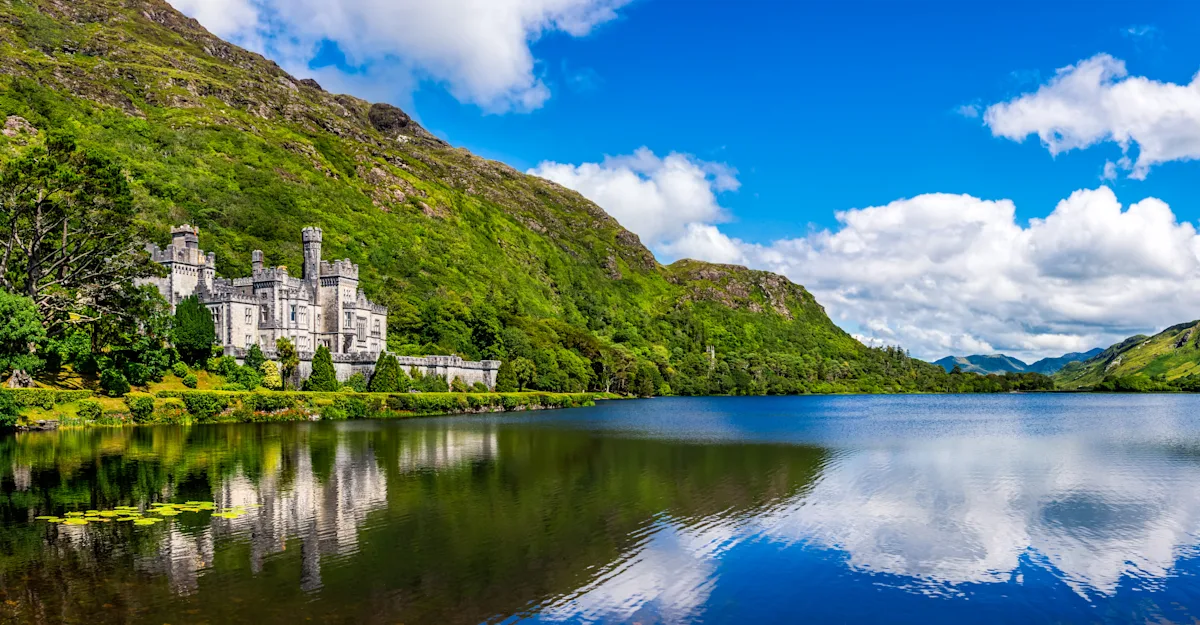
This morning, visit Kylemore Abbey, a 1,000-acre private estate centered on a lakeside castle built in the 1860s as a grand romantic gesture by English politician and industrialist Mitchell Henry to his wife, Margaret, after they fell in love with the area on their Irish honeymoon. Outside, the Victorian Walled Garden features formal flowerbeds and glasshouses. Kylemore Abbey was established on the site in 1920, when Benedictine nuns fleeing Belgium during World War I purchased the estate for a monastery. They also ran a school for girls from 1923-2010.
Next, we head to an oyster farm to see how oysters are cultivated in the cold Atlantic waters of Connemara. We’ll get a close-up look at the small-scale aquaculture enterprise, from growing and tending the oysters to harvesting them, with a tasting included. Later this afternoon, return to Renvyle House, with time to explore the shoreline and tidal pools with our Expedition Leader. Or, choose an optional activity on your own, such as fishing or boating. This evening, we’re off to a local pub for dinner for an opportunity to enjoy storytelling and music in a traditional setting.
Day 7: County Sligo—Food Foraging & Sheepdog Demonstration / County Donegal—Lough Eske Castle
Continuing north, we stop at a family-run regenerative farm for a fascinating foraging experience called “Nourished in Nature.” With our hosts, we explore coastal and upland habitats to collect native plants and seaweeds used for food and medicine. We also have a tour of the farm, learning about sustainable agricultural practices, visiting the market garden and saying hello to the free-range organically raised livestock, including hens, pigs and cattle. Then, at another farm, we watch a working sheepdog demonstration, observing how the dog responds to whistles and commands as it gathers and moves a flock across the fields. The precision is evident behind this human-canine partnership that remains central to sheep farming in western Ireland.
Continue into County Donegal, the northernmost county in the Republic of Ireland, which is known for its strong traditions and enduring heritage, including a Gaeltacht region where the Irish language is spoken. Our destination is Lough Eske Castle, where we spend our last three nights. Set among dense woodland, this luxury lakeside hotel occupies a restored castle on the site of the original castle where the O’Donnells, a powerful 14th-century Donegal clan, were based.

Day 8: Derry, Northern Ireland—History Through Personal Testimony
County Donegal shares a longer border with Northern Ireland, part of the United Kingdom, than it does with the Republic of Ireland, and today we cross over it to reach Derry. In the this city on the River Foyle enclosed by 400-year-old rampart walls, history comes alive among 18th-century architecture, cobbled lanes and museums that tell its difficult stories. At the Museum of Free Derry, we learn about the Bloody Sunday in 1972, the darkest and most pivotal event during the Troubles, and the history that led to it. We then take part in a Theatre of Witness workshop, hearing directly from people whose lives were affected by conflict. Their stories give us a lens on Ireland’s sectarian conflict through individual experience—what happened to families and communities, and how reconciliation became possible. We return to Lough Eske Castle in Donegal this evening.
Day 9: Donegal—Slieve League & the Atlantic Coast
On our last full day in Ireland, we visit one of its most dramatic natural sights: Slieve League, where sheer granite sea cliffs rise nearly 2,000 feet above the Atlantic Ocean—the tallest in Europe, and three times higher than the Cliffs of Moher. These rugged headlands on the Donegal coast are one of the most impressive highlights on the Wild Atlantic Way. A local storyteller-guide accompanies us, sharing tales from myth and legend and maritime history connected with this coast, us as we walk to dramatic viewpoints over the cliffs and Donegal Bay below. Return to Lough Eske Castle this afternoon for a final night, with time to go angling on the lake, take a horse-drawn carriage ride or relax on the tranquil grounds of the estate. Before dinner, we’ll gather in the castle cellar for a whisky tasting, with non-alcoholic options available, to toast our Irish adventures together.
Day 10: Donegal / Dublin—Depart
After an early breakfast, we depart Lough Eske Castle and drive to Dublin Airport to meet homeward flights.