Itinerary
Itinerary
Day 1: Arrive in Buenos Aires
Arrive in Argentina’s capital, with individual airport transfers and host assistance
Meet your Expedition Leader and fellow travelers for a welcome dinner and orientation
Arrive in Buenos Aires, Argentina’s cosmopolitan capital, offering a lively introduction to the country’s diverse cultural traditions. Individual transfers are provided from the airport to our hotel, with time to settle in before meeting our Expedition Leader and fellow travelers this evening. Our journey kicks off with dinner at a local restaurant—our first chance to taste the celebrated fare of Argentina—with an introduction by our guide to the exciting experiences ahead.

Day 2: Discover the Flavors & Rhythms of Buenos Aires
Explore notable neighborhoods, cafes and historic sites on a city tour with lunch
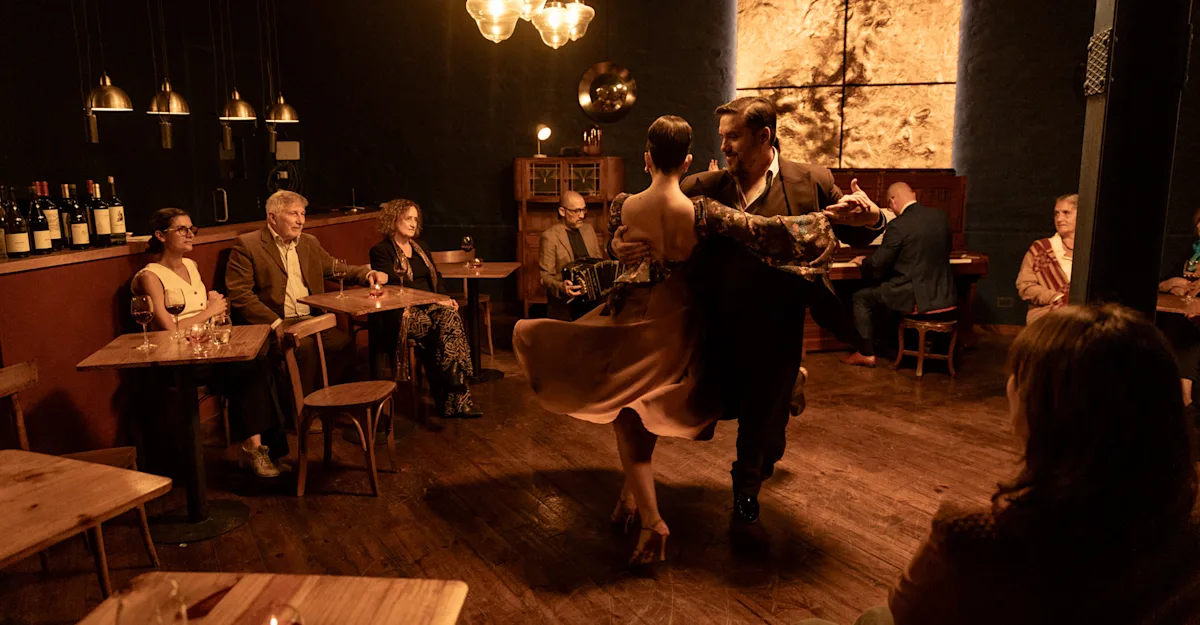
Learn about Argentina’s tango tradition from an expert before an intimate tango performance
Today we explore the rich history and contemporary culture of Buenos Aires through the neighborhoods, food, art and traditions that define the city. Settled in the 16th century by Spanish conquistadores, Buenos Aires grew from a remote colonial port into Argentina's capital and largest metropolis. With grand boulevards, neoclassical architecture, acclaimed opera and avant-garde museums, the city has earned the nickname "the Paris of South America," though most of its European immigrants came from Spain and Italy in the late 19th and early 20th centuries. The city hums with energy, reflecting the vital soul of passionate porteños—what Buenos Aires residents are called—in love with soccer, cafe culture, tango, theater, nightlife, steakhouses and mate, a loose-leaf tea drunk from a gourd with a filtered straw. We'll make our way through several distinctive districts, stopping along the way at cafes and restaurants that capture the city's Belle Epoque heritage and contemporary vibe.
Then, later tonight, we enjoy an intimate encounter with one of Argentina’s most iconic art forms. A private audience with a tango expert provides background for the music, history and social context behind this celebrated dance tradition, before we experience a tango performance at a secret tango society this evening, followed by dinner at a nearby restaurant.
Day 3: Experience Argentina’s Gaucho Heritage
Visit San Antonio de Areco, where gaucho culture is celebrated and workshops are devoted to traditional silversmithing and leatherwork
Gather on an estancia, or ranch, for a traditional Argentine barbecue lunch
Leave the urban hustle behind and travel into the countryside to San Antonio de Areco, where we spend the day immersed in the culture of the gauchos, Argentina's celebrated cowboys. Officially recognized as Argentina's National Capital of Tradition, the town is famous for preserving gaucho heritage, colonial architecture and rural life on the pampas, Argentina's sprawling grassy plains. On a walking tour, discover local history and visit artisan workshops where silversmithing and leatherwork continue traditional practices passed down through generations. We then gather on an estancia—a large cattle ranch—for a classic asado lunch, the Argentine barbecue that is as much a social ritual as a meal. Along with the roasted meat, try another Argentine favorite, empanadas. After a full day of rural immersion, return to our hotel in the city for the night.
Day 4: Fly to Jujuy / Winery Lunch / Colorful Purmamarca
Fly to Jujuy and travel through northwest Argentina to Purmamarca
Explore the town on foot and visit a local design project
This morning we fly from Buenos Aires to Jujuy in northwest Argentina, entering a dramatically different region defined by high desert landscapes, vividly colored mountains and Andean culture. Continue to Purmamarca, where lunch and a tasting await at Bodega Kindgard, a multigeneration family-run vineyard and winery known for its high-elevation wines and view of the dramatic Hill of Seven Colors. Kindgard's acclaimed grapes are grown within the Quebrada de Humahuaca, a narrow, arid 100-mile-long river valley that holds UNESCO World Heritage status as an outstanding representation of south Andean valleys and their role as a physical linkage between the high Andes and vast temperate plains in southeast South America. The corridor, in use as a major trade route over the past 10,000 years, was the site of extensive economic, social and cultural interchange. The natural environment in the valley is nearly intact, with hundreds of archaeological and architectural sites that bear witness to its long and rich history. In Purmamarca, we take a walking tour through town and visit a local design project for an introduction to the region’s creative traditions and contemporary community life before arriving at our hotel.

Day 5: Meet Farmers & Cook with Local Ingredients / Pucara de Tilcara
Explore the narrow gorge of Quebrada de Humahuaca, famous for its colorful sandstone landscapes
Learn about farming traditions on visits with a flower grower in Maimara and a vegetable producer in Tilcara
Harvest ingredients for a home-cooking experience and enjoy the lunch we make
With a private local guide and our Expedition Leader, spend the day exploring the landscape and cultural heritage of the Quebrada de Humahuaca, the spectacular narrow gorge renowned for its stacked sandstone in layers of vibrant colors, like rippling horizontal ribbons. Through our local connections, we have a firsthand look at the agricultural traditions of northwest Argentina. In Maimara, meet a local flower grower, then continue to Tilcara to visit with a vegetable farmer, learning about what is grown in this high-altitude environment and the methods to produce it. Then we harvest ingredients to use in a hands-on cooking experience in our host's home, creating our own lunch.
Later, visit the historic Pucara de Tilcara archaeological site, a pre-Incan fortified settlement built on a small hill overlooking the Rio Grande de Jujuy. It was likely occupied as early as the 10th century, though traces of human habitation in the area date back at least 10,000 years. During the 15th century, the expansion of the powerful Inca Empire into this region resulted in significant cross-cultural exchange, though Incan influence ended with the arrival of the Spanish in 1536, who founded the modern town of Tilcara, where we have dinner at a local restaurant this evening.
Day 6: Exploring the Salinas Grandes Salt Flats
Follow a spectacular route to the high-altitude Andean Plateau to reach the vast Salinas Grandes salt flats
Have lunch on the salt flats and learn about traditional salt extraction methods
One of Argentina's most stupendous landscapes is our focus today, as we climb to the Andean Plateau to reach Salinas Grandes, the third-largest salt flat in the world. Our full-day exploration begins with a drive along one of the most breathtaking routes in the country, ascending the winding curves of the Cuesta de Lipan to an altitude of 13,680 feet. Eventually, the dazzling expanse of Salinas Grandes comes into view. The horizon beyond the shimmering white sea of salt appears infinite, and time seems to stand still as we observe the vastness, feeling a profound sense of solitude. Evaporation cycles over millions of years in the Andean altiplano have left behind a bright white salt crust spanning 82 square miles. A closer look reveals intriguing details, including hexagonal patterns and turquoise brine pools.
Set within this extraordinary landscape, Pristine Camps hosts us for an exclusive experience, including lunch. Looking like a scene from a sci-fi movie on a distant planet, white hexagonal structures, connected by a boardwalk, dot the flat white salt plain. We sit down for lunch inside one, where the camp's signature cuisine is crafted with a farm-to-table approach, featuring regional specialties and local wines. Our time in this otherworldly setting also includes a guided visit to private salt pools, discovering the living ancestral craft of salt extraction.
Day 7: Colonial Salta / Museum of High Altitude Archaeology
Explore the historic center of colonial Salta on a guided walking tour and visit the Museum of High Altitude Archaeology
Enjoy a relaxed afternoon at our country house hotel on a classic finca, or rural estate.
Continuing our journey through Argentina's entrancing northwest, we leave Purmamarca for Salta, famed for its well-preserved colonial architecture and strong regional identity. Situated in the Lerma Valley and surrounded by the scenic backdrop of the Andean highlands and the red rock formations of Quebrada de Cafayate, Salta is known locally as La Linda, "the beautiful." The city was founded in 1582 by Spanish conquistador Hernando de Lerma as a strategic stopover along trade and communication routes between Peru and Buenos Aires. Its history spans Indigenous Andean civilizations, Spanish colonial trade, pivotal battles during the Argentine War of Independence, and contemporary regional growth, all of which is on display as we explore it during our visit.
Wander the cobbled streets and lively plazas of Salta's historic city center on a guided walking tour before visiting the Museum of High Altitude Archaeology, or MAAM, with a private guide. Founded in 2004, the museum showcases the regional heritage of the pre-Hispanic world, offering an important window into the Indigenous history and archaeology of the high Andes. Afterward, we head to our country house accommodations on a peaceful finca, or rural estate, where we enjoy a leisurely afternoon and a fine dinner this evening.

Day 8: Fly to Mendoza Wine Country / Finca Adalgisa—Aroma & Tasting Experience
Fly to Mendoza and enjoy lunch in a wine cellar, flight schedules permitting
Enhance your wine-tasting prowess through aroma, in a session led by a wine expert
Relax at our boutique hotel on a working finca, surrounded by century-old malbec vines
Fly this morning to Mendoza, Argentina’s premier wine region, in the eastern foothills of the Andes. Depending on flight schedules, we plan to arrive in time for lunch in a wine cellar—our first encounter with the region’s deep connection to winemaking. Producing roughly 70% of the country's wine, Mendoza vintages are created in optimal conditions: a high-altitude desert climate, intense sunlight, big day-to-night temperature swings, and irrigation from Andean snowmelt. Malbec leads the way, alongside cabernet sauvignon, chardonnay, and torrontes varietals.
We travel a short distance to Chacras de Coria on the outskirts of Mendoza where we spend the next three nights on an atmospheric finca, a working agricultural estate surrounded by malbec vines and olive trees more than a century old. This afternoon, participate in a guided sensory tasting experience centered on aroma, led by a renowned wine educator and international wine judge. Training your sense of smell, it will alter the way you taste wine forever and will also provide a template for future tastings of other aromatic beverages, including whiskey, gin, tea and coffee. Afterward, there's a bit of time to relax before dinner: wander the garden paths, take a swim in the pool, borrow a book from the library, or enjoy the plant-filled solarium. Then gather together to enjoy a meal of classic Argentine barbecue.

Day 9: Learn About Sustainable Winemaking in Mendoza
Visit organic and biodynamic vineyards to learn about sustainable grape growing and winemaking
Enjoy wine tastings on two different estates, plus a multi-course lunch at a vineyard
Today we follow the famed Uco Valley Wine Route through the vineyards of Mendoza, backdropped by the High Andes, meeting people connected to the region's wine culture and tasting wines in the landscapes where they originate. Learn about the winemaking process as we visit both organic and biodynamic vineyards—biodynamic production treats a vineyard as a single, self-sustaining ecosystem, building on organic methods by avoiding synthetic pesticides and fertilizers while adding specific compost preparations and using lunar/astrological calendars to achieve low-intervention winemaking.
We begin at Domaine Bousquet, Argentina's leading organic winery. Our visit opens with a private guided tour of the organic garden and estate vineyards to learn about the sustainable and regenerative practices used in grape cultivation. Then move to the tasting room to discover details of the barrel-aging process. Our experience includes five featured pours paired with a curated artisan cheese board. Continue to SuperUco, an artisan biodynamic winery founded by the renowned Michelini brothers. Tour the circular vineyard, garden and cellar to observe how nature, family traditions and minimal-intervention winemaking practice intertwine. We'll taste three distinct terroir-driven wines, followed by a hearty lunch at the on-site restaurant, Cosa Nostra, where Italian heritage meets fresh local ingredients. We return to Finca Adalgisa for a relaxing evening and a light wine and tapas dinner at the estate.
Day 10: Mendoza’s Olive Oil Traditions / Empanada Cooking Class
Learn about Mendoza's thriving olive oil industry during visits to two local producers
Prepare homemade empanadas to enjoy at our farewell dinner at the finca
Wine may be Mendoza’s most famous product, but the region also has a longstanding tradition of olive cultivation, which we delve into on a trip to Maipu today, outside the city. On a private guided tour of Corazon de Lunlunta, a boutique producer of olive oil, balsamic vinegar and wines, learn about olive oil production and enjoy a tasting flight of three premium extra-virgin olive oils and two artisan balsamic vinegars, served with a charcuterie board of cured meats, fine cheeses and fresh sourdough bread. Continue to Olivícola Laur, one of the world’s leading olive oil producers. Here, we'll sample extra-virgin olive oils, balsamic vinegars and a signature plate of Laur gourmet products, accompanied by a glass of estate wine. Our savory morning concludes at a boutique project by renowned winemaker and entrepreneur Karim Mussi. Tour the historic 1904 property, then indulge in an exquisite lunch at the bodega, served inside the original mud-brick house-turned-tasting room.
Return to Finca Adalgisa for a deliberately unhurried afternoon, then gather for a private culinary experience focused on the art of the traditional Argentine empanada. Guided by Cristina Brino—a pioneer of Mendocinian cooking classes—this evening combines hands-on dough and filling preparation, traditional clay oven cooking and warm local hospitality. We'll enjoy the freshly baked empanadas we've prepared alongside an artisanal charcuterie board, crisp garden salads and select boutique wines, ending the night with a classic regional dessert. It's a convivial final time together as we celebrate the flavors, experiences and people that have shaped our journey through Argentina.
Day 11: Mendoza / Depart
Transfer individually to Mendoza Airport
Continue home, return to Buenos Aires or begin a trip extension
Our cultural journey through Argentina concludes today. Individual transfers are provided to Mendoza Airport for departing flights, whether you're returning to Buenos Aires, continuing home, or beginning additional travels in Argentina or elsewhere in South America.