

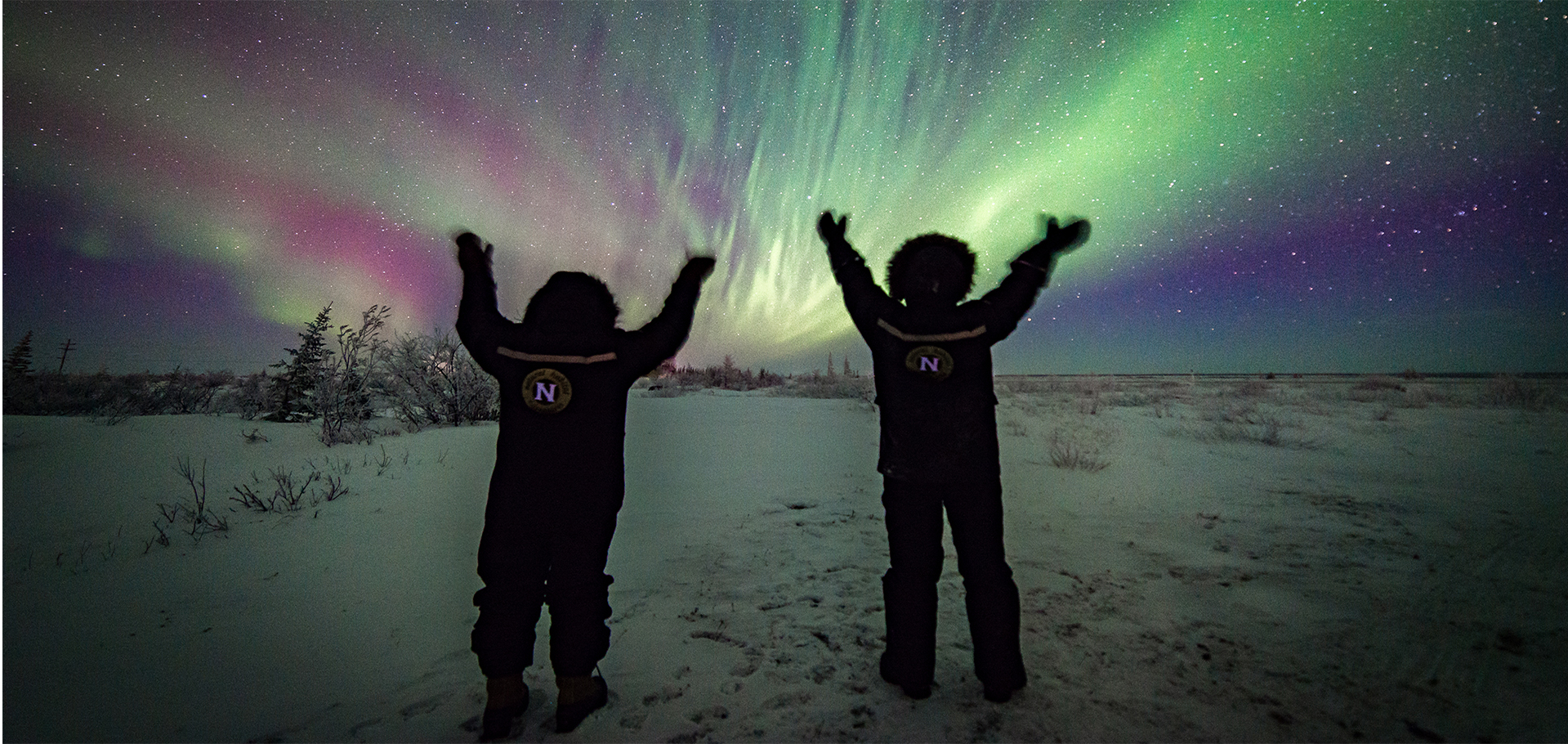
You might be surprised by the variety of optical phenomena we have the privilege of viewing on our beautiful planet. Count yourself lucky if you’ve been an audience to some of these performances by Mother Nature, including the northern lights, sun dogs, fire rainbows, light pillars and the rare Brocken specter. Keep your eyes on the skies to check these five off your list!
1. Northern Lights
Among the most well-known sky phenomena are the northern lights—gorgeous displays of green to pink hues that you can see in the night sky in the far north during certain times of the year. Several destinations offer clear viewing opportunities, including Alaska, Canada and Iceland. Nat Hab’s Northern Lights & Arctic Exploration itinerary is the ultimate way to experience this natural beauty. (More on that below!)
2. Sun Dogs
Sun dogs, also known as mock suns/parhelia, are halo effects. They display as bright spots on one or both sides of the sun. These patches of light form when light refracts through ice crystals. While you can see them anywhere in the world, sometimes multiple times a week, your chances are better in cooler climes and when cirrus clouds are prevalent.

3. Fire Rainbows
Another halo effect you might observe when cirrus clouds are around is circumhorizontal arcs, also called fire rainbows. Light passing through high-altitude clouds creates a colorful streak parallel to the horizon, sometimes appearing like a colorful fire along the surface. Because of the conditions required to create this effect, you can’t see these arcs north of 55° north latitude or south of 55° south latitude.

4. Light Pillars
A rather rare sight, light pillars appear as vertical beams shooting upward into the sky from the ground. Conditions must be just right to see this phenomenon—cold weather and flat crystals forming close to the ground that reflect light. People have seen light pillars in countries with extremely cold temperatures, such as Finland and Russia.

5. Brocken Specter
Another rare sky phenomenon is the Brocken specter. This refers to the magnified shadow of an onlooker standing at a higher altitude with the sun shining from behind them. Because of the misty or foggy conditions at such a height, light projected through the mist gives the impression of an enormous, shadowy figure ringed with a multicolored halo ahead of you.

Many more such atmospheric phenomena have been observed and recorded over time. If you see any of these during your travels or near where you reside, consider yourself among the lucky few to share the thrill of viewing such a magnificent sight.
Where Can You See the Northern Lights?
Also called the aurora borealis, this natural phenomenon is easily observed at high altitudes in northern regions. Popular northern lights viewing destinations include places closer to the poles, such as Canada, Alaska, Greenland, Norway, Finland, Iceland and Antarctica. In some areas, you can view the northern lights most nights of the year. They sometimes even appear during the day, though they’re easier to see with the naked eye in the dark.
So, what exactly causes the northern lights? When charged particles such as electrons and protons interact with gases in the upper atmosphere, the resulting billions of flashes produce a sequence of lights that look like they dance across the sky. Sometimes these forms appear in waves and clouds with uncertain shapes moving around aimlessly in the air. Other times, they look like solid masses of light suspended from above, alternating between darker and lighter shades of different colors. Those colors depend on how much oxygen or nitrogen there is in the atmosphere.

© Eddy Savage
Photography enthusiasts and travelers, past and present, continue to be mesmerized by the radiant light show every time it occurs—and rightly so. For those who do not live in places where the aurora borealis is easily seen, traveling to such a region is usually a once-in-a-lifetime experience to cherish.
Does climate change affect these phenomena?
Thankfully, there appears to be no research proving any direct threat to the northern lights or other optical phenomena from climate change or global warming. However, some people worry about how climate change could affect the destinations where these phenomena are usually seen.

© Eddy Savage
Global warming has raised temperatures, causing permafrost to melt, which releases more methane into the environment and further increases global warming. This cycle can destroy infrastructure in some destinations, which, over time, could hinder viewing sky phenomena.
Another concern is that light pollution in densely populated areas or frequently visited destinations may make viewing these phenomena more difficult over time. Cloud formations could obstruct views, or changes in weather patterns not typically observed during a certain season in a region could shift when certain phenomena occur.
Every action to reduce our contributions to global warming and climate change helps ensure we can continue viewing magnificent atmospheric phenomena—for ourselves and future generations. And this includes traveling responsibly and offsetting carbon emissions from transportation!
Nat Hab’s northern lights adventure is one of the best ways to view the northern lights and enjoy the experience in an eco-friendly manner. There’s nothing more beautiful than chancing upon unexpected visuals in the sky as you travel to new and old destinations.

© Eddy Savage