

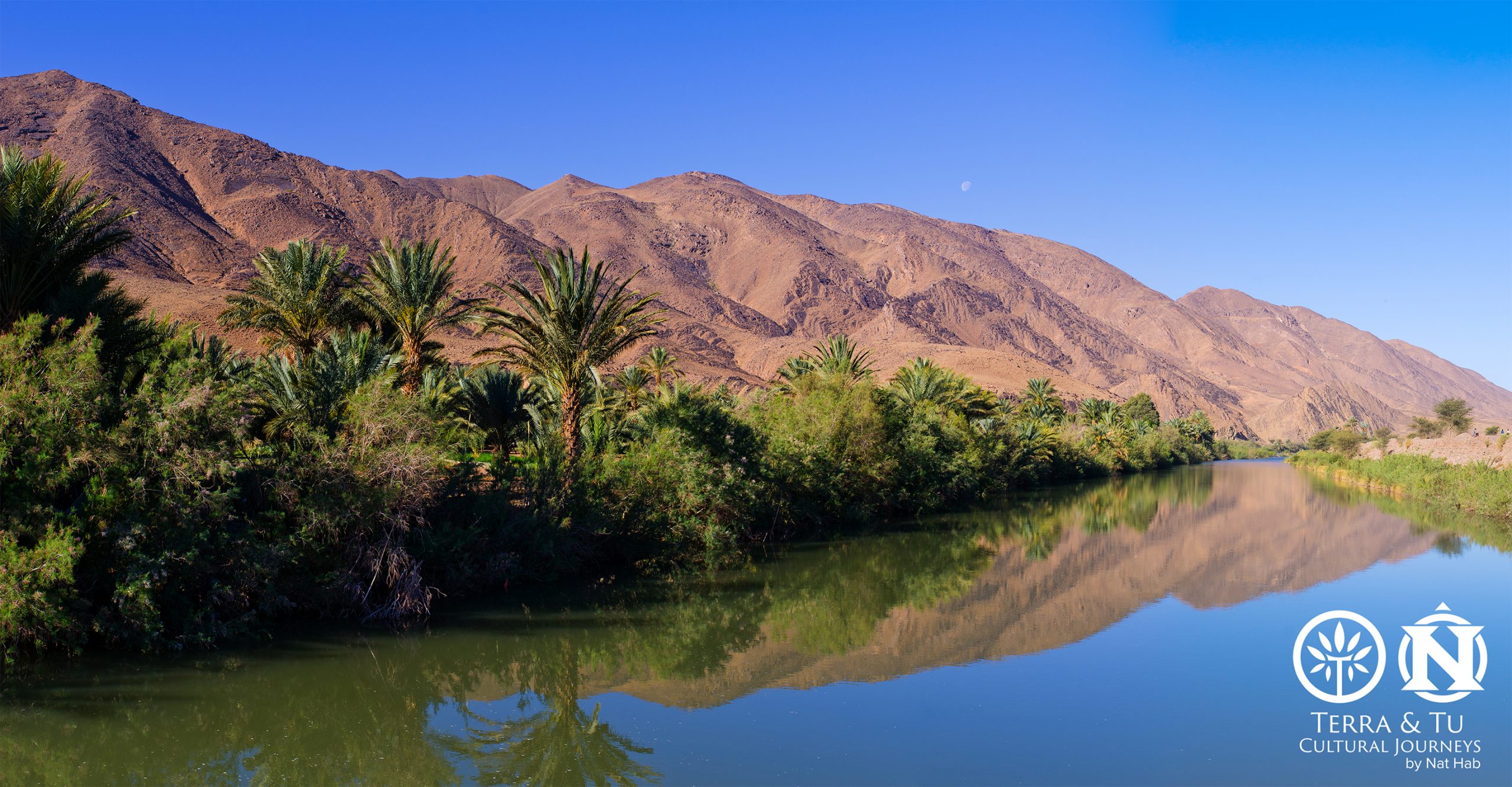
In southern Morocco, the most important architecture is one you feel more often than see.
You feel it as the air cools under a date-palm canopy. You feel it in the hush of a shaded courtyard. This close to the Sahara, you feel it in green spaces that depend on design—water captured, carried and shared through systems that have shaped daily life for centuries—and that we sometimes cannot see.
On Nat Hab’s Cultural Journey: The Heart of Morocco, the nature–culture connection comes into focus around an often hidden infrastructure that carries water from the High Atlas mountains to fields and valley floors.
In the Draa Valley and the palm oases near Skoura, water management has long guided where people live, what they grow, how they cook and what kinds of craft traditions can endure.
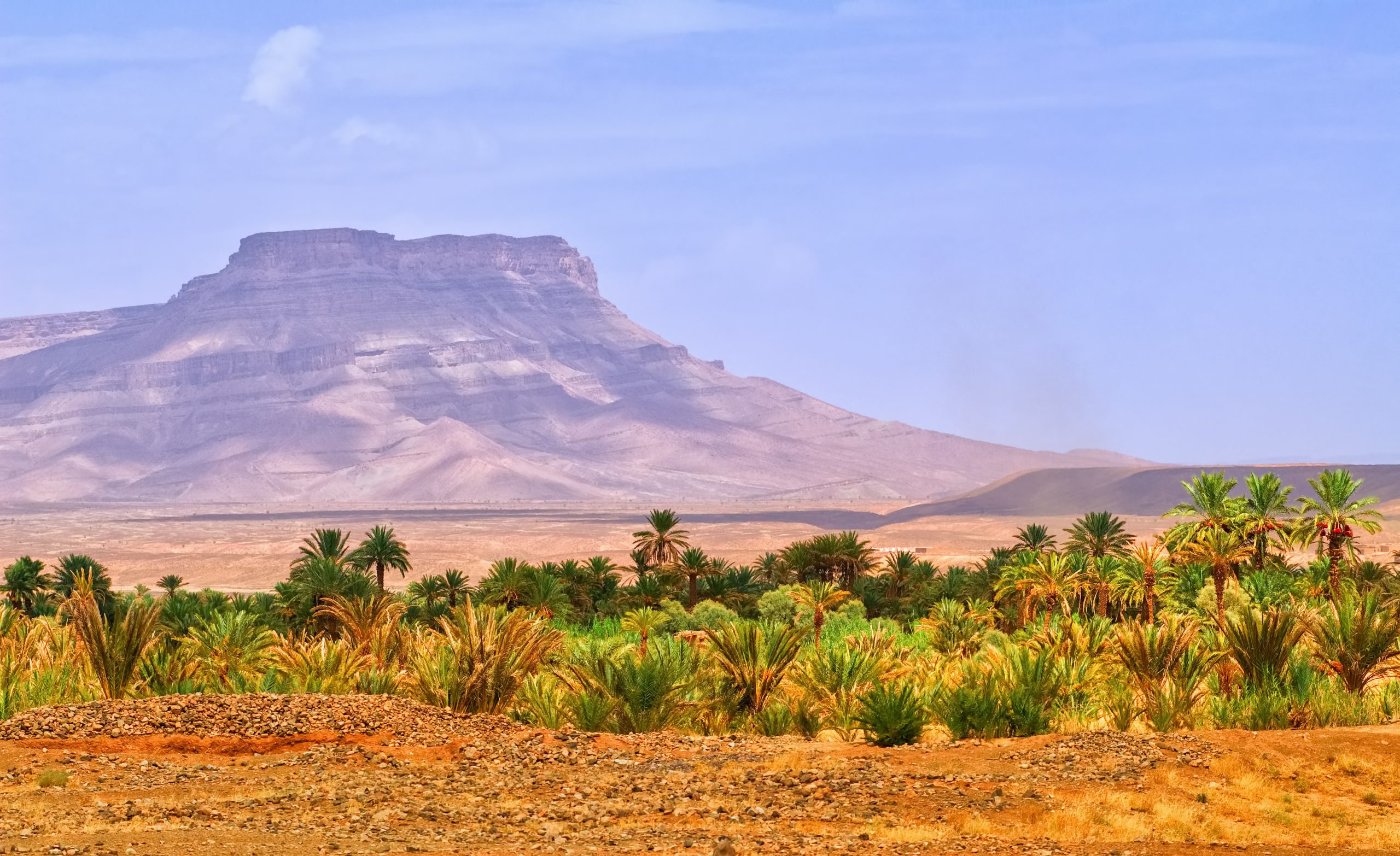
Draa Valley, Morocco.
How do oases stay green at the edge of the Sahara?
Southern Morocco’s oases are not decorative patches of green; they are working agro-ecosystems built to make aridity livable—especially in the Draa-Tafilalet region, which the Food and Agriculture Organization of the United Nations (FAO) describes as renowned for its oases, covering nearly 90% of the territory. It’s surprisingly green.
Date palms create microclimates that supports other crops beneath it. In practice, that oasis logic often looks like:
—Date palms high above, shaping shade, humidity and wind protection
—Fruit trees in a middle canopy
—Vegetables and herbs below, growing in moderated light where evaporation slows
A walk through Skoura’s palm groves allows guests to experience this system firsthand: temperatures shift in shade. The air carries moisture differently near gardens and canals. The oasis is a designed landscape where agriculture and ecology stretch scarce water farther.
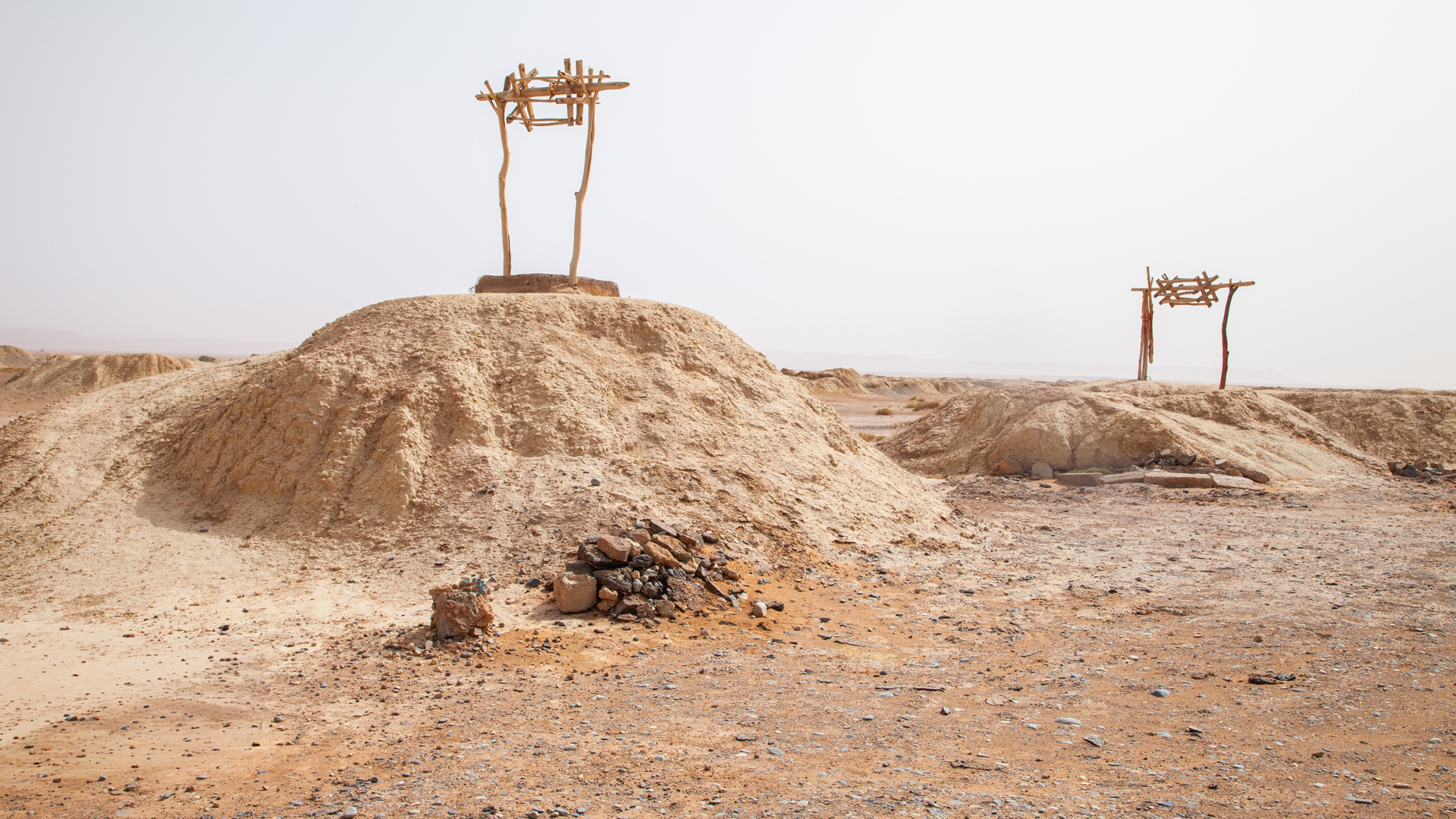
Ancient khettara underground irrigation system.
How are khettara used in water management?
In Moroccan oases, some of the most consequential engineering runs underground in khettaras, hydraulic systems that mobilize water by gravity from the water table to irrigate oasis agriculture. A khettara is a gravity-fed irrigation system: a gently sloped subterranean channel that captures groundwater and delivers it to fields without pumps.
Khettaras rely on community:
—Maintenance: tunnels and shafts cleared, repaired and kept functional
—Shared agreements: how water is allocated across gardens and fields
—Local knowledge: how terrain, groundwater and seasonality affect flow
How does water shape craft in the Drâa Valley and Skoura?
In southern Morocco, craft traditions often carry the landscape inside them, in their materials and the conditions and people that created them. Two pottery moments on this journey fit naturally inside a water-and-oases story:
—Tamegroute’s green-glazed ceramics are fired in kilns fueled by palm fronds.
—In Skoura, a fourth-generation potter uses a kiln built by his grandfather and labor-intensive, traditional methods—hand shaping and sun drying to make functional pots, jars like those that stored and carried water.
In Morocco’s oasis valleys, water is measured, shared and stored as carefully as dates in the palm groves. Craft grows out of that care. Two pottery encounters on this journey are rooted in water:
—In Tamegroute, the famous green-glazed ceramics are fired in kilns fueled with palm fronds—a reminder that the date palm isn’t just food and shade, but a working resource in an oasis economy. The result is functional ware shaped by heat, scarcity and daily use, not souvenir design.
—In Skoura, a fourth-generation potter still works with a kiln built by his grandfather, hand-shaping and sun-drying vessels the slow way. The forms aren’t decorative abstractions: they echo the practical containers that once stored and carried water—objects made for a place where reliability matters, and where the rhythm of work follows what the oasis can provide.
Just as irrigation depends on shared rules and timing, so does craft—knowledge passed down, conserved and adjusted to what the landscape allows.
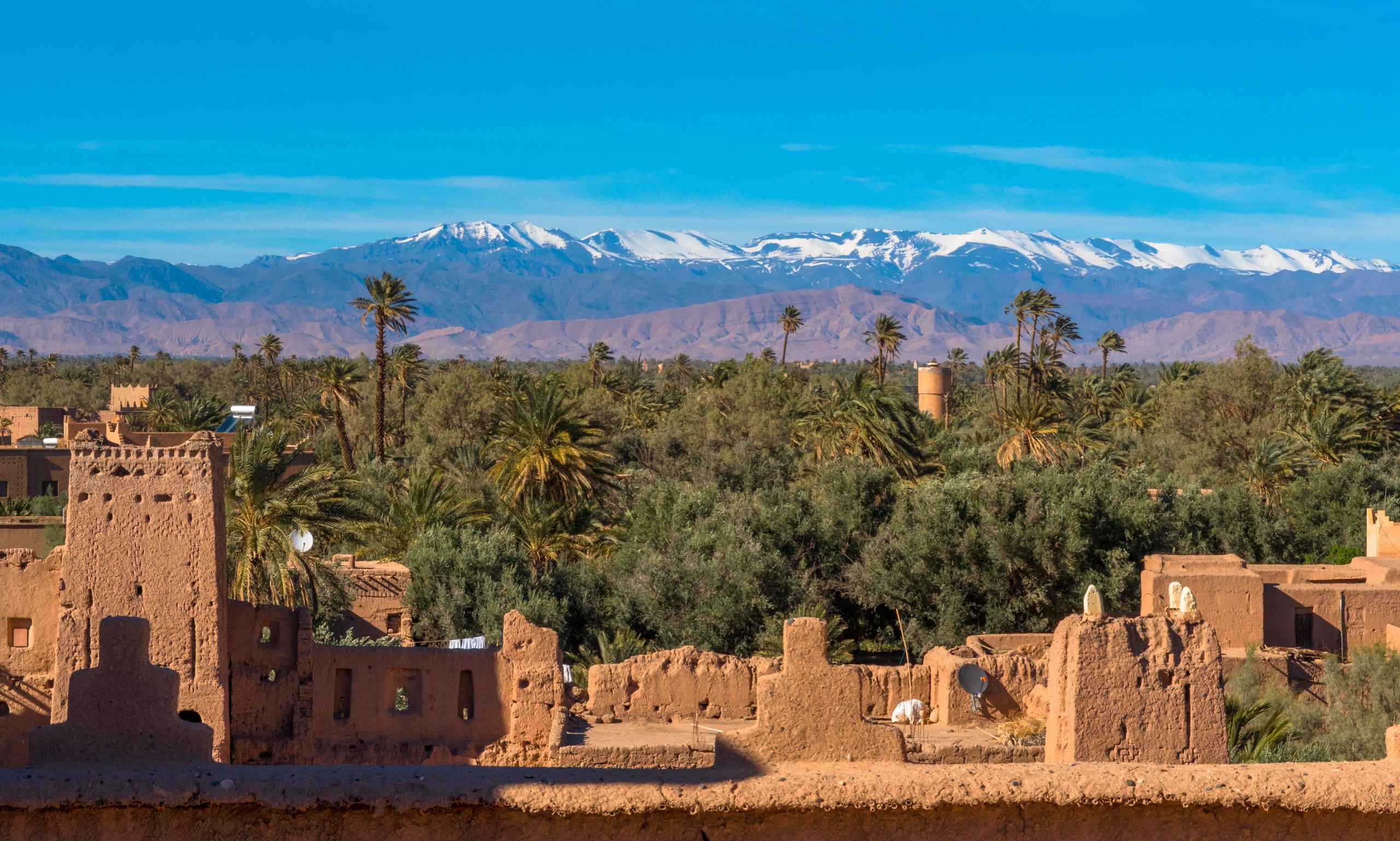
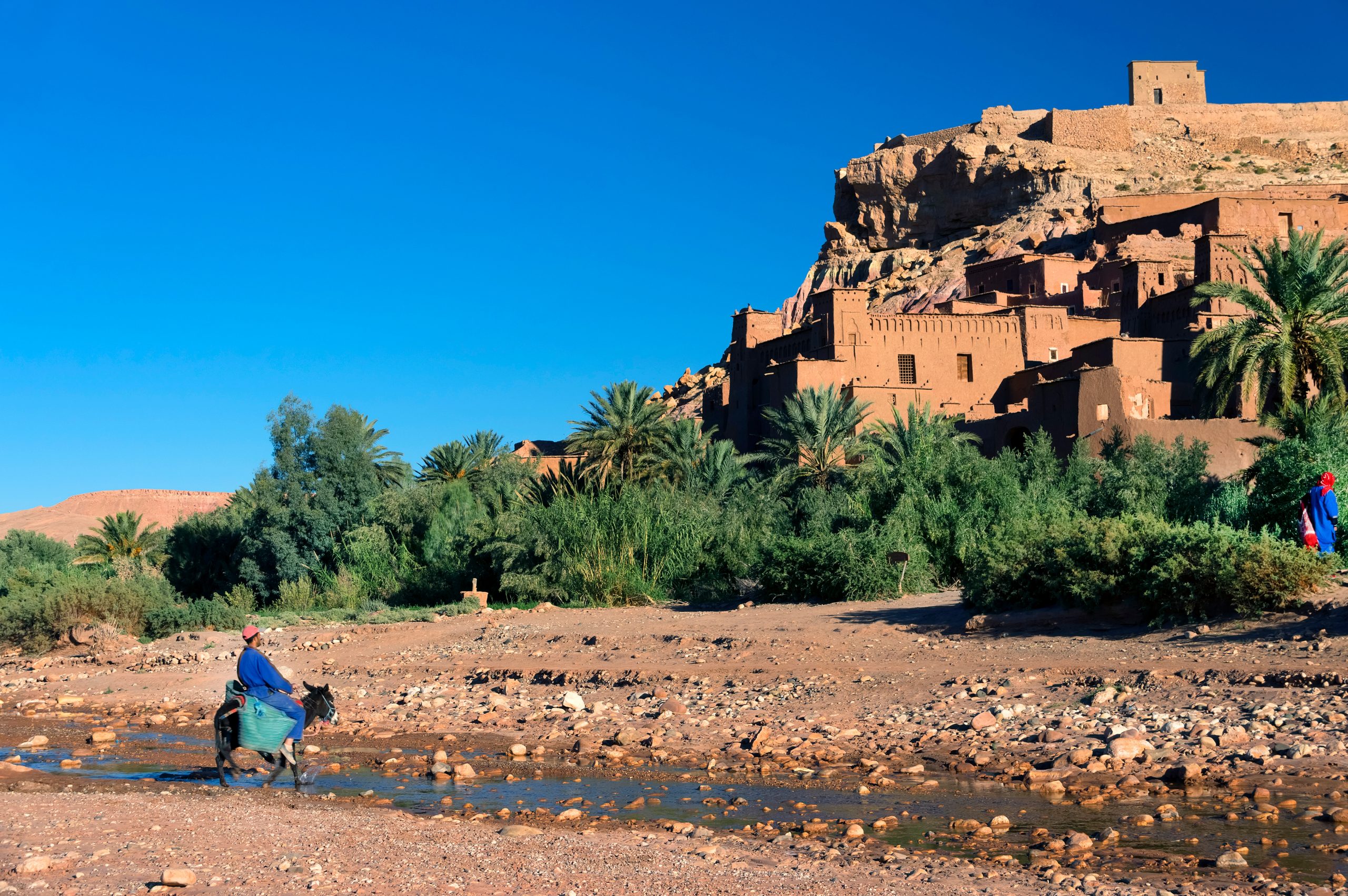
Kasbah Amridil in Skoura, Morocco, with the snowy Atlas Mountains in the distance.
What does food reveal about water, place and hospitality in southern Morocco?
Food on this journey works because it is place-faithful, rooted in what the landscape can reliably provide, and cooking methods that have been practiced for centuries:
Several Heart of Morocco itinerary experiences sharpen that point:
—Cooking in Skoura’s palm grove: herbs, vegetables and slow tagine techniques make sense when you’ve walked through the layered oasis system that supports cultivation under date palms.
—Abidar bread baked in sand on the Salt Road: practical, portable, suited to arid travel and minimal infrastructure—food shaped by desert constraints.
—A home-cooked Amazigh meal in the High Atlas: flatbreads from a clay oven and herb-laced salads, reflecting a different water geography—mountain valleys and cultivated groves.
Hospitality here is not a performance add-on. It’s part of the social infrastructure that makes travel through arid and mountain environments possible—then and now.
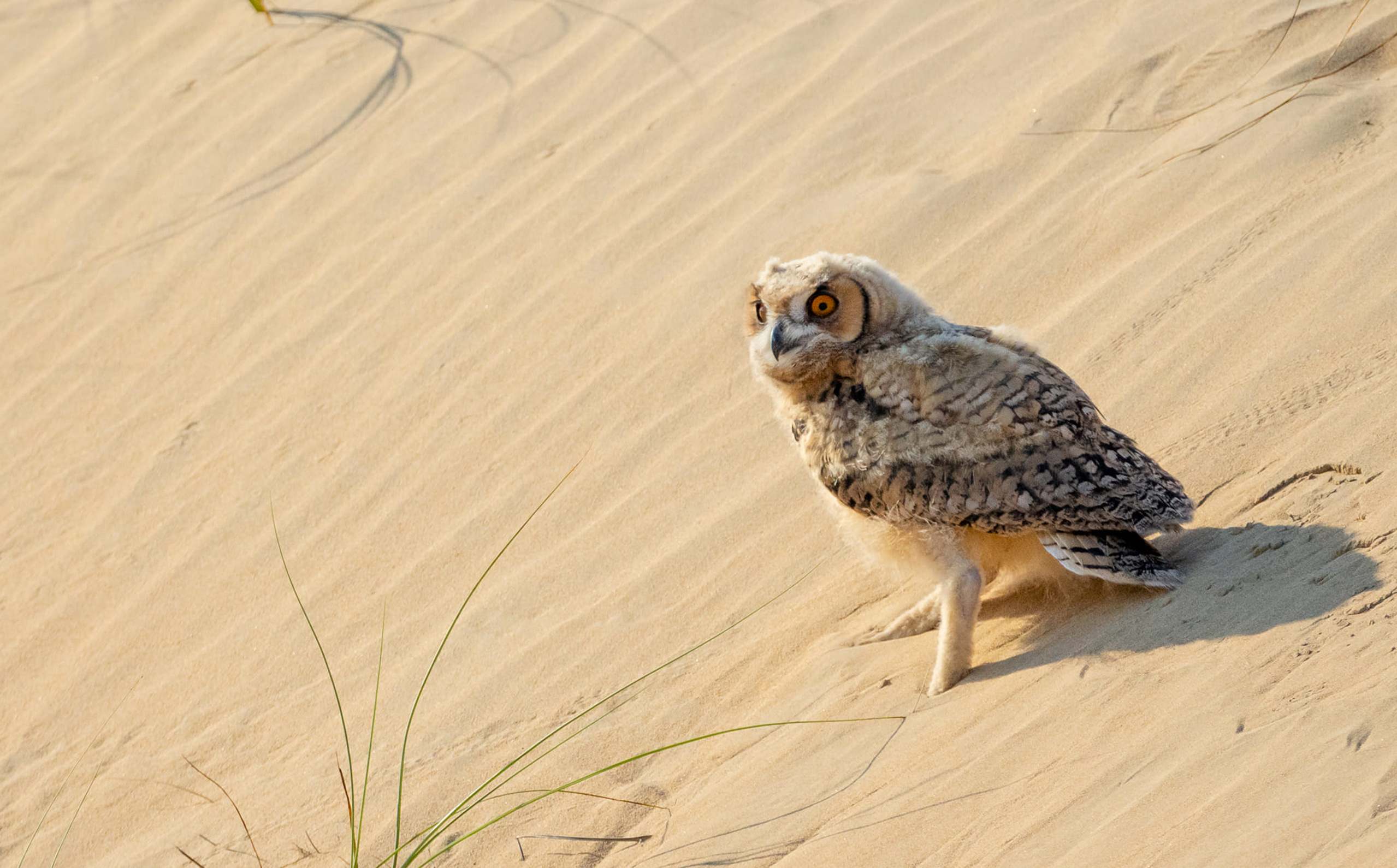
Pharaoh eagle owl, Sahara, Morocco.
How does water support birdlife in Morocco’s oases?
Morocco lies along one of the world’s key migratory corridors. Millions of birds migrate between Europe and Africa each year along the East Atlantic Flyway. While coastal wetlands are better known, inland river corridors and irrigated oases provide critical stopover habitat.
Morocco has recorded nearly 490 avian species, and southern Morocco alone hosts well over 250 of them, including desert specialists and migratory species moving along the Flyway.
In the Draa Valley palm corridor and Skoura, along irrigated groves, gardens and canals, guests may spot:
—Eurasian hoopoe
—European bee-eater
—White stork (seasonal)
—Barn swallow and other swallows around fields and water
—Laughing dove / Eurasian collared dove around villages
—House sparrow / Spanish sparrow near farms and date groves
—Common bulbul in greener corridors
—Warblers in orchard edges and scrub (species varies)
Near Erg Chigaga and Lake Iriki basin, along the edge of the Sahara:
—Desert larks and other larks on open reg and dune margins
—Wheatears in stony and sandy flats (species varies)
—Sandgrouse when conditions and water sources align
—Ravens and other hardy desert generalists
—Raptors overhead (kestrel/eagle-type silhouettes depending on season)
—Waders and waterbirds only when Lake Iriki temporarily holds water after rain (episodic)
In the Ourika Valley and Toubkal area orchards, walnut groves and mountain slopes:
—Raptors riding thermals along ridgelines and valley edges
—Choughs and other corvids in mountain terrain
—Swifts and swallows over villages and fields
—Small passerines in orchards and terraces (species varies)
—Songbirds in riparian vegetation where streams run close to trails (season-dependent)
Temporary wetlands near Lake Iriki can also attract migratory species after rainfall events. In an arid landscape, water creates habitat islands. Those green threads support both agriculture and biodiversity.
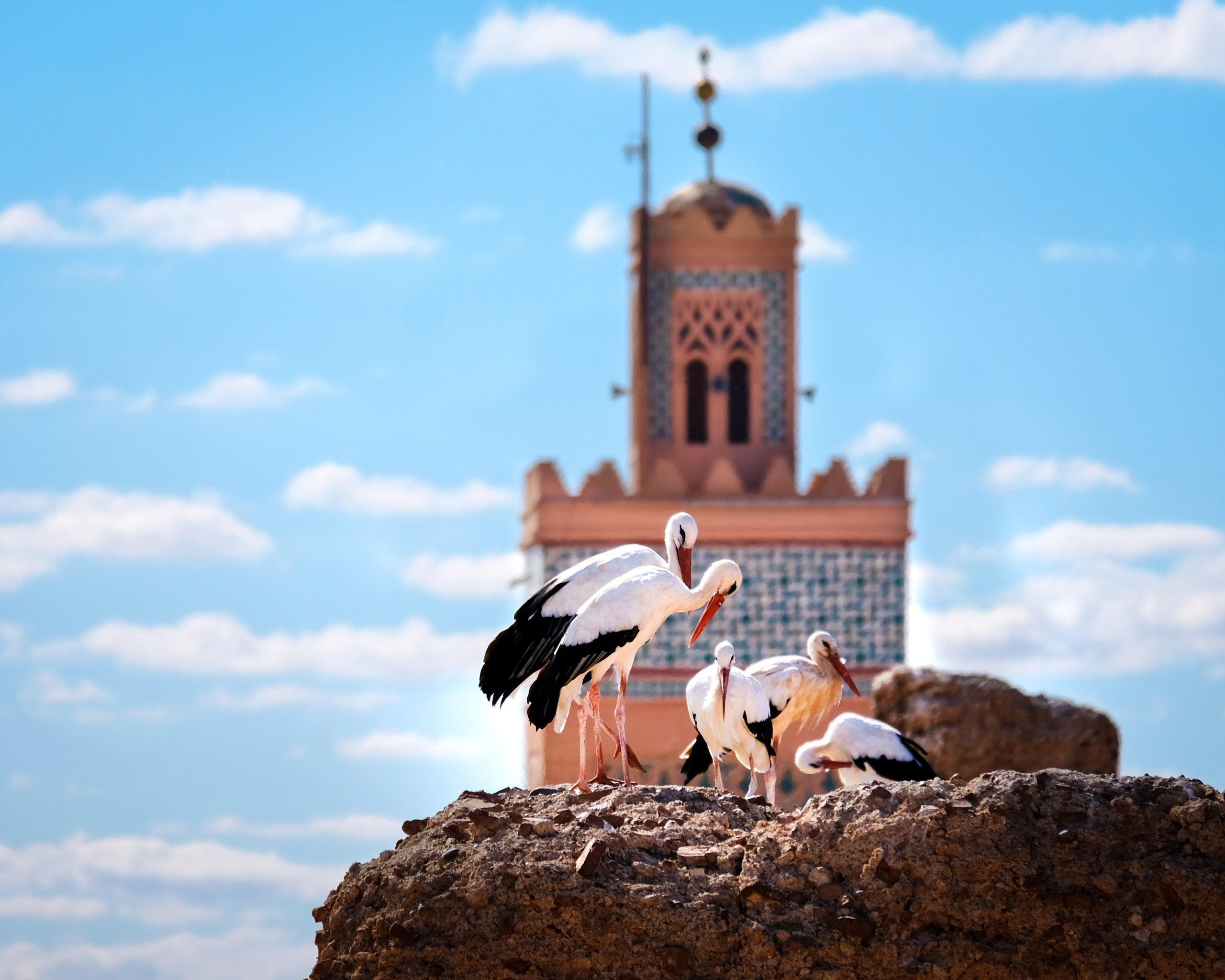
Storks, Marrakech, Morocco.
Nat Hab in Morocco: nature and culture intersect
Nat Hab’s Cultural Journeys are immersive, small-group trips focused on the intersection of nature and local culture. These journeys feature authentic, off-the-beaten-path experiences like visiting artisans, farm-to-table dining and direct, sustainable support for local communities.
Cultural Journeys weave travelers intimately into the heart of local communities. As long as humans have lived on the land, nature and culture have been intertwined—and mutually dependent on each other. Nat Hab’s Cultural Journeys delve deep into this connection, exploring the rich relationship between people and place. Conservation, whether of wild habitats or enduring cultural traditions, depends on knowing we are part of a whole.
In southern Morocco, water makes that relationship visible. The oasis is a living design—palms creating microclimate, gardens tucked into shade, irrigation knowledge maintained in community practice. It’s also part of Morocco’s wider water story: Morocco has 38 Ramsar sites covering 300,538 hectares. Morocco’s oasis water systems illustrate what our journey is about: a place where nature and culture have shaped each other for centuries—and where traveling with expert local access allows guests to experience that connection.
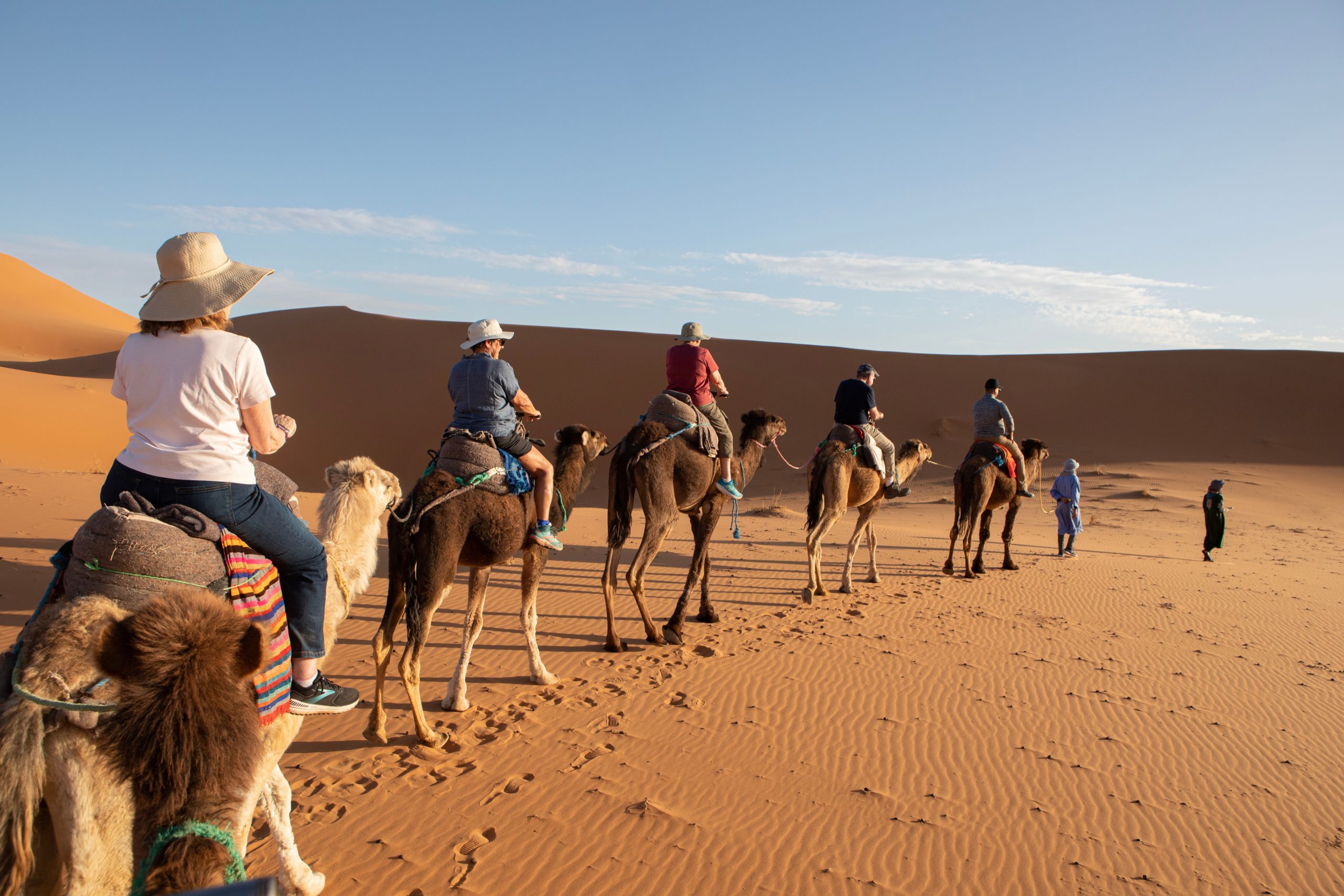
Desert camel tour, photographed by Nat Hab Staff © Charlotte Bassin