

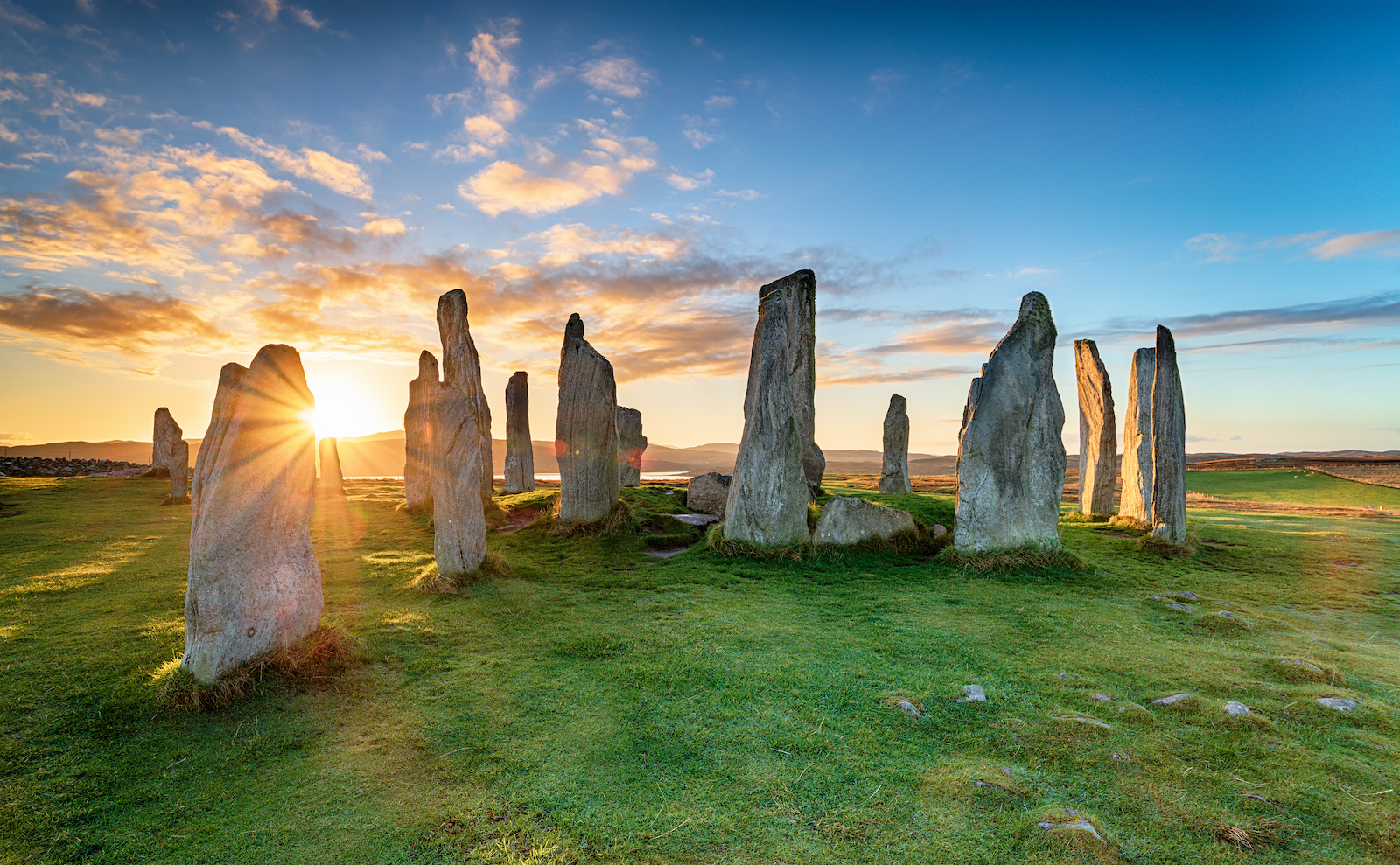
What Are the Callanish Standing Stones on the Isle of Lewis?
The Callanish Standing Stones are Lewisian gneiss ritual stones on the Isle of Lewis in Scotland’s Outer Hebrides that predate Stonehenge by roughly 2,000 years.
The heather-carpeted Scottish Highlands and isolated Western Isles have long occupied a place in folklore and myth—think of how instinctively the Loch Ness monster comes to mind when imagining Scotland. Few places evoke as strong a sense of curiosity as one of the country’s most intriguing archaeological sites: the Callanish Standing Stones. Though older than Stonehenge, the 5,000-year-old stones on the west coast of the Isle of Lewis remain freely accessible. Located just over a 10-minute drive from Dun Carloway, another ancient island site, their easy access does nothing to diminish their sense of mystery.
How Old Are the Callanish Stones and How Were They Built?
Dating to the late Neolithic era, the stones later became a focus of ritual activity during the Bronze Age. Known locally as Callanais or Calanais, the site consists of a ring of 13 standing stones—each about 12 feet tall—arranged in a cruciform pattern around a central monolith rising roughly 14 feet. All are formed from Lewisian gneiss, a complex crystalline rock estimated to be between 1.7 and 3 billion years old, making it the oldest rock found in Western Europe and among the oldest on Earth. The way the stones encircle the central pillar gives the impression of a guarded presence at the heart of the circle.

What Was the Purpose of the Callanish Standing Stones?
Although the stones served as a ceremonial center for at least a millennium, their precise purpose remains unknown. Archaeologists believe the site was abandoned around 1,000 B.C. and later buried beneath peat until its rediscovery in 1857.
One prevailing theory suggests the stones functioned as an astronomical observatory or lunar calendar. Archaeologist Patrick Ashmore, who led excavations in the early 1980s, proposed that every 18.6 years the moon appears to skim unusually low across the southern hills. This rare celestial event may have been observed and predicted by those who built the site, conferring authority through their knowledge of the skies. Other interpretations suggest the stones marked seasonal events such as the winter solstice.
Archaeological Discoveries at Callanish
Excavations conducted between 1980 and 1986—prior to conservation work prompted by heavy foot traffic—revealed unexpected structures beneath the surface. These findings strengthened connections between Callanish and the great stone rings of Orkney, a journey of five or six days by sea in prehistoric times. Pottery fragments uncovered at the site also point to possible long-distance cultural links across ancient Scotland.
Legends and Folklore of the Callanish Stones
As with many prehistoric sites, Callanish is woven into local legend. One story claims the stones are petrified giants punished for refusing to convert to Christianity. Another tale speaks of a magical white cow with red ears that emerged from the sea during a time of famine. The cow instructed a local woman to gather villagers with milk pails at the stones, where milk appeared nightly until a greedy visitor brought two pails instead of one, ending the gift forever.

Visiting the Callanish Standing Stones Today
Visitors can freely walk among the stones and respectfully touch the towering monoliths. Fans of Outlander may recognize the site’s influence—the fictional stone circle Craig Na Dun was inspired by Callanish. Seasonal light dramatically alters the experience: in summer, the stones stand beneath a sun that barely dips below the horizon while winter nights occasionally bring auroral color to the sky above the circle.
Wildlife Encounters in the Outer Hebrides
A visit to Callanish often pairs naturally with wildlife exploration. Along nearby cliffs and coves, millions of seabirds nest during breeding season. Offshore waters host minke whales, common and gray seals and the world’s northernmost population of bottlenose dolphins, drawn by Atlantic currents warmed by the Gulf Stream. Inland habitats support red deer, badger, pine marten and the critically endangered Scottish wildcat—the United Kingdom’s only native feline.

Nat Hab’s Wild Scotland Photo Expedition
A Wild Scotland Photo Expedition through the Scottish Highlands and Western Isles also includes visits to key historic landmarks. Guests explore Eilean Donan Castle, strategically built in the 13th century on an island where three sea lochs converge to guard against Viking raids. Accommodations reflect the region’s layered history as well, such as Coul House, a stone manor built in 1821 on an estate established by the Mackenzie clan in 1560.
Whether drawn by ancient astronomy, deep-rooted folklore or the wildlife-rich landscapes of the Outer Hebrides, the Callanish Standing Stones offer a compelling starting point for exploring Scotland’s past and present. Paired with historic castles, remote coastlines and enduring conservation efforts, they anchor a journey shaped by time, place and enduring mystery.