

Know Before You Go
Yellowstone Nature Trivia
Can you name which keystone species was restored to Yellowstone in 1995? Any idea what it means when a bison wallows, or what the largest geyser in the world is called? Take our Yellowstone nature quiz below to put your knowledge to the test, then share it with your family and friends to see who knows the most about this national treasure! When you're finished, scroll down to reveal the correct answers and explanations.
Answer Explanations:
Which of the following is true about Yellowstone?
Correct Answer: It became the first national park in the world.
Explanation: The world’s first national park was established on March 1, 1872, when President Ulysses S. Grant signed the Yellowstone National Park Protection Act into law. Photo Credit—Sean Beckett
Old Faithful geyser erupts:
Correct Answer: Every 1 to 2 hours
Explanation: Discovered in 1870 on the Washburn Expedition, Old Faithful was named for its frequent and somewhat predictable eruptions, which take place about 20 times a day. The average time between eruptions is 74 minutes, but intervals range between 60 and 110 minutes. Eruptions are 1.5 to 5 minutes in length, and the amount of water expelled ranges between 3,700 and 8,400 gallons. The geyser varies in height from 100 to 180 feet.Photo Credit—Simon Krejcik
How many states does Yellowstone cover?
Correct Answer: 3
Explanation: 96 percent of Yellowstone is in Wyoming, while 3 percent is in Montana with the remaining 1 percent in Idaho.
Photo Credit—Henry Holdsworth
Which of these Yellowstone geysers is the tallest in the world?
Correct Answer: Steamboat
Explanation: Steamboat is the largest geyser in the world, reaching heights of up to 380 feet. Eruptions are rarer, having taken place just nine times between 1992 and 2014. However, the geyser has become much more active recently, erupting 14 times between March and August of 2018.Photo Credit—Henry Holdsworth
Approximately how many geysers does Yellowstone have?
Correct Answer: 500
Explanation: Half of the world’s geysers are found within Yellowstone National Park. The park has about 10,000 thermal features, including hot springs, mudpots, fumaroles, travertine terraces and steam vents, along with 500 geysers.
Which Yellowstone mammal is the largest animal in North America?
Correct Answer: Bison
Explanation: A mature bull can weigh 2,000 pounds, making the bison the largest mammal in North America. Grizzly bears can reach a weight of 1,000 pounds, though bears in Yellowstone tend to weigh between 200 and 700 pounds. Black bears are smaller, weighing between 135 and 315 pounds, and mountain lions weigh 85 to 170 pounds.
Photo Credits—Black Bear: Wendy Erlendson; Grizzly: Jennifer Fogle; Bison & Mountain lions: Henry Holdsworth
Which ungulate (hoofed mammal) is the most abundant large mammal found in Yellowstone?
Correct Answer: Elk
Explanation: Elk are the most abundant large mammals in Yellowstone. Summer herds have reached upwards of 20,000. Elk compromise 90 percent of wolf kills and are an important food source for mountain lions, bears and scavenging coyotes.
Photo Credits—Mule deer: Justin Gibson; Elk: Eva Powers; Bighorn sheep: Sean Beckett
What is another name for a bison calf?
Correct Answer: Red Dog
Explanation: Bison calves tend to be born between late March and May and have orange-red hair. Hence, the term “red dog” became used to describe the babies.Photo Credit—Cythina Guy
What does it mean when a bison is wallowing?
Correct Answer: It’s rolling in the mud
Explanation: Wallowing references when bison roll in the mud to rid themselves of excess hair and insects.Photo Credit—Henry Holdsworth
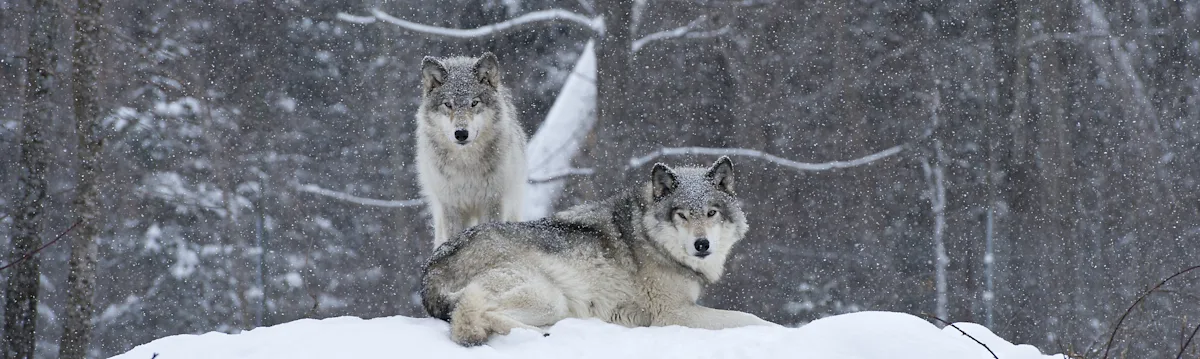
Which apex predator was restored to Yellowstone National Park in 1995?
Correct Answer: Gray Wolf
Explanation: Yellowstone’s last wolf pack was killed in 1926. The loss of this keystone species significantly affected the Greater Yellowstone Ecosystem. With the wolves’ removal and nothing to control their populations, elk numbers skyrocketed. Elk ate aspens and willows, which had severe repercussions on the many species that relied upon the trees, such as beavers. The elk browsed on shrubs along the banks of streams, and, unshaded, the streams rose in temperature and left cold-water fish species to suffer. In 1995, wolves were restored to the park, and this change for the better became quickly apparent. The carcasses of wolf kills provided food for other animals such as foxes, bears and bald eagles. Elk populations dropped back to a sustainable number, and willows and aspens are now thriving.
Photo Credit—Red fox: Wilma McKenzie; Coyote: Henry Holdsworth; Bobcat: Sean Beckett
Which animal is not found in Yellowstone?
Correct Answer: Caribou
Explanation: Caribou are found in Alaska and are functionally extinct in the lower 48 states.Photo Credits—Pine marten: Henry Holdsworth; Caribou: Lindsay Ohlert; Moose: Sean Beckett
Which of the following is not a threat to Yellowstone’s forests?
Correct Answer: An overpopulation of wolves
Explanation: A continual rise in temperature poses the risks of affecting the animals and plants of this incredible ecosystem. Forests cover 80 percent of the park. As the climate warms, pest insects and invasive beetles threaten Yellowstone’s trees, which provide homes for jays, pine martens and other animals. Droughts and higher temperatures correspond with an increase in fire frequency and season length.Photo Credit—Henry Holdsworth
World Wildlife Fund is helping conserve wildlife in the Greater Yellowstone Ecosystem by:
Correct Answer: All of the above
Explanation: World Wildlife Fund is restoring grasslands for bison herds, recovering the population of black-footed ferrets and promoting sustainable ranching in the Northern Great Plains. WWF is partnered with the American Prairie Reserve, a land trust that allows bison to roam freely, and is collaborating with native tribes to bring herds back to sacred lands. The nongovernmental organization (NGO) is also protecting black-footed ferrets at 17 reintroduction sites and conserving habitats for prairie dogs, the ferrets’ primary prey. In addition, WWF is working with ranchers on sustainable land management and grasslands conservation to ensure a positive outcome for cattle and native wildlife.
Photo Credit—Henry Holdsworth