

Know Before You Go
Northern Lights Trivia
Can you name the most common color of the aurora? Any idea of the myths and stories the legendary lights have inspired? Take our northern lights quiz below to put your knowledge to the test, then share it with your family and friends to see who knows the most about the aurora borealis! When you're finished, scroll down to reveal the correct answers and explanations.
Answer Explanations:
How close does the aurora typically come to the earth?
Correct Answer: 50 miles
Explanation: While this dynamic light show may appear close to the viewer, the northern lights are actually many miles away from the ground. The aurora can reach up to 400 miles above the planet!Photo Credit—Brad Josephs
The northern lights have inspired wonder in the generations of people who have laid <br> eyes upon them, and many myths and legends have originated as a result. Which of the following has not been a cultural belief of civilizations found across the world?
Correct Answer: In Norse mythology, the spellbinding lights were thought to be fairies casting enchantments and dancing through the sky.
Explanation: In Norse mythology, the lights were believed to be the glimmers of armor and gleams of shields belonging to the Valkyries—women warriors on horseback. They were tasked with leading fallen warriors on the rainbow bridge Bifröst to the realm of the gods. In Finland, legends tell of Arctic foxes racing across snowy mountain peaks, their bushy tails igniting sparks that cause the blazing aurora borealis. Aptly, the Finnish call the aurora “revontulet,” which translates to “fox fires.” In this sparkling Finnish Lapland, the indigenous Sámi people have a belief that water spray from the spouts of whales creates the shining illuminations. The Makah Tribe of Neah Bay, Washington, tells stories of how the lights are the fires of dwarves in the far north, who catch whales and boiled their blubber. Another hunting story stems from Inuit tribes in Alaska, who see the lights as the spirits of animals they have hunted, such as seals, salmon and deer. In Estonia, the brilliant lights were believed to be horsedrawn sleighs carrying celestial guests to a magnificent wedding feast.
Photo Credit—Brad Josephs
The aurora borealis is named after:
Correct Answer: The Roman goddess of the dawn and the Greek god of the north wind
Explanation: The aurora borealis is named after Aurora, the Roman goddess of the dawn, and Boreas, the Greek god of the north wind and winter. Venus is the Roman goddess of love, and the all-powerful Zeus is the Greek god of the sky. The Roman goddess of the night is Nox, while the radiant Greek goddess of the rainbow is Iris. Luna is the Roman goddess of the moon, and Astraea is the Greek goddess of the stars. Photo Credit—Emily Kautz
The aurora borealis is an awe-inducing arc of color, stretched in a seemingly endless band, hundreds or thousands of miles long. What is this oval-shaped band called?
Correct Answer: The Van Allen Belt
Explanation: The northern lights appear as a radiant, curving ribbon through the sky, known as the Van Allen Belt. The band is named after James Van Allen, who is credited with initiating magnetospheric research in space, and whose satellite instruments confirmed the existence of the belt in 1958. Sally Ride was the first American woman in space, and Neil Armstrong was the well-known first man to walk on the moon. Katherine Johnson is an African-American mathematician whose calculations of orbital mechanics were instrumental to the first moon landing and many spaceflights.Photo Credit—Alexander de Vries
Where would you not be able to see the Aurora Australis?
Correct Answer: Greenland
Explanation: The Aurora Australis is the southern lights, found in the Southern Hemisphere. The aurora can sometimes be seen in regions such as southern Australia, Stewart Island in New Zealand and Ushuaia, Argentina, at the tip of Patagonia. However, unless standing at the South Pole, these lights will appear much fainter than their northern brethren. This is because the auroral zone only covers Antarctica, and to observe truly dazzling light displays, one must be underneath this band. The north auroral belt passes over northern Canada, Alaska, Scandinavia, Russia and Greenland, allowing for greater opportunity to see the lights.Photo Credit—Brad Josephs
What North American location has one of the highest concentrations of these glittering lights on earth?
Correct Answer: Churchill, Manitoba
Explanation: The town of Churchill is smack dab in the auroral zone and thus has one of the densest concentrations of auroral activity in the world. The remoteness of the subarctic affords limited light pollution for outstanding lights viewing. Powerful aurora displays often appear right above the gazer’s heads.
Photo Credits—Churchill: Court Whelan; Baja: Valerie Wimberly; Winter Park: Emily Kautz
What is the most common color of the aurora?
Correct Answer: Green
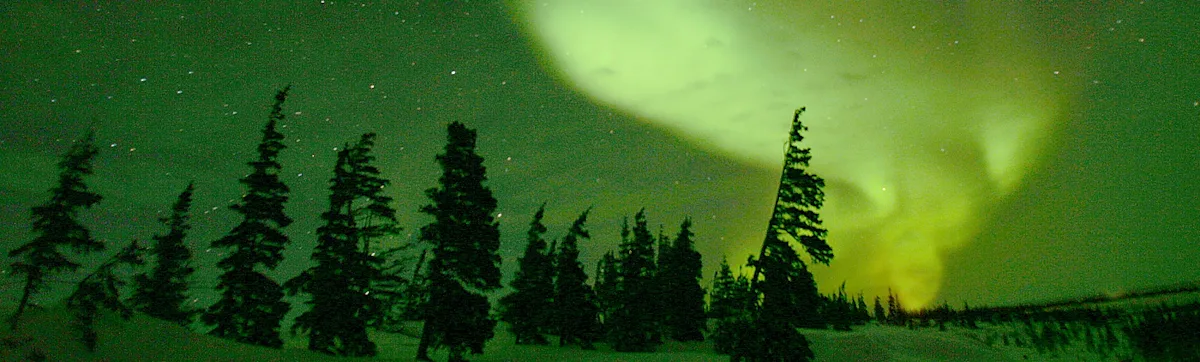
Explanation: The color of the aurora depends upon which particular atoms collide with solar wind particles. The most predominant and frequent color is green, produced by oxygen atoms about 60 miles from the earth’s surface. A rare red color is produced by oxygen atoms higher in the atmosphere, 200 miles away. Ionized nitrogen molecules create blue and purple light, and neutral nitrogen atoms cause the pink rippling borders sometimes seen beneath the green.Photo Credit—Green & Red: Eric Rock
Do the northern lights appear more colorful in person or on a camera?
Correct Answer: On a camera
Explanation: This swirling, multicolored phenomenon appears brightest on camera. This is due to the photoreceptors in the retina of our eyes. There are cones, which are very good at receiving color but are not light sensitive. There are also rods, which are sensitive to light but not receptive to color. This combination means that humans are not very well suited to see color at night. A digital instrument such as a camera is better able to pick up the vibrancy of the aurora.Photo Credit—Eric Rock
What is an advantage of photographing the northern lights during a new moon versus a full moon?
Correct Answer: The ability to see more stars and brighter lights
Explanation: Photographing the aurora during a new moon, when the sky is exceptionally dark, means the stars appear most numerous and the northern lights brighter. A full moon also has its benefits. Moonlight creates a soft, diffuse light for photographs. Photographers can capture scenery without the need for flash, and without creating harsh shadows. There is also the chance of photographing a lunar halo, known as a “moon dog,” which happens when airborne ice crystals form around a particularly bright moon.Photo Credit—Court Whelan
On a northern lights tour, Nat Hab travelers can gaze up at this shimmering <br> phenomenon the from the comfort of:
Correct Answer: All of the above
Explanation: Intrepid travelers are captivated as they lie under sky covered by astounding, twinkling lights, watching the luminous colors of the aurora eddy and swirl. The Aurora Pod is a heated, custom-built glass construction that provides exclusive, unparalleled access to the northern lights as one reclines in comfort with an unobstructed view of this spectacle. The Tundra Lodge is a mobile hotel on the subarctic tundra, where lights can be viewed from open observation platforms. Aurora Domes allow onlookers to observe the lights through clear Plexiglass and are located outside of town in utter darkness. Stepping to the upper level allows for an unimpeded circular view of the night sky.Photo & Result Credit—Brad Josephs