
Know Before You Go
Alaskan Wilderness Trivia
Can you name the highest mountain in North America? Any idea of what a coastal brown bear eats, or what wildlife might be unveiled as you cruise Kenai Fjords? Take our Alaska wilderness quiz below to put your knowledge to the test, then share it with your family and friends to see who knows the most about the Last Frontier. When you're finished, scroll down to reveal the correct answers and explanations.
Answer Explanations:
What is the highest mountain in North America?
Correct Answer: Denali
Explanation: Denali is 20,320 feet—that’s almost 4 miles high! Mount Logan is the highest peak in Canada at 19,551 feet, and Citlaltépetl is the tallest mountain in Mexico at 18,491 feet. Mount Rainer is in the state of Washington and is 14,411 feet.Header Credit: Alan Jones
In 1917 McKinley National Park, now known as Denali National Park, was created. Naturalist Charles Sheldon was influential in its establishment, petitioning Congress and the people of Alaska to create this preserve for which animal?
Correct Answer: Dall's sheep
Explanation: Charles Sheldon grew concerned that human encroachment was threatening the Dall’s sheep and lobbied for the creation of a preserve to protect the native ungulate. On February 26, 1917, the national park was established.Dall's Sheep: Dawn Wilson, Caribou: Lindsay Ohlert
Which of the following is a fake fact about moose?
Correct Answer: Females often give birth to triplets
Explanation: Mothers give birth to one or two calves each May. Males’ antlers drop during the winter and regrow each year. Moose grow to a massive size and are browsers. The word moose stems from the Algonquin word mooswa, meaning “twig eater.”
Photo Credit: Eric Rock
Katmai National Park is home to the largest population of:
Correct Answer: Brown bears
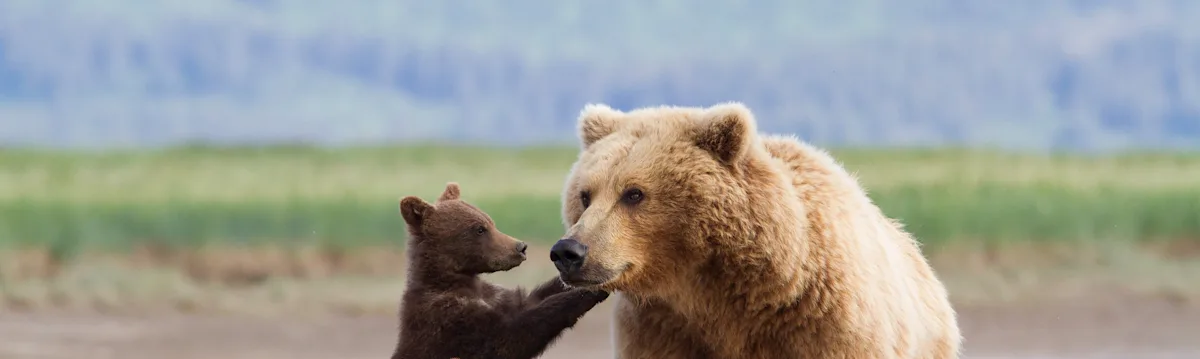
Explanation: Giant coastal brown bears reign over Katmai, with the largest protected population found in this critical sanctuary. Brooks Falls, located in the national park, is perhaps the best place in the world to watch bears feast on the salmon runs.Barred Owl: Donna Donohue, Brown Bear: Brad Josephs, Black Bear: Wendy Erlendson
Salmon accounts for how much of a coastal brown bear’s diet?
Correct Answer: More than 40%
Explanation: On the coast, salmon accounts for more than 40 percent of the brown bears’ diet. The fat and protein in these fish are chiefly why these brown bears grow to be the largest in the world. Inland bears must rely on more terrestrial sources of nutrition, including roots, berries, plants, insects and the occasional caribou calf.Photo Credit: Brad Josephs
Of the thousands of eggs laid by a spawning salmon, how many survive to return to <br> their natal stream in adulthood?
Correct Answer: 2–3
Explanation: Five species of salmon spawn in the brooks and streams of Alaska—Chinook, coho, sockeye, chum and pink. Pacific salmon spend most of their lives at sea before returning upstream to the freshwater rivers of their birth to spawn. Their powerful tails allow them to swim hundreds of miles against the current and leap more than 13 vertical feet to climb waterfalls in the rushing rapids. Females deposit between 2,000 and 4,500 eggs, yet just about ten of the young fry will reach sexual maturity. Only two to three will live long enough to return to their natal stream to spawn.Photo Credit: Tom Gutierrez
Besides snatching leaping salmon from rushing rivers, coastal Alaskan brown bears:
Explanation: All of the above
Explanation: Bears are intelligent creatures that are adept at seeking out a variety of food sources, including foraging for elderberries, soapberries and roots, digging for clams on the tidal flats and browsing on sedge grass. Some tribes have paid close attention to the plants bears seek. Bearberries, so named due to the fondness bears have for the fruit, have been used by Alaska Natives as both a food and medicine. Osha is called "bear root" because bears were observed eating the root when they were sick or weak from hibernation to restore their energy. The Navajo in Southwest America credit the bear with leading them to this medicine, which is used to stimulate the immune system.
Photo Credit: Lisa Sidorsky
Which plant has not been traditionally harvested by Alaskan Native peoples as a food source?
Correct Answer: Corn
Explanation: Fiddlehead ferns have been harvested in early spring by the Yup’ik, Dena’ina and Koyukon Athabascans as a food resource high in vitamins A and C. A tea is made of fireweed leaves, and the spring shoots can be eaten. Athabascans have harvested many kinds of berries, including bright orange salmonberries along with the tender shoots of the plant. It was too cold to grow corn in Alaska.
A cruise down the Kenai Fjords reveals ice blue glaciers and a host of wildlife, with the exception of:
Correct Answer: Yellow-eyed penguins, leopard seals, manatees and spinner dolphins
Explanation: A cruise through the Kenai Fjords will unveil all sorts of seafaring animals—orcas, humpbacks, minke whales, gray whales, fin whales, sei whales, peregrine falcons, bald eagles, puffins, Steller sea lions, sea otters, harbor seals and porpoises. Manatees and spinner dolphins are found in tropic waters, yellow-eyed penguins live in New Zealand, and leopard seals inhabit the Antarctic.
In 2015, Mount McKinley was restored to its native Alaskan name, Denali. The name “Denali” stems from the Athabascan word “deenaalee,” meaning:
Correct Answer: The tall one
Explanation: Denali means “the tall one” in Koyukon, which is a subset of the Athabascan language. The mountain plays an integral role in the creation myth of Athabascan peoples. On the eve of the National Park Service’s 100th anniversary, the name of North America’s highest peak changed from “Mount McKinley” to “Denali.”
World Wildlife Fund is helping protect Alaska’s Bristol Bay. Bristol Bay is:
Correct Answer: All of the above
Explanation: World Wildlife Fund endeavors to conserve Alaska’s wilderness in its effort to protect Bristol Bay. Bristol Bay provides habitat for 29 species of fish, more than 190 bird species, and more than 40 terrestrial animals, including bald eagles, moose, brown bears, wolves, seals and whales. The world’s largest salmon fishery, Bristol Bay hosts runs of all five salmon species, and 46 percent of the world’s wild sockeye salmon rely on this critical watershed. Salmon is an important subsistence food and is regarded as the lifeblood of the Yup’ik, Dena’ina, and Alutiiq peoples. There are 25 tribal councils in Bristol Bay, and salmon is an integral part of these indigenous communities’ cultural traditions.
One of the most significant threats to Bristol Bay is Pebble Mine, a proposed open-pit gold and copper mine that would contaminate the waters of this crucial watershed. Capable of generating up to 10 billion tons of toxic mine waste, it would devastate indigenous people’s traditional way of life, destroy pristine river systems and disrupt the habitats of endangered species. WWF is partnering with Alaskan organizations to build community support and is playing an active role in educating the US government on the importance of Bristol Bay as a livelihood of the Alaskan people and sanctuary for wildlife.
Join Natural Habitat, the travel partner of WWF, on an adventure to witness Alaska’s breathtaking wildlife for yourself.Photo Credit: WWF-US/Megan Chinsky