

M/C Natural Habitat Rosalinda Eastern Itinerary
Itinerary
Day 1: Arrive in Ecuador’s beautifully preserved colonial capital
Meet your local guide upon arrival in Quito
Check in to a boutique hotel in Quito’s colonial quarter
Upon arrival at the airport in Quito, you are met by our local representative and transferred to the city's historic Old Town, the heart of Ecuador's capital, about an hour away. Settle in to your boutique hotel in the colonial quarter, and enjoy dinner on your own this evening.

Day 2: Explore the churches, plazas and flavors of colonial Quito
Walk the cobblestone lanes of Quito’s UNESCO-listed Old Town
Step inside La Compania Church to see its gold-leaf interior
Taste chocolate made from Ecuador’s prized cacao
After breakfast, embark on a full day of discovery in Ecuador’s capital. Heralded as Latin America's best-preserved colonial city, Quito's Old Town is a UNESCO World Heritage Site filled with cobblestone lanes, elegant plazas and monuments, and ornate gilded churches. On a guided city tour, take in a panorama of the city and surrounding volcanic peaks from Panecillo Hill, visit the 16th-century Church and Convent of San Francisco, and wander through San Francisco Square. Marvel at the baroque splendor of La Compañia Church with its gleaming gold-leaf interior, and survey Independence Plaza, the original center of Quito from which we view the Archbishop's Palace, Cathedral and Presidential Palace.
We also visit an artisanal chocolate shop featuring products handmade from Ecuador's finest cacao beans, where we'll do a chocolate tasting. Ethically cultivated by a women's cooperative using traditional organic techniques, this rare cacao is prized by the great chocolatiers of the world for its heady aroma and superior flavor. Following lunch, the afternoon is at leisure to explore the city further on your own or visit the shops near our hotel, where you can purchase local handcrafts ranging from classic hats to wooden toys. This evening, we gather for a welcome dinner with one of our Expedition Leaders.

Day 3: Board the Rosalinda and encounter North Seymour’s seabirds
Settle aboard the Natural Habitat Rosalinda
Walk among the Galapagos’ largest magnificent frigatebird colony
Look for blue-footed boobies and endemic land iguanas
Rise early for the return transfer to Quito airport to board our flight to the Galapagos Islands, which has a short layover in Guayaquil. Our second Expedition Leader meets us as we land on the island of Baltra and joins us on the transfer to the jetty to board the Natural Habitat Rosalinda. This deluxe motor-sailing catamaran will be our home base for the next week as we cruise the archipelago. Once we are settled in to our cabins and have taken part in a safety orientation, we cast off and cruise toward our first landing on North Seymour, a small geological uplift. Ashore, we follow a trail that leads to swallow-tailed gulls, blue-footed boobies and endemic land iguanas. North Seymour is also home to the largest colony of magnificent frigatebirds in the Galapagos. Strolling along the beach, we're likely to see marine iguanas and sea lions in the northerly swells. Back aboard Rosalinda, our Expedition Leaders offer a briefing about tomorrow's activities, followed by sunset cocktails and dinner.

Day 4: Sea lions, white-sand shores and the spires of Kicker Rock
Snorkel with resident sea lions off Isla Lobos
Walk Cerro Brujo’s white-sand beach among sea lions and boobies
Circle the 300-foot tuff formations of Kicker Rock at sunset
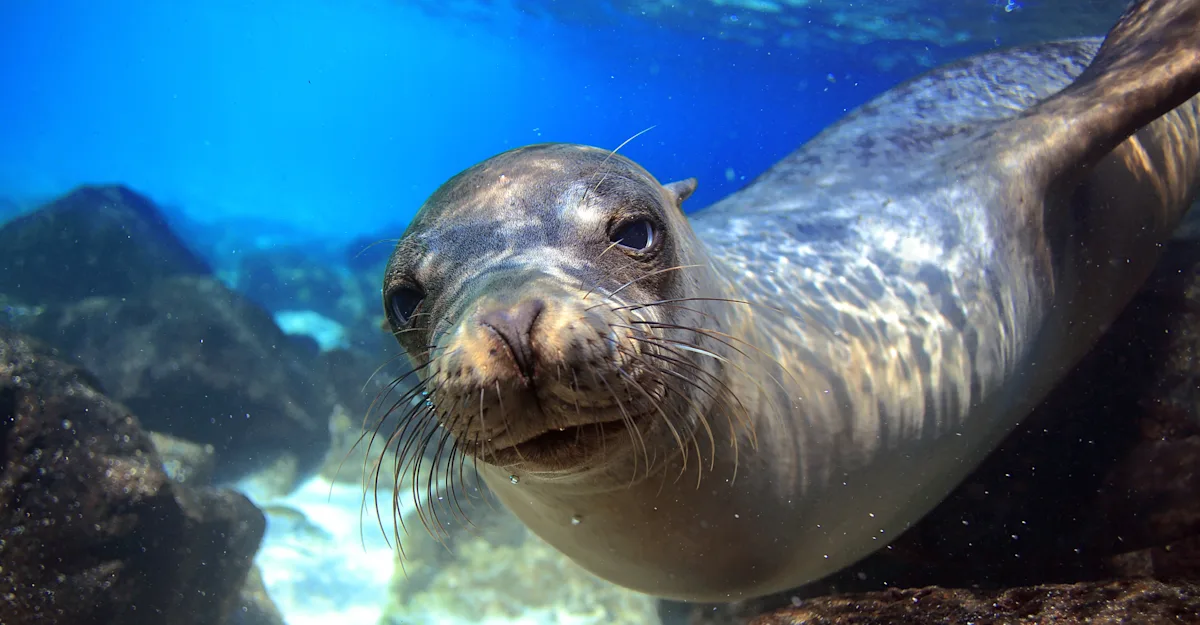
On Isla Lobos this morning, our adventures begin with a walk over the rocks to look for blue-footed boobies, nesting frigatebirds and endemic lava lizards from San Cristobal. Returning to our catamaran, don snorkel gear for a shallow-water swim with the resident sea lion colony and marine iguanas, followed by a short ride by panga (motorized inflatable raft) along the shoreline to look at a frigatebird colony.
This afternoon we land at Cerro Brujo, or "Wizard Hill." This ancient volcanic tuff cone on San Cristobal sits next to an expanse of powdery white sand that's home to a large colony of Galapagos sea lions as well as blue-footed boobies, pelicans, egrets and marine iguanas. After a walk on the beach to scout for sea lions, we have a chance to swim with them, too. At every turn, our discoveries are enhanced by the in-depth knowledge of our Expedition Leaders, who are expert naturalists on the flora and fauna of the Galapagos. Back aboard the Rosalinda once more, sail on to Kicker Rock, a dramatic volcanic tuff cone that rises 300 feet above the ocean's surface. Circumnavigating the rock, look for marine life as we watch the sun sink below the horizon.
Day 5: Waved albatross, sea lions and endemic wildlife on Española
Snorkel Gardner Bay among tropical fish, rays and sea turtles
Walk a white-sand beach lined with sea lions
Look for nesting waved albatross at Punta Suarez
Española is one of the most prolific wildlife sites in the Galapagos. Along the island's north shore this morning, follow a cliff formed by eroded cinder cones and layers of old basalt where we observe giant cacti and many different bird species. Next, we do some deepwater snorkeling at one of the offshore islets in Gardner Bay, looking for large schools of tropical fish, rays and marine turtles. Ashore, an idyllic white sand beach awaits, where sea lions laze by the dozens and Pacific green sea turtles frequent the rocky part of the shoreline. Return to our catamaran for lunch on board as we sail to Punta Suarez. Hiking on the headlands, we witness abundant birdlife, hoping to see Hood mockingbirds, blue-footed boobies, nesting swallow-tailed gulls and Galapagos hawks. Española is also the world's main nesting site for the huge waved albatross, with a wingspan of 7–8 feet.
Day 6: Flamingo lagoons, reef life and Floreana’s maritime history
Look for pink flamingos in Punta Cormorant’s brackish lagoon
Drift-snorkel Champion Islet alongside playful sea lions
Leave a postcard in the historic Post Office Barrel, established in 1793
This morning we land at Punta Cormorant on Floreana, one of the few populated islands in the Galapagos. Following a trail through a Palo Santo forest to a brackish lagoon, look for pintail ducks, common stilts and bright pink flamingos. Winding our way past a wide variety of plants, we reach a beach of fine sand where sea turtles lay eggs in the dunes and rays swim in the shallow water. Back aboard ship, sail a short distance to Champion Islet just offshore, one of the best drift-snorkel spots in the Galapagos. As the current floats us past the steep walls of this submerged volcanic crater, we spy large schools of fish and bright corals as we're followed by playful young sea lions.
Floreana's rich cultural history is filled with intrigue, including tales of pirates who once hid out here. One relic of this colorful past is the "Post Office Barrel," established by British whalers in 1793, where travelers still leave mail for personal delivery via visitors passing through. After a short snorkel to look for sea turtles, we paddle around the mangrove-lined shores of Post Office Bay where large bull sea lions patrol the rocky terrain and reddish-colored marine iguanas bask near the tree cacti.
Day 7: Stay among wild giant tortoises at Nat Hab’s private highlands camp
Visit the Charles Darwin Research Station’s tortoise breeding center
Spend the night at Nat Hab’s private Tortoise Camp
Look for wild giant tortoises among reforested Scalesia trees
The day begins in Puerto Ayora, the main town on Santa Cruz, with a visit the world-famous giant tortoise-rearing center run in tandem by Galapagos National Park and the Charles Darwin Research Station. Here, international scientists conduct research dedicated to conserving the unique habitats and species of the Galapagos. At the facility, visit the protection pens where hatchlings are bred to increase depleted tortoise populations, a central mission for both the research station and the national park. To date, more than 5,000 tortoises bred at the station have been released into the wild.
After some free time to explore town, followed by lunch back on board the Rosalinda, we head to shore again and drive into the misty highlands of Santa Cruz to reach Nat Hab's private Tortoise Camp. This exclusive setting offers a rare opportunity to spend a night in wild tortoise habitat, and these ancient, gentle reptiles that are the archipelago's namesake often wander right through camp. Accommodations are in safari-style raised platform tents and charming treehouses with views of the ocean. While rustic, they offer comfortable amenities, including real beds and private en suite facilities.
Our private camp offers rare proximity to wild tortoises, which are attracted to the area's lush vegetation, including the reforested zone where native Scalesia trees have been planted. Since 2022, Nat Hab guests have helped plant more than a thousand of these important trees, endemic to the islands and habitat for a diverse array of plants and animals. However, invasive species and deforestation threaten the Scalesia forests, making their conservation a high priority. Tortoises are most commonly seen in camp from July through February. From March to June, we make an excursion to a nearby tortoise reserve for closer views, as the reptiles migrate seasonally to a lower elevation.
Please note: At times, Tortoise Camp may be closed due to poor weather conditions.

Day 8: Lava tubes and endemic wildlife on ancient Santa Fe
Explore subterranean lava tubes near Tortoise Camp
Search for Santa Fe land iguanas beneath giant prickly pear cacti
Cruise past sea caves where seabirds nest and turtles bask
Spend the morning exploring a network of subterranean lava tubes and caverns adjacent to Tortoise Camp. Returning to Rosalinda, we'll have lunch on board as we sail for Santa Fe. Once we land, take a short hike through a forest of prickly pear cacti to look for the endemic land iguanas that wait patiently underneath for fruit to drop. Returning to our catamaran, we explore a small islet surrounded by great reef diversity, then set out for a cruise along the north coast. Along this expanse, large cliffs and sea caves are used by many species of seabirds for nesting and roosting, and also by basking green sea turtles and sea lions.
Day 9: Climb above Pinnacle Rock before snorkeling with penguins
Ascend Bartolome’s summit for sweeping island views
Snorkel with Galapagos penguins below Pinnacle Rock
Paddle the turquoise channel beside Sombrero Chino
Rosalinda sails on to Bartolome, where we climb to the island's highest point for 360° views, passing intriguing geological formations along the path including spatter cones, tuff cones and lava tubes. From the summit, survey a panorama of the surrounding islands and Pinnacle Rock, famously shown in the 2003 film Master and Commander. Some of the best snorkeling in the Galapagos awaits around the base of this ancient submerged volcano. It's an underwater playground that's home to huge schools of fish permanently under attack by Galapagos penguins. Gentle white-tipped reef sharks, sea turtles and stingrays are also common sightings.
Continue on to Sombrero Chino, a small island off the coast of Santiago, which really does look like a Chinese hat! A paddling excursion here reveals more of the Galapagos' fascinating marine life and striking geology, as we witness the delicate lava and spatter cones on the island’s surface. The small channel of turquoise water provides an idyllic snorkeling site, particularly along the Santiago coast where it is possible to see sharks, sea lions, penguins and rays.
Day 10: Circle Daphne Major before returning to Quito
Cruise around the island famed for pioneering research on Darwin’s finches
Bid farewell to the Natural Habitat Rosalinda and crew
Just off Santa Cruz lies Daphne Major, which we circumnavigate. One of two small volcanic islands (along with Daphne Minor) that are a haven for various bird species, Daphne Major is formed of a tuff crater. It’s a noted location for bird research, especially on Darwin's finches. Two Princeton University scientists have been conducting longitudinal studies over more than three decades, observing subtle evolutionary processes at work. Blue-footed boobies nest in the interior of the crater, while masked boobies nest on the sides of the cone and along the crater's edge.
All too soon, our time in the Enchanted Isles comes to a close as we return to Baltra and say goodbye to the Natural Habitat Rosalinda, her crew and our Expedition Leaders. From Baltra, we board our flight back to the mainland. Upon arrival at the Quito airport, we're met and transferred to our nearby hotel, just minutes away, where an overnight stay is included. A complimentary shuttle will return you to the airport for your homeward flight.
Learn more about the seasonal variations of Galapagos weather and wildlife viewing .
Interested in extending your trip? Link it up with another adventure!


M/C Natural Habitat Rosalinda Western Itinerary
Itinerary
Day 1: Arrive in Quito’s historic colonial heart
Meet your local guide upon arrival in Quito
Check in to a boutique hotel in Quito’s colonial quarter
Upon arrival at the airport in Quito, you are met by our local representative and transferred to the city's historic Old Town, the heart of Ecuador's capital, about an hour away. Settle in to your boutique hotel in the colonial quarter, and enjoy dinner on your own this evening.
Day 2: Explore the churches, plazas and flavors of colonial Quito
Walk the cobblestone lanes of Quito’s UNESCO-listed Old Town
Step inside La Compania Church to see its gold-leaf interior
Taste chocolate made from Ecuador’s prized cacao
After breakfast, embark on a full day of discovery in Ecuador’s capital. Heralded as Latin America's best-preserved colonial city, Quito's Old Town is a UNESCO World Heritage Site filled with cobblestone lanes, elegant plazas and monuments, and ornate gilded churches. On a guided city tour, take in a panorama of the city and surrounding volcanic peaks from Panecillo Hill, visit the 16th-century Church and Convent of San Francisco, and wander through San Francisco Square. Marvel at the baroque splendor of La Compañia Church with its gleaming gold-leaf interior, and survey Independence Plaza, the original center of Quito from which we view the Archbishop's Palace, Cathedral and Presidential Palace.
We also visit an artisanal chocolate shop featuring products handmade from Ecuador's finest cacao beans, where we'll do a chocolate tasting. Ethically cultivated by a women's cooperative using traditional organic techniques, this rare cacao is prized by the great chocolatiers of the world for its heady aroma and superior flavor. Following lunch, the afternoon is at leisure to explore the city further on your own or visit the shops near our hotel, where you can purchase local handcrafts ranging from classic hats to wooden toys. This evening, we gather for a welcome dinner with one of our Expedition Leaders.
Day 3: Board the Rosalinda and step ashore on Las Bachas
Settle aboard the Natural Habitat Rosalinda, your catamaran for the week
Wade ashore on the white coral sands of Las Bachas
Look for nesting green sea turtles and flamingos in coastal lagoons
Rise early for the return transfer to Quito airport to board our flight to the Galapagos Islands, which has a short layover in Guayaquil. Our second Expedition Leader meets us as we land on the island of Baltra and joins us on the transfer to the jetty to board the Natural Habitat Rosalinda. This deluxe motor-sailing catamaran will be our home base for the next week as we cruise the archipelago. Once we are settled in to our cabins and have taken part in a safety orientation, we cast off and head for Las Bachas, a beautiful white sand beach on the island of Santa Cruz. The azure water reveals a kaleidoscope of fish, while the powdered coral sand is a favorite nesting site for green sea turtles, and pink flamingos often dot the saltwater lagoons. Back aboard the Rosalinda, our Expedition Leaders offer a briefing about tomorrow's activities, followed by cocktails and dinner. After dark, head up to the sundeck to view a sky filled with stars.
Day 4: Explore a flooded volcanic caldera alive with seabirds
Kayak Darwin Bay among nesting seabirds
Climb Prince Philip’s Steps past frigatebird and booby colonies
Snorkel from the beach with sea lions, rays and sea turtles
Genovesa, or Tower Island, is a collapsed shield volcano that attracts millions of seabirds that come here to breed and nest. Paddling kayaks inside the flooded crater, we are surrounded by red-footed boobies, swallow-tailed gulls, storm petrels and yellow-crowned night herons that rend the air with a cacophony of squawks. Surrounded by vertical cliffs of the collapsed caldera, Darwin Bay is an ideal breeding site for the birds that congregate on Genovesa, including red-billed tropicbirds and shearwaters that nest in holes in the lava walls.
Our first landing is at El Barranco, also known as Prince Phillip's Steps—a steep path with stairs carved into the rock that leads to a plateau full of birdlife in a Palo Santo forest. Walk among colonies of great frigatebirds and Nazca boobies to a lava field where storm petrels nest in underground lava tubes. We may also see Galapagos doves, mockingbirds and perhaps an endemic short-eared owl.
Return to Rosalinda for lunch on board as we continue to Darwin Bay Beach, following a trail into lush mangroves where red-footed boobies nest. We may also see nesting colonies of common frigatebirds, Nazca boobies, and huge numbers of breeding swallow-tailed seagulls. After the walk, snorkel from the beach, where plenty of local sea lions loll in the sun, and sightings of rays and sea turtles are common below the water’s surface.
Day 5: Walk young lava flows before staying among wild tortoises
Cross the ropy pahoehoe lava fields of Sullivan Bay
Spend the night at Nat Hab’s private Tortoise Camp in the highlands
Look for wild giant tortoises among reforested Scalesia trees
Wake to the orange glow of sunrise on the volcanic craters of Santiago. This morning, we visit Sullivan Bay on the east coast of the island, known for its spectacular volcanic formations, relatively recent lava flows and unique geological scenery. The lava here is the pahoehoe type, which resembles smooth ropes. Few plants are able to take root on the barren rock, and we admire the hardy pioneers that have, like the lava cactus.
This afternoon, Rosalinda sails for Santa Cruz. Here, we leave our ship behind to ascend into the misty highlands for a night at Nat Hab's private Tortoise Camp. This exclusive setting offers a rare opportunity to spend a night in wild tortoise habitat. Accommodations are in safari-style raised platform tents and charming treehouses with views of the ocean. While rustic, they offer comfortable amenities, including real beds and private en suite facilities. But the true draw of our stay is the proximity to wild tortoises. These ancient, gentle reptiles that are the archipelago's namesake often wander right through camp, attracted to the area's lush vegetation, including the reforested zone where native Scalesia trees have been planted. Since 2022, Nat Hab guests have helped plant more than a thousand of these important trees, endemic to the islands and habitat for a diverse array of plants and animals. However, invasive species and deforestation threaten the Scalesia forests, making their conservation a high priority. Tortoises are most commonly seen in camp from July through February. From March to June, we make an excursion to a nearby tortoise reserve for closer views, as the reptiles migrate seasonally to a lower elevation. Nearby, we can also explore a network of subterranean lava tubes and caverns.
Please note: At times, Tortoise Camp may be closed due to poor weather conditions, in which case we will remain aboard the Natural Habitat Rosalinda for the night, though all sightseeing inclusions will remain the same.
Day 6: Wild giant tortoises and the science helping protect them
Search the highlands for giant tortoises in the wild
Visit the tortoise-rearing center at Charles Darwin Research Station
Explore the shops and seaside cafes of Puerto Ayora
Spend the morning exploring the Santa Cruz highlands in search of more giant tortoises. During the season when tortoises are rare in camp, we visit either El Manzanillo or El Chato tortoise reserve to view more of them in the wild. Continue to Puerto Ayora, the main town on Santa Cruz, where we visit the world-famous giant tortoise rearing center at Charles Darwin Research Station. Here, international scientists conduct studies dedicated to conserving the unique habitats and species of the Galapagos. At the facility, we will observe the protection pens where hatchlings are bred to help increase the depleted tortoise population, a central part of the missions for both the research station and Galapagos National Park. We also have a bit of free time in town, where you’ll find a nice selection of shops, cafes and seaside bars.
Day 7: Flamingo lagoons and endemic wildlife on Isabela’s young shores
Walk hardened lava past lagoons where flamingos and herons feed
Look for giant land iguanas on Urbina Bay’s uplifted shore
Snorkel Moreno Bay’s mangrove-lined waters in search of sea turtles
This morning we land at Punta Moreno on Isabela, the largest island in the Galapagos. The point is located between two volcanoes, Sierra Negra and Cerro Azul, and we step ashore to walk atop the hardened lava. At first glance, the corrugated rock landscape appears lifeless. However, the ropy black surface is dotted with numerous coastal lagoons harboring a wide variety of birdlife. Commonly seen species include flamingos, paint-billed crakes, white-cheeked pintails and herons. We also see endemic Galapagos flora taking root on this young, barren lava flow, including giant opuntia cactus, Palo Santo trees, carob trees and lichens. The protected waters of Moreno Bay are surrounded by mangroves, creating ideal habitat for sea turtles, which we may spot from the pangas or as we snorkel. We may also see cormorants along the shoreline.
At Urbina Bay this afternoon, step onto a black sand beach to witness one of the best examples of geological uplift in the Galapagos, a phenomenon that occurs when molten rock beneath the surface suddenly shifts. In 1954, the shoreline was uplifted, exposing 1.6 square miles of shoreline. The coastline was driven three-quarters of a mile farther out to sea, exposing coral and stranding marine organisms on what is now shore. Urbina is home to a colony of some of the largest land iguanas in the islands and the iconic Galapagos tortoise, and we may also see bright yellow Darwin’s cotton flowers here, unique to the archipelago.
Day 8: Marine iguanas, flightless cormorants and historic Tagus Cove
Walk among marine iguana colonies and nesting flightless cormorants
Cross the Bolivar Channel while watching for whales and dolphins
Explore Tagus Cove, home to penguins and 19th-century maritime graffiti
Fernandina awaits today, the youngest and most active volcano in the Galapagos, erupting most recently in 2018. The rippling pahoehoe lava at Punta Espinosa is a stark backdrop for the surprising variety of life that flourishes here: flightless cormorants nest on the rocks, Galapagos hawks soar overhead, sea lions sprawl on the beach, and huge colonies of marine iguanas bask in the sun. Bright orange Sally Lightfoot crabs pepper the black rocks at water's edge, a vivid counterpoint to the aquamarine sea. A snorkeling excursion offers a good chance to see sea turtles and submerged marine iguanas feeding on algae. Fernandina is home to a number of rare and unique Galapagos species such as the flightless cormorant, Galapagos penguin, Galapagos hawk and Galapagos snake, among others. We’ll also see fascinating lava cactus, which grows on young lava flows and needs virtually no water.
As we cross the Bolivar Channel to reach Isabela once more this afternoon, keep watch for whales and dolphins. Anchoring at Tagus Cove, we set out in search of penguins, pelicans and graffiti dating to the 1800s when the names of ships were carved into the rock above a historic anchorage for pirates and whalers. Another snorkeling opportunity awaits, perhaps with a chance to frolic again with young sea lions. Inside the submerged volcanic cone we find saltwater Darwin Lake.
Day 9: Fur seals, tide pools and the volcanic cliffs of Santiago
Look for endemic Galapagos fur seals in Puerto Egas’ lava grottos
Explore tide pools filled with octopuses, sea stars and urchins
Snorkel or kayak beneath the tuff cliffs of Buccaneer Cove
At Puerto Egas on Santiago, one of the most volcanically active islands in the Galapagos, we make a morning landing on a black sand beach with eroded rock formations. The trail crosses the dry interior where remains of a salt mining enterprise are still visible, and continues along the coast. Tide pools are home to a variety of marine life, including sea urchins, octopus, sponges and sea stars. Birdlife abounds, with great blue herons, lava herons, oystercatchers, yellow-crowned night herons, Galapagos doves, finches, mockingbirds and seasonal shorebirds. In the lava grottos we find a colony of Galapagos fur seals, one of the only places in the islands where these endemic animals are on view from land. After our walk, there may be time to swim or snorkel off the beach with the resident sea lions, and we may also see turtles, rays and reef sharks.
This afternoon, sea conditions permitting, we visit Buccaneer’s Cove. Formerly a safe haven for pirates, whalers and sailors in the 18th and 19th centuries, it is a scenic site with impressive tuff cliffs and a dark reddish-purple sand beach. We may have a chance to do some deep-water snorkeling here or go kayaking.
Day 10: Search Black Turtle Cove before returning to Quito
Ride a panga through mangrove waterways in search of reef sharks and rays
Bid farewell to the Natural Habitat Rosalinda and crew
Returning to Santa Cruz this morning, we explore Black Turtle Cove, a sheltered lagoon on the north coast of the island. Take a panga ride to explore the turquoise water, hoping to see white-tipped reef sharks, rays and sea turtles. All too soon, our time in the Enchanted Isles comes to a close as we return to Baltra and say farewell to the Natural Habitat Rosalinda, her crew and our Expedition Leaders. From Baltra, we board our flight back to the mainland. Upon arrival at the Quito airport, we're met by our local representative and transferred to our nearby hotel, just minutes away, where an overnight stay is included. A complimentary shuttle will return you to the international airport for your homeward flight.
Learn more about the seasonal variations of Galapagos weather and wildlife viewing .