Itinerary
Day 1: Hyderabad—Arrival in the Deccan
Arrive in Hyderabad, a historic Deccan capital shaped by Persian, Arabian and South Indian influences.
Join your Expedition Leader and fellow travelers for a welcome dinner and introduction to the journey ahead.
Arrive in Hyderabad, founded in 1591 and shaped by centuries of Deccan, Persian and Arabian influences evident in its architecture and cuisine. You are met on arrival and transferred to The Leela Hyderabad in Banjara Hills.
This evening, meet your Expedition Leader and fellow travelers over a welcome dinner. Our Expedition Leader introduces the route ahead and provides context for the distinct histories, cultures and landscapes we will encounter across South India.

Day 2: Hyderabad—Old City Bazaars & a Family Table
Explore Hyderabad’s old city, from the Charminar and Laad Bazaar to Chowmahalla Palace and the traditional pearl market.
Share a home-cooked lunch with a local family, then visit the Qutb Shahi Tombs.
Enter Hyderabad’s old city on foot, beginning at the Charminar, built in 1591 under Sultan Muhammad Quli Qutb Shah. Continue through Laad Bazaar as merchants open for the day, then visit Chowmahalla Palace, once the seat of the Asaf Jahi dynasty.
Hyderabad and nearby Golconda were important centers of international trade, particularly in diamonds and pearls. Visit the traditional pearl bazaar, where pearls are still sold alongside attar, textiles, footwear and Hyderabad sweets.
At midday, a local family welcomes us into their home for lunch, introducing us to a cuisine influenced by Mughal, Turkish and Arabic traditions. Later, visit the Qutb Shahi Tombs, a royal necropolis combining Persian, Afghan and Indian architectural influences.
Day 3: Hyderabad / Hubli / Hampi—Into the Vijayanagara Empire
Fly to Hubli and continue to Hampi, where the ruins of the Vijayanagara capital spread among immense granite boulders.
Explore the Vittala Temple complex and watch evening light illuminate the ancient city from a scenic viewpoint.
Fly to Hubli this morning, then continue overland toward Hampi as the Deccan Plateau gives way to the immense granite boulders that characterize the region.
By the early 16th century, Hampi was the capital of the powerful Vijayanagara Empire, a city of roughly half a million people whose temples, royal compounds, canals and reservoirs spread across the landscape surrounding the Tungabhadra River.
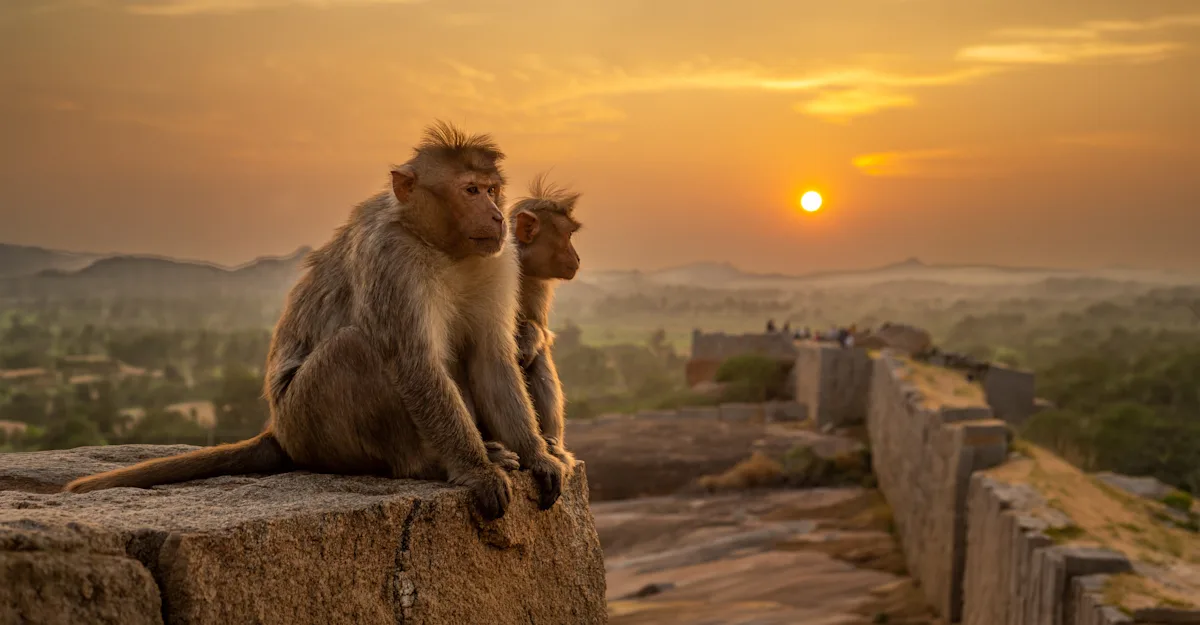
After settling into Evolve Back Kamalapura Palace, make a first visit to the Vittala Temple complex, where the famous stone chariot stands before the temple. End the afternoon at a viewpoint overlooking the remains of the former capital as golden light illuminates the ruins and surrounding boulder fields.

Day 5: Hampi—Sunrise, Sacred Traditions & the Tungabhadra
Watch sunrise from Matanga Hill, then take part in a puja at the continuously active Virupaksha Temple.
Return to the Tungabhadra River for a late-afternoon coracle ride through Hampi’s boulder-lined landscape.
Leave before sunrise for a moderate 20- to 30-minute ascent of Matanga Hill. From the summit, the Tungabhadra River, temple towers, abandoned city and boulder-strewn hills spread below us in the first light of morning.
After descending, continue past a monolithic Nandi statue and along the ancient bazaar to Virupaksha Temple. Believed to have functioned continuously since the 7th century, it remains an active place of Hindu worship, and we witness and take part in a puja rather than experiencing the temple solely as a historic monument.
After breakfast and time to rest, those who wish may visit Hampi’s Royal Enclosure. Late this afternoon, return to the Tungabhadra River for another perspective on the landscape, traveling by round bamboo coracle before gathering for drinks on the riverbank as evening settles over Hampi.
Day 6: Hampi / Chitradurga / Mysuru—Fort Walls & Market Stalls
Explore the fortifications of Chitradurga and hear the story of Karnataka folk heroine Onake Obavva.
Arrive in Mysuru and wander Devaraja Market among produce, flowers, perfumes and puja offerings.
Today’s longer drive to Mysuru is broken by a visit to Chitradurga Fort. Explore its massive lower fortifications with a guide who shares the story of Onake Obavva, one of Karnataka’s best-known folk heroines.
After lunch, continue to Mysuru and head directly to Devaraja Market. Banana and coconut varieties, vegetables, flowers and puja offerings fill the stalls, while perfume sellers and small shops line the surrounding lanes. Our Expedition Leader and local guide lead us through sections of the market visitors could easily overlook before we continue to our heritage hotel.

Day 7: Mysuru—Palace Halls, Home Cooking & the Silk Loom
Explore Mysuru Palace, then join a local hostess for an interactive cooking session and lunch in her home.
Follow Mysuru’s centuries-old silk tradition from silkworm cocoons through dyeing, spinning and weaving.
Begin at Amba Vilas Palace, better known as Mysuru Palace, where our guide introduces the Wadiyar dynasty through its audience halls, ceremonial spaces and lavish interiors.
At midday, a local hostess welcomes us into her home for an interactive cooking session and lunch. She introduces seasonal ingredients and techniques used in Mysuru cooking as we prepare and share a meal together.
This afternoon, turn to another long-standing regional tradition: silk. Mysuru’s association with sericulture dates to the 18th century, when Tipu Sultan promoted the industry. With a textile specialist, visit a village where silkworm cocoons are raised and harvested, then follow the process through dyeing and spinning before the thread reaches the loom.
Day 8: Mysuru / Bandipur / Wayanad—Into the Western Ghats
Travel through Bandipur Tiger Reserve, watching from the vehicle for elephants, spotted deer, langurs and other wildlife.
Enter the tropical forests of Wayanad and join a naturalist-led night walk in search of frogs, insects and reptiles.
Our road to Kerala passes through Bandipur Tiger Reserve, part of the Nilgiri Biosphere Reserve and one of India’s important wildlife corridors. We cannot stop within the reserve, but we watch from the vehicle for elephants, spotted deer and langurs, with other wildlife possible though never assured.
Beyond Bandipur, dry forest gradually gives way to increasingly moist vegetation as we climb into the Western Ghats and eventually reach Wayanad’s tropical evergreen forest.
Our base for the next two nights is CGH Wayanad Wild, a rainforest lodge at approximately 2,300 feet. After lunch and time to relax, head into the forest after dinner with a naturalist and flashlights, focusing on frogs, insects, reptiles and other species most active after dark.

Day 9: Wayanad—Rainforest Trails, Tea & Coffee Country
Hike through tropical wet evergreen forest beneath towering old trees in the Western Ghats.
Explore tea, coffee and spice plantations, then learn more about local wildlife with Wayanad Wild’s resident naturalist.
Set out early for a moderate hike through tropical wet evergreen forest, walking beneath massive old trees while bird calls and other signs of forest life surround us.
After breakfast, visit Harrison Malayalam Tea Estate, following tea production from plucking through withering, rolling, fermentation and drying, then taste the finished tea.
At Moovatty Coffee Plantation, robusta coffee grows beneath a shade canopy while pepper vines climb tree trunks and cardamom grows below. After lunch at the estate, walk through the plantation and visit its drying, pulping and storage areas.
Back at Wayanad Wild, join the resident naturalist for an evening session using remote-camera images and field observations to better understand the wildlife that shares the surrounding forest.
Day 10: Wayanad / Kozhikode / Alappuzha / Kumarakom—Across Kerala by Rail
Descend from the Western Ghats to Kerala’s coastal plain and board the Vande Bharat Express for the journey south.
Travel past paddy fields, towns and coconut palms before arriving on the shores of Vembanad Lake.
Leave Wayanad early, descending from the Western Ghats through hairpin bends as rainforest gives way to Kerala’s lower country and coconut groves.
Time permitting, stop briefly in Kozhikode for a taste of Malabar breakfast specialties before boarding the Vande Bharat Express. Traveling south in air-conditioned Executive Chair Car, watch paddy fields, towns, coconut palms and glimpses of water pass outside the windows.
Disembark at Alappuzha and continue after lunch to Kumarakom Lake Resort on Vembanad Lake. Later this afternoon, there may be time to walk toward the nearby Kumarakom Bird Sanctuary or simply enjoy the hotel.

Day 11: Kumarakom—Houseboats & Kerala’s Snake-Boat Tradition
Cruise Kerala’s lakes and canals aboard a traditional kettuvallam houseboat, passing villages connected by water.
Meet a local snake-boat crew and take a place alongside the rowers to experience the rhythm of this village tradition.
Board a traditional kettuvallam houseboat from the hotel jetty and enter Kerala’s network of lakes and canals. Travel through backwater villages, stopping where possible to step ashore and see communities linked by water rather than roads. Lunch is served aboard.
Later, meet a local chundan vallam crew and learn about Kerala’s village snake-boat tradition. These racing boats can stretch approximately 100 feet, with large crews paddling in rhythm to vanchipattu, traditional songs that set the stroke.
After learning the basic technique, take a place alongside the local rowers for short bursts of paddling. Then share coconut water or chai with the crew while learning about the village boat clubs, the people who race for them and life outside competition season.
Day 12: Kumarakom—Inside the Working Backwaters
Explore narrow canals by shikkara and meet a family preserving the rare tradition of barehand fishing.
Walk Kuttanad’s earthen bunds with a farmer, then share lunch overlooking rice fields below the surrounding waterways.
Leave the wider waterways behind and enter Kerala’s narrower canals by shikkara. These channels once carried rice, coir, copra and spices toward the coast and still pass homes, farms, coir yards and small settlements.
Meet a family that continues the increasingly rare practice of barehand fishing. Watch the fisherman work in shallow water without nets or hooks, then sit with the family to learn how the skill is passed between generations.
Continue into Kuttanad, where farming relies on an engineering system that holds water back from fields lying below the level of the surrounding lake and canals. Walk an earthen bund with a farmer, with rice fields below on one side and higher water on the other.
Lunch is hosted by a farming family overlooking the fields, featuring ingredients tied directly to the surrounding landscape. Return to the resort this afternoon before a farewell drink beside the lake and our final dinner together.
Day 13: Kumarakom / Delhi—Departure
Fly from Kochi to Delhi and relax at Roseate House, where a day room is available until departure.
Transfer to the international airport this evening for flights home.
Transfer to Kochi Airport this morning for our flight to Delhi. On arrival, continue to Roseate House, where a day room is available until departure.
There is time for lunch, rest and a chance to freshen up before our late-evening transfer to the international airport for flights home.