Itinerary
Itinerary
Day 1: Arrive in Cairo, where the Nile meets the Sahara
Arrive in Cairo, where the Nile threads a city of minarets, markets and bridges
Join your Expedition Leader and fellow travelers for a welcome dinner
Arrive in Egypt’s capital of Cairo, where the Nile weaves its way through an urban collage of minarets, high-rises, markets and bridges before fanning out into a broad delta emptying into the Mediterranean Sea. The Sahara Desert rises on the city’s western edge, an abrupt contrast to the metropolis it borders. We’ll explore more of this dynamic city tomorrow, but this evening, it’s time to meet your Expedition Leader and fellow guests at a welcome dinner, including an overview of all the exciting experiences to come.

Day 2: Giza's ancient wonders and medieval Cairo up close
Approach the Great Sphinx closer than public viewing allows through a private access gate
Explore the Grand Egyptian Museum's royal treasures and everyday objects of ancient life
Walk medieval Historic Cairo, a UNESCO site of mosques, madrasas and fountains
This morning we head to Egypt’s most famous archaeological site, the Giza necropolis complex with its famous pyramids and Great Sphinx. Atop the limestone Giza plateau, the three main pyramids, built more than 4,000 years ago, rise out of the desert on the west edge of Cairo, containing the tombs of several Fourth Dynasty kings and queens from Egypt’s Old Kingdom. Entering through a special access gate, we travel by private golf cart, moving comfortably while avoiding crowds. Our special permission allows us to approach the Sphinx more closely than the standard public viewing area permits. Standing near its massive paws, you’ll appreciate the scale of one of the world's most recognizable archaeological treasures.
After lunch, continue to the Grand Egyptian Museum where royal treasures, ceremonial objects, tools and everyday belongings offer a closer look at how ancient Egyptians lived, worked and worshipped from prehistory to the end of the Greek and Roman periods. One of the largest and most spectacular collections in the world, the Grand Museum bridges the grandeur of ancient Egyptian civilization with state-of-the-art digital interactivity.
This evening, take a walking tour through the historic heart of Cairo, containing one of the densest and oldest concentrations of medieval Islamic architecture in the world. A UNESCO World Heritage Site, Historic Cairo encompasses the sector of the city built after the Muslim conquest in 641 to its modern expansion in the 19th century. Spanning a full millennium, the zone contains more than 600 classified monuments, including mosques, madrasas, fortifications, hammams and fountains. Cairo in the Middle Ages became the new center of the Islamic world, reaching its golden age in the 14th century. As the call to prayer echoes across the rooftops, our group gathers for dinner at a local restaurant overlooking Cairo's most evocative neighborhood.
Day 3: Into the pharaohs' hidden tombs at ancient Thebes
Descend into painted tombs of New Kingdom pharaohs, including Tutankhamun and Seti I
Cross the Nile by motorboat to the concealed Valley of the Kings
Visit Deir el-Medina, where the artisans who built the royal tombs lived
Fly south this morning to Luxor, the modern name for ancient Thebes, the magnificent capital of Egypt during its Middle and New Kingdoms. The Nile bisects the city, lined on either side with temples and monuments. Highlights of Luxor include the Karnak temple complex, the Avenue of Sphinxes, and the Colossi of Memnon. Crossing the Nile by motorboat, continue to the Valley of the Kings. Concealed in a remote desert valley, this is the burial site of New Kingdom pharaohs, including Tutankhamun. Limestone corridors descend into burial chambers with walls and ceilings covered in vivid painted scenes and hieroglyphs. Visit the tomb of Tutankhamun, discovered by Howard Carter in 1922, and the remarkable tomb of Seti I, with chambers extending deep into the mountainside. Lunch is served at Howard Carter's House, the former residence of the famed archaeologist. Later, we visit Deir el-Medina, home to the artisans who built and decorated the royal tombs. Their houses, workshops and painted burial places offer a rare glimpse into the lives of the skilled craftsmen behind Egypt's most famous monuments. Late this afternoon, arrive at our hotel on Luxor's West Bank to spend two nights.

Day 4: Karnak by dawn, Luxor Temple by lamplight
Enter Karnak's Hypostyle Hall at dawn, 134 towering columns still cool and quiet
Cross the Nile for a private dinner in a Luxor family's home
Explore Luxor Temple illuminated after dark, its columns and carvings glowing
Rise very early to explore Karnak, the massive temple-city complex built over 2,000 years, starting in about 2055 BC. Sometimes referred to as "an encyclopedia of ancient Thebes," Karnak is one of the world’s greatest archaeological destinations and the second-largest religious site worldwide (only Angkor Wat in Cambodia is bigger), covering 200 acres. The Great Temple at the heart of Karnak is so big that St. Peter’s, Milan and Notre Dame cathedrals would fit within its walls. We arrive while the air is still cool and the site remains relatively quiet. Pass through monumental gateways and courtyards into the vast Hypostyle Hall within the Great Temple, where 134 towering columns covered in hieroglyphs create one of the most stunning spaces of ancient Egypt.
Return to our hotel for breakfast and time to relax, then head out this afternoon to meet a local artist whose murals draw inspiration from village life, animals and Egypt's enduring artistic traditions. This evening, cross over the Nile for a private dinner in a local home. Over a meal with our hosts, enjoy conversation about daily life in modern Luxor, family traditions and celebrations, and the impact tourism has brought to the city over the years.
After dinner, we visit Luxor Temple, illuminated after dark. Its columns, statues and bas relief carvings offer a mesmerizing encounter with the civilization that flourished here more than 3,000 years ago. The thousands of sandstone fragments scattered across the site contain hieroglyphic texts and paintings of temple rituals, offering rich insight into this major religious center that was once the capital of ancient Egypt, with Amenhotep III, Ramses II, Tutankhamun and other pharaohs adding new buildings to the sprawling complex over hundreds of years. Luxor Temple was known as “the place of the First Occasion,” where the god Amon was reborn during the pharaoh’s annual coronation reenactment. Today, remains of this vast complex include the colossal Great Colonnade Hall, nearly 200 feet long with 28 tall columns. Luxor Temple is also famous for its carvings of festival scenes, which were largely completed around 1330 BC during the reign of Tutankhamun.
Day 5: Board a private luxury dahabiya to explore the Nile
Wander Esna's covered Qisariyya market, famous for its handwoven textiles
Sleep aboard your private dahabiya, a Nile sailing ship for just 12 guests
Visit Asma in her mud-brick home and garden on El Hegz Island
Depart Luxor this morning and drive south to Esna, one of the most important caravanserais—a way station for travelers along a trade route—in southern Egypt in the 18th century, with traders from all over Africa coming via the western desert and Red Sea. We stop to wander the Qisariyya Heritage Street Market, a site of commerce for centuries. Opposite the Temple of Khnum on the Nile, this traditional two-story wooden covered market with its narrow lanes is famous for its handwoven textiles, while merchants also sell produce, spices and other wares.
Soon, it’s time to board our dahabiya, the classic Nile sailing vessel that will be our home for the next four nights. Accommodating just 12 guests, it offers a quieter and more personal way to experience the Nile versus typical ships. With its shallow draft, the dahabiya can tie up beside islands, villages and peaceful stretches of shoreline often bypassed by larger vessels. Once we’re underway, our first stop is El Hegz Island, where small agricultural plots and fields and modest houses sit close to the river's edge. We go ashore to visit our friend Asma in her traditional mud-brick home, joining her in the garden, surrounded by herbs, flowers and cultivated plants, she shares stories about family customs, village celebrations and daily life along the Nile. Then return to our dahabiya and continue sailing toward Edfu, with dinner served aboard.

Day 6: A well-preserved temple and slow miles up the Nile
Explore the Temple of Edfu, one of ancient Egypt's best-preserved temples
Sail slowly upriver, watching date palms and desert escarpments pass by
Watch fishermen work small boats and village life along the shoreline
At Edfu, we go ashore this morning to visit its famous temple, one of the best-preserved in ancient Egypt. Completed in 57 BC and dedicated to Horus, the falcon-headed god, the Temple of Edfu offers an intricate look at the architecture and decoration of the Ptolemaic period. Reliefs cover the temple walls, depicting ceremonies, offerings and the enduring struggle between Horus and rival god Seth. The temple remained buried under layers of debris for millennia, which is why it has survived in such precise detail, uncovered in 1860 by French archaeologist Auguste Mariette. Return to the dahabiya for lunch, with the remainder of the day spent sailing languidly up the Nile. From the shaded deck, observe date palms, cultivated fields and desert escarpments along the riverbanks. Fishermen work from small boats, waterbirds move among reeds and irrigation channels, and village life is visible along the shoreline. By evening, we moor in a quiet stretch of river away from the busy docks used by larger ships.
Day 7: Farming, quarries and craft along the Nile's banks
Join a farmer on Besaw Island to see how the Nile feeds his fields
Sail to Gebel el-Silsila, where quarries supplied stone for Egypt's temples
Meet a Faris artisan who weaves palm fronds into furniture and household goods
Begin the day on Besaw Island, where we're welcomed into the home of a local family for breakfast. Until the construction of the Aswan High Dam tamed the river's floods, the island was completely uninhabitable. Today, it is a lush, thriving agricultural area. As second-generation settlers with roots tracing back to the first seeds planted, our host family participates in the living history of Besaw Island, both as small-scale farmers and fishers. On a walk with our farmer host, observe how water is directed from the Nile into the fields, learn which crops are grown and rotated throughout the year, and hear how families adapt to changing river conditions and seasonal growing cycles. We also gain a close-up view of subsistence fishing, hearing how families continue to depend on the river using techniques and knowledge passed down through generations.
Return to our dahabiya and sail to Gebel el-Silsila, where sandstone cliffs rise directly from the riverbank. Much of the stone used to build Egypt's great temples and monuments came from these quarries, and traces of that history remain in the shrines, inscriptions and carvings in the rock walls. Continue sailing toward Faris, with lunch along the way. In the late afternoon, take a short walk through the village to meet an artisan who transforms palm fronds into furniture and household items. Using materials gathered from the surrounding groves, he continues a craft that remains integral to Nile communities, creating practical pieces for everyday use. Back aboard the dahabiya, another peaceful evening on the river awaits.
Day 8: A double temple and old caravan trails to Aswan
Explore the double Temple of Kom Ombo, built for the crocodile and falcon gods
Visit a Daraw camel barn on the historic 40 Days Road caravan route
Swim or kayak off Herbiab Island, ringed by mango and citrus trees
This morning, step ashore at Kom Ombo, a small town on the Nile in the heart of a fertile agricultural region, surrounded by vast fields of sugarcane and corn. The village is home to a large Nubian population, many of whom were displaced when their homes were submerged by construction of the Aswan High Dam and the creation of Lake Nasser, completed in 1970. Our focus is the town’s namesake temple, set on a low hill overlooking the river. Construction was started by an Egyptian pharaoh in the 2nd century BC and completed by a Roman emperor around 30 BC. The building is unique because of its “double” design, with two sets of courts, halls, sanctuaries and rooms duplicated for two different gods, the crocodile god Sobek and the falcon god Horus.
Back aboard the dahabiya, sail on to Daraw, a market town with longstanding connections to historic trans-Saharan caravan routes linking Egypt and Sudan, including the 1,110-mile-long Darb El Arba'in, known as the “40 Days Road” for the length of time it took to cover it in antiquity. Camels were the dominant mode of transport for centuries, and we visit a local camel barn to learn about their care and the role they continue to play in regional trade and transportation. Continue to Herbiab Island, where the Nile broadens to flow over sand bars and among granite outcrops. The small island, covered with mango, orange, and lemon trees, is fringed by a sandy beach, and there may be time to swim or kayak before we continue toward Aswan. Our final evening aboard the dahabiya offers one last chance to survey the sunset over the Nile.
Day 9: Felucca sailing and a rescued temple at Aswan
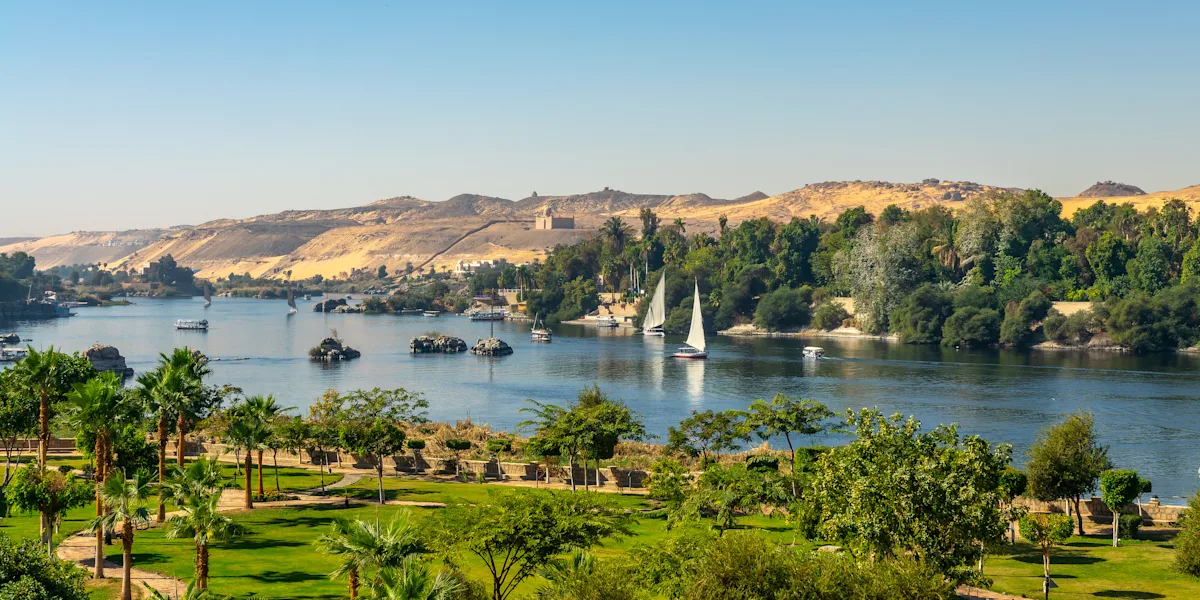
Sail the Nile by felucca, gliding past islands and palm-lined banks
Explore the Temple of Isis, moved stone by stone to save it from rising waters
Disembark in Aswan, long a Nubian trading hub on the Nile
Say farewell to the crew as we disembark the dahabiya this morning in Aswan, a city long central to trade along the Nile and known for its Nubian heritage. Nubia, home to some of Africa's earliest kingdoms and renowned for its rich deposits of gold, was also the gateway through which luxury products like incense, ivory and ebony traveled from their source in sub-Saharan Africa to the civilizations of Egypt and the Mediterranean. Aswan is better known today for its High Dam, built over a decade in the 1960s. Generating massive amounts of hydroelectric power, the dam also allows control of the Nile's seasonal flooding, yet with major environmental consequences: much of its rich fertilizing silt is now impounded in reservoirs and canals and no longer deposited by rising river waters on farmlands, creating less productive soil.
Take a morning sail on a felucca, a traditional wooden boat driven by wind and guided by a single sail, flitting across the Nile as they have done for centuries. Glide past islands, riverside villages and palm-lined banks while enjoying a quiet perspective on the river. After lunch, visit the Temple of Isis, originally built on Philae Island. Rescued from rising waters during construction of the Aswan High Dam, which submerged the island, the temple complex was carefully dismantled and rebuilt stone by stone on Agilkia Island nearby. Explore its courtyards, colonnades and sanctuaries while learning about the enduring importance of Isis, the goddess of love, motherhood and magic. This important temple was one of Egypt's last sites of pagan worship, where Isis and Osiris were venerated for nearly 500 years after the Roman conquest of Egypt in 30 BC and the ensuing spread of Christianity in later centuries. Late this afternoon, arrive at our hotel in Aswan.

Day 10: Hands-on cheese and pottery in fertile Fayoum
Learn traditional cheese-making, one of Fayoum's longstanding rural pursuits
Walk among the pottery studios and kilns of Tunis village overlooking Lake Qaroun
Try your hand at the potter's wheel after a private studio demonstration
Fly from Aswan to Cairo this morning, then continue southwest to Fayoum, a fertile basin fed by canals and Lake Qaroun. Long cultivated yet bordered by desert, the region offers another perspective on Egypt, where farming villages, pottery workshops and fossil-rich landscapes exist side by side. After getting settled into our hotel, followed by lunch, enjoy an introduction to one of Fayoum's traditional pursuits through a local cheese-making experience. Later, explore Tunis village, overlooking Lake Qaroun, known for its pottery studios. Walk among workshops and kilns where artisans continue a craft that has become closely associated with the village. Visit a local pottery studio for a private demonstration, then try your hand at working with clay, finding a new appreciation for the artistry of these master potters.

Day 11: Fossil whales in the desert Valley of the Whales
Explore Wadi El-Rayan's sculpted dunes, desert lakes and waterfalls
Walk among fossil whale skeletons at Wadi El-Hitan, a UNESCO World Heritage Site
Break for a lunch served out in the desert amid the dunes
The contrasting features of the desert landscape around Fayoum are mesmerizing, a setting unique in Egypt. Begin the day in the valley oasis of Wadi El-Rayan, a protected natural area of sculpted sand dunes, waterfalls and desert lakes that's home to rare species such as the slender-horned gazelle and fennec fox. Continue to Wadi El-Hitan, the Valley of the Whales, a UNESCO World Heritage Site that is one of the world's most important fossil locations. Walk among exposed vertebrae, skulls and fossil remains of the earliest, and now extinct, suborder of whales, Archaeoceti, revealing a time when this now-arid landscape lay beneath an ancient sea. These fossils represent one of the major stories of evolution: the emergence of the whale as an ocean-going mammal from a previous life as a land-based animal.
Break the day with a memorable lunch served in the desert, then choose between a quad-bike excursion among the dunes or leisure time back at our hotel. This evening, gather for a farewell dinner as we reflect on our wondrous journey, a passage through time that has connected Egypt's great monuments of antiquity with the communities and traditions that define life along the Nile today.
Day 12: A final lunch in Cairo before flights home
Gather for a final lunch together before homeward flights from Cairo
Rest in a day room connected to the airport by walkway before late departures
After breakfast, depart Fayoum and drive to our 5-star airport hotel in Cairo, where we have a final lunch together. Since most North America-bound flights won't depart until late tonight or in the early hours of the morning, we've booked day rooms for relaxation, refreshment and access to the hotel's full slate of amenities. When it's time to head over for your flight, the hotel is connected to the airport by a convenient walkway.