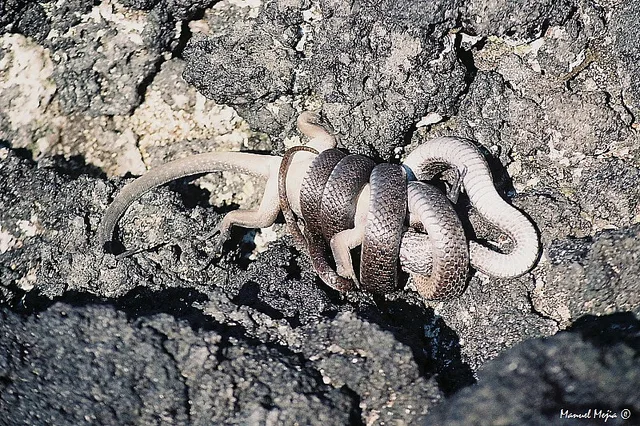
galapagos racer eating a marine iguana

Photo of the Day: Galapagos Racer vs Marine Iguana

There are 19 endemic reptile species in the Galapagos Islands, opens in new tab. While giant tortoises and the land and marine iguanas understandably get most of the attention, some of the archipelago’s lesser known reptile species are pretty interesting in their own right. For example, did you know that there are three species of snakes endemic to the islands? This one here is a Galapagos racer (Alsophis biserialis) and, as you can see, he’s captured a young marine iguana. They also eat lizards, geckos, rats, and grasshoppers and they are preyed upon by the Galapagos Hawk.
galapagos racer eating a marine iguana
Galapagos Racer Eating a Marine Iguana by Manuel Mejia is licensed by CC BY-NC 2.0.

Tagged

More from Galapagos Islands

All Galapagos Islands stories
  • Galapagos Islands

    Tune In: A Galapagos Binge

    Sep 7, 2026 · Jennie Lay

    The Galapagos Islands might be the single best love-at-first-sight solution for what I call “complacent nature deficit disorder.” These are islands of instant gratification, where you’re almost guaranteed to encounter the cerulean foot of a blue-footed booby, the Godzilla-like gaze of a marine iguana and the lumbering girth of a giant tortoise.

  • Galapagos Islands

    A Wild Day in the Galapagos: Whales, Sharks & an Erupting Volcano

    Sep 6, 2026 · WWF

    First, whales. One morning in September, we woke up earlier than usual. We had been navigating overnight toward Bartolome Island, and our guides, Roberto and Giancarlo, had prepared us for possible whale sightings on the final leg of our voyage. We bundled up and stood on the top deck, hot cups of coffee in hand.

  • Galapagos Islands

    Blue-Footed Boobies in the Galapagos: 8 Fascinating Facts

    Jun 6, 2026 · Julie Waggoner

    The Galapagos Islands are home to some of the world’s most recognizable wildlife, and few species attract more attention than the blue-footed booby. Known for their turquoise-blue feet, comic-looking courtship displays and remarkable diving skills, these seabirds are a highlight of many Galapagos wildlife adventures.