Meet Super Diego: The Most Interesting Giant Tortoise in the World (Video)
Even in death, Lonesome George, opens in new tab is still undoubtedly the world’s most famous Galapagos giant tortoise. As the last living Pinta Island tortoise, his inability to reproduce and save his subspecies made him an international celebrity and a powerful, poignant symbol of the finality and tragedy of extinction.
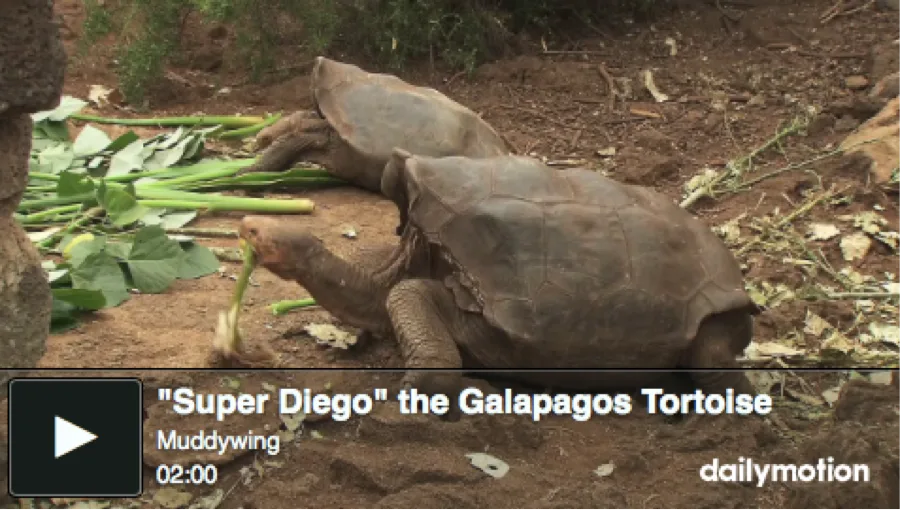
But while George was busy getting all of the press and his likeness printed on t-shirts and coffee mugs, another giant tortoise was quietly busy doing what George couldn’t: breeding prolifically and helping to save his kind from extinction. Diego, who is often called ‘Super Diego’ by his keepers and many fans, is an Española giant tortoise who has sired hundreds of offspring and played a critical role in one of the great Galapagos conservation success stories.
Diego’s story begins sometime between 1900 and 1930 when he and twelve other tortoises were captured on Española and transported to the San Diego Zoo. He might have quietly lived out his days there, but in the 1960s conservationist realized that his kind was in serious trouble. Only 14 Española tortoises (two males and twelve females) remained on the island. Rats, which had been introduced by humans long ago, devoured tortoise eggs and nestlings, while introduced goats and pigs destroyed tortoise habitat. The remaining wild Española tortoises were packed up and shipped to the Charles Darwin Research Station on Santa Cruz where they became part of an ambitious and groundbreaking captive breeding program. In 1977, Diego was sent back to the islands to augment the program’s limited gene pool.
According to his keepers, Diego is the biggest, oldest and most dominant tortoise in the captive breeding program and the most prolific breeder. It is estimated that he’s the father of 40 to 45 percent of the approximately 1,780 tortoises that have been born at the breeding center and returned to the wild. Diego’s offspring have been reproducing in the wild on Española island since 1990.
Now that George is gone, it is high time that Diego assumes his rightful place as the world’s most beloved and important giant tortoise.
Check out the video below to learn more.