That Magic Otavalo Overload
This post was written by Natural Habitat Adventures Chief Exploratory Officer Olaf Malver. Read more of Olaf’s fascinating travel anecdotes on his regular travel column, “Olaf’s Corner.”, opens in new tab
The rickety bus from Quito to Otavalo in Ecuador was bursting with a rich cacophony of Otavaleños women chattering in Quechua, yellow chickens clucking nervously from small bamboo cages, and the bus radio filling the coach with the popular song of “El Condor Pas” in Spanish. It was all a jumble of pleasant and exotic sensory overload. It was the essence of a good travel adventure.
This all happened on my journey to Ecuador in the early 90s; my first South American experience since I left Denmark. At that point, I had only had two very conflicting impressions on what to expect on a journey to the Andean highlands.
The first one dates back from my teenage years on the pedestrian streets of Copenhagen. Here, traveling street bands of Quechua musicians were often seen showing off their amazing flute and guitar skills—singing that same popular Simon and Garfunkel tune. The bands exuded hardworking happiness and entertained us well, even on a rainy Copenhagen night in October! The tunes were melancholic yet alluring and the native dresses were colorful. The music made my fantasies fly off towards colorful Inca festivals in large stone temple complexes—all backdropped by volcanoes and dark green tropical jungles.
The second part of my mental pre-trip luggage for my first South American journey was the then recently published and thought-provoking book, “The Motorcycle Diaries,” a brilliant memoir that traces the early motorcycle travels of the Marxist revolutionary Che Guevara through South America. During that formative 8,000 mile odyssey, Guevara is transformed by witnessing the social injustices of exploited mine workers, persecuted communists, ostracized lepers, and the tattered descendants of a once-great Inca civilization. By journey’s end, he and his friend had traveled by motorcycle, steamship, raft, horse, bus, and hitchhiking, across places such as Ecuador’s Andean highlands, Atacama Desert, and Amazon Basin. The diary ends with a declaration by Guevara displaying his willingness to fight and die for the cause of the poor, and his revolutionary dream of seeing a united Latin America.
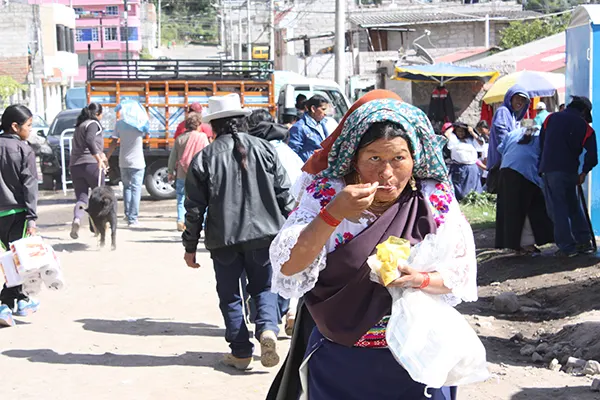
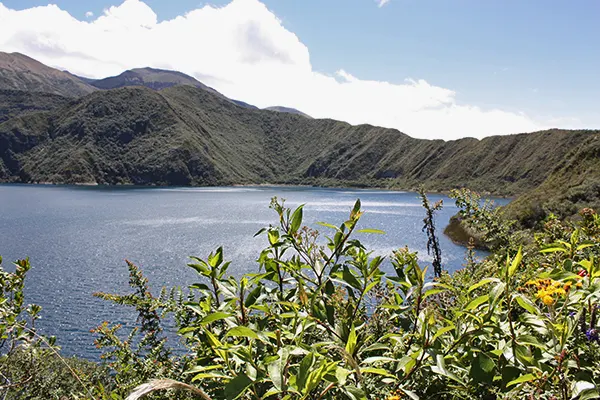
So with these two conflicting preconceptions of both a rich South American cultural display and downtrodden indigenous cultures, I stepped off the bus into that bustling Saturday morning market on the central plaza of Otavalo. This is the indigenous town in the Imbabura Province of Ecuador, surrounded by the beautiful peaks of the snow-clad Imbabura and Cotacachi volcanoes.
From the outset, what I saw was an amazingly captivating and rich place full of bustling commerce between the locals, as well as for tourists. It was not Che’s sad socioeconomic disaster. There was economic vibrancy at its best. Almost one third of the town was full of stalls selling textiles, tagua nut jewelry, musical instruments, dream catchers, leather goods, fake shrunken heads, indigenous costumes, hand-painted platters and trays, purses, clothing, spices, raw foods, spools of wool, and more.
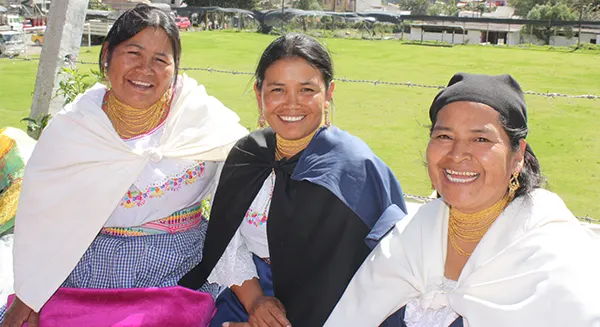
This cultural richness was also seen in how the locals dressed. The Otavaleña women wore distinctive white embroidered blouses with flared lace sleeves and black overskirts. Their long hair was tied back with a narrow band of woven and multicolored cotton strings. The women were adorned with long necklaces of gold and coral beads bracelets around each wrist. The men also wore their traditional dresses of blue ponchos, fedoras, white calf-length knickers and long black braids that hung down nearly to the waist—a pre-Inca tradition.
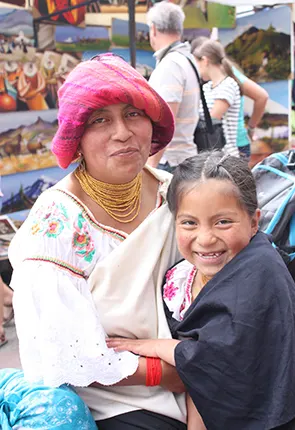
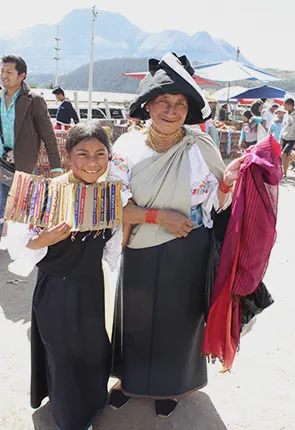
I also discovered that as famous as Otavalo was for its textiles, many of the nearby villages and towns were equally known for their own particular crafts. Cotacachi, the center of Ecuador’s leather industry, is famous for its polished calf skins and decorated horse saddles. In neighboring San Antonio, where the local specialty is wood carving, the main street prominently displays carved statues, picture frames, and furniture.
And finally, I reconnected with the same traditional live music I had first heard on the streets of Northern Europe. All over the market, bands of young people formed folklore groups (conjuntos) that played beautiful tunes with their indigenous wind and percussion instruments, as well as European stringed instruments.
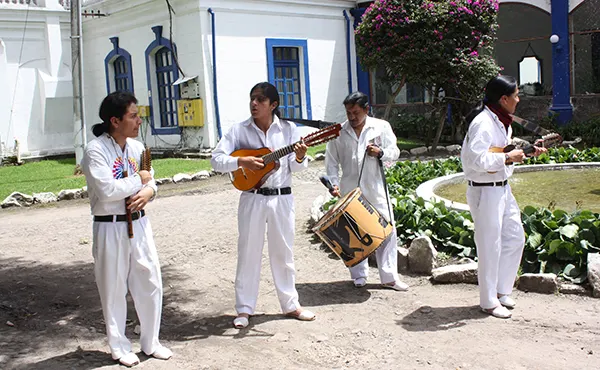
It became clear that the people of the Andean highlands have been able to hold on to their distinctive traditional cultures and practices despite years of oppression from Spanish colonization. They had somehow embraced modernization and still kept their distinctive culture by being an outward-looking society based on their trade and agricultural traditions.
From pre-Inca times through the early Spanish colonial era, a separate merchant group (mindalaes) traded cotton textiles, beads, and other luxury goods throughout the region. Later, non-hacienda natives continued to travel and market textiles. Today, there are part- and full-time merchants who travel throughout Ecuador and to other South and Latin American countries, North America, and Europe selling textiles made by the Otavalo people.
The preservation of their culture was aided by the fact that traditionally, there was a high degree of gender equality, which was probably even greater before the Spanish conquest. From a very early age, children of both genders help with textile and agricultural tasks, carry water, wash clothes, gather firewood, and care for their younger siblings.
Finally, the soil of the Andean highlands is rich compared to the Amazon Basin or the southern deserts in Chile and pampas areas in Argentina. In Otavalo, subsistence farmers successfully grow potatoes, corn, beans, quinoa, cherries, and garden vegetables.
Although few in between, there are other such indigenous success stories in South America. The tribe of the Kuna Yala natives in northern Panama is one. These people are famous for their beautiful embroidered mola textiles and they also trade coco nuts.
However, these few examples of indigenous richness and perseverance are rare in the plethora of many disenfranchised tribes of South America. So in that sense, Che Guevara was right at the time of his journey. Even looking into a crystal ball to find out how the native South American cultures will fare in the general globalization processes…it is still too soon to predict.
If you want to experience a culturally rich and proud indigenous South America culture, then treat yourself with a two-day visit to Otavalo in the Andean highlands of Ecuador prior to your Galapagos adventure. On these trips, you’ll stay at an authentic colonial hacienda near the scenic market town of Otavalo. You’ll explore the region intimately, perhaps hiking at the base of imposing volcanoes or making a visit to a traditional village.
Otavalo, Ecuador, offers a rewarding introduction to a side of Ecuadorian culture that’s distinctly different from what you’ll encounter in the Galapagos. It is unfamiliar, yet wonderful—creating a pleasant foreign sensory overload.
That Magic Otavalo Overload.