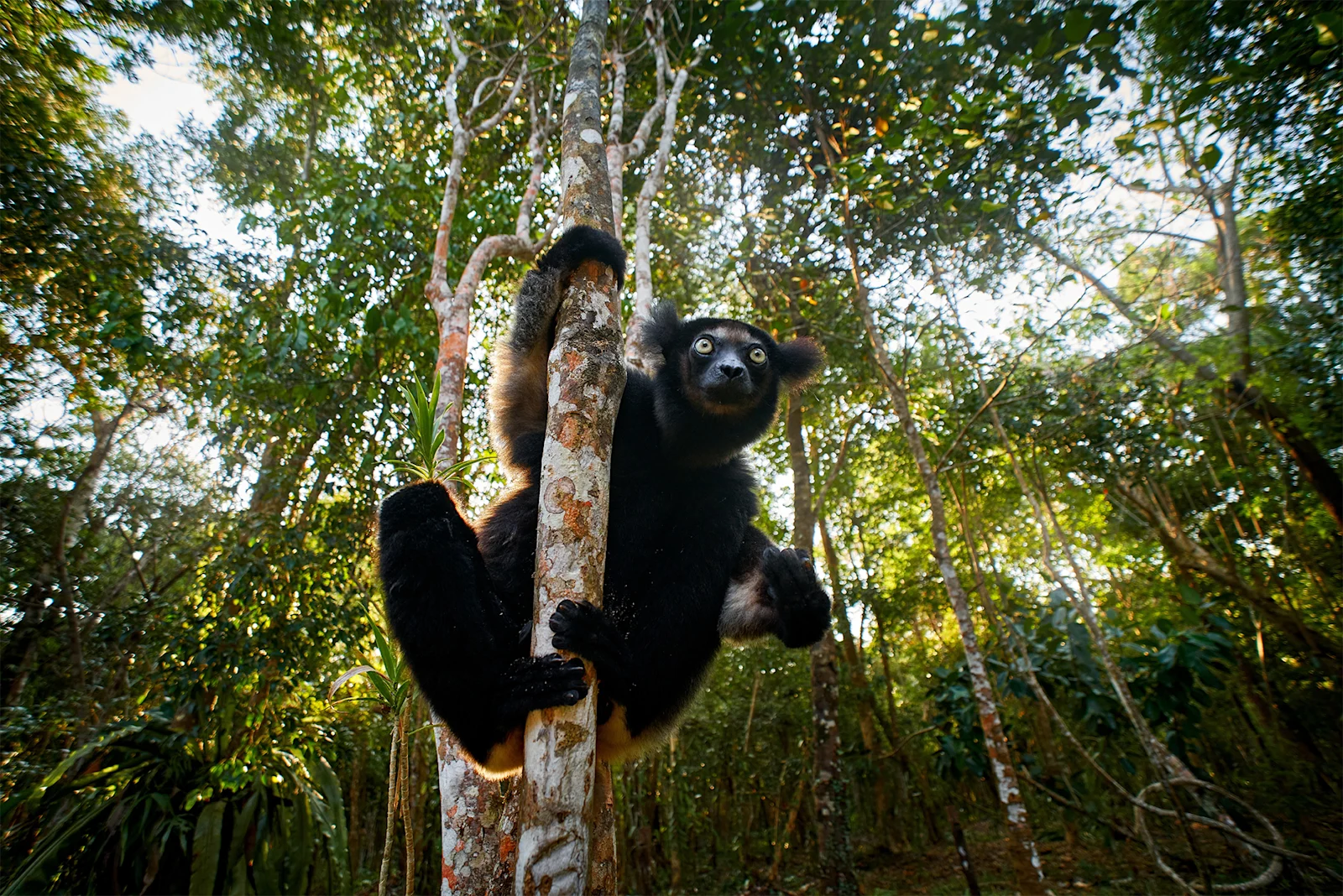
Wildlife Madagascar, babakoto, Indri indri, monkey, wide angle lens with habitat in Kirindy Forest, Madagascar. Lemur in the nature . Sifaka on the tree, sunny day. Largest living lemur.

A Kaleidoscope of Wildlife on Africa’s Largest Island

Madagascar is indeed a world apart, a wildlife kaleidoscope, both visually and verbally! Its rain forests are home to primitive primates such as diademed sifakas, indri and tenrecs, while unique flora such as baobabs and pachypodia punctuate its desert landscapes. Curious about those exotic-sounding names? Here is a short video to give you a teaser to visit Madagascar:

For even the best-traveled nature lover, this large island off the southeast coast of Africa offers a rainbow of discoveries. It’s no wonder World Wildlife Fund (WWF) has chosen Madagascar as a priority place, opens in new tab—more than 80 percent of the island’s rare and intriguing plants and animals, including more than 100 varieties of lemur, exist only here. Other charming creatures include Parson’s chameleons, iridescent sunbirds, and a host of intriguing animals you’ll find nowhere else on Earth.

Madagascar is a living time capsule: once part of a super-continent, Madagascar broke away from that landmass 100 million years ago and has since existed largely in biological isolation. Very few travelers are lucky enough to discover a “continent” they never knew existed! You can do so on a Madagascar wildlife adventure.
More from Nature & Wildlife

All Nature & Wildlife stories
  • Nature & Wildlife

    Our Beautiful, Singular, Habitable World

    Nov 10, 2026 · Candice Gaukel Andrews

    The question of whether Earth is alone in harboring life has captivated humanity for millennia. Likewise, other planets that could support human communities have stoked our imaginations for decades, resulting in books, films and other artworks that show us thriving on distant celestial bodies.

  • Nature & Wildlife

    Extreme Weather Effects

    Nov 3, 2026 · Candice Gaukel Andrews

    The continental United States and many global regions experienced their hottest summer on record in 2026, driven by human-caused climate change and an intensifying El Nino, according to the National Oceanic and Atmospheric Administration’s National Climate Report published on September 9, 2026. Average temperatures were roughly 3 degrees Fahrenheit above the 20th-century baseline.

  • Nature & Wildlife

    5 Apex Predators and Where to Find Them

    Nov 1, 2026 · Cathy Brown

    An apex predator is the hardcore animal at the top of its food chain, the baddest of the bad, with few or no natural predators in its ecosystem.