



Itinerary
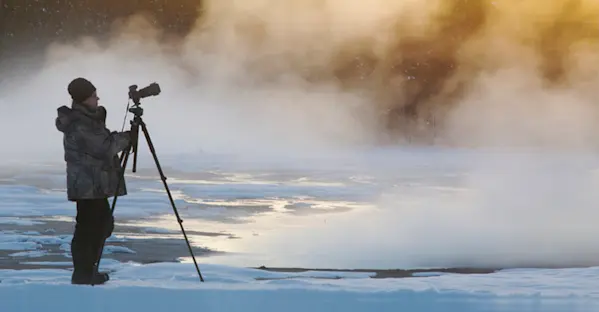
On this unique photography adventure, capture dramatic landscapes and rare wildlife in secluded nature reserves and national parks, get close-ups of giant pandas at research and breeding bases, and photograph scenes of daily life in traditional villages and the ancient walled city of Xi'an. Your Nat Hab Expedition Leader is both a naturalist guide and an accomplished nature and wildlife photographer, offering personalized coaching with tips and techniques to help you get your best shots.
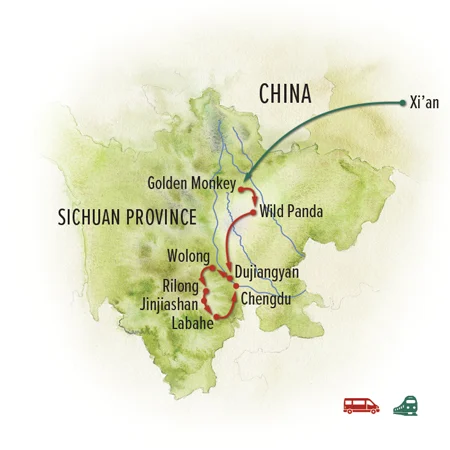
Arrive in the ancient imperial capital of Xi'an, one of China’s earliest regions to be settled, and transfer to our hotel in the Yanta District where we find a number of iconic cultural sites including the Wild Goose Pagodas. Xi’an is where China's first emperor united the disparate warring tribes of the vast realm in the 3rd century B.C. to launch one of the world’s most extraordinary civilizations. The capital of 13 dynasties, Xi’an’s walled city and narrow streets hark back to a time when it was a center for cultural, religious and economic interactions between East and West at the east end of the Silk Road traveled by Persian and Arab traders 1,300 years ago.
After lunch, we visit a portion of the ancient city wall. Xi'an is one of the few cities in China where the old city walls still stand, with most sections carefully restored or rebuilt. Constructed originally in 1370 during the Ming dynasty, the imposing 40-foot-high walls are surrounded by a dry moat and form a rectangle with an 8.6-mile perimeter. Atop the city walls, photograph the old city within its confines, and get panoramic shots over modern-day Xi'an beyond. This evening, gather for a welcome dinner, the first of many delectable Chinese meals.

Depart early this morning to photograph Xi’an’s most famous sight, the Terracotta Warriors. Unearthed in 1974 in the suburbs outside the walled city, the stone army is one of the world's most remarkable archaeological discoveries. Consisting of 8,000 life-size soldiers, 130 chariots and more than 500 horses, none identical, the army was built to guard the massive mausoleum complex of Qin Shihuang (259–210 B.C.), the pivotal leader who became China’s first emperor. The figures vary in height according to their rank, the tallest being the generals. The majority of the figures remain in situ in the pits near the mausoleum, while other non-military terracotta figures were found in adjoining pits, including officials, acrobats, strongmen, and musicians. The Terracotta Army was discovered by a group of local farmers who were digging a well near the Qin Emperor's tomb mound in a region laced with underground springs. Subsequent excavation and research via ground-penetrating radar have revealed that the Army is part of a much larger necropolis covering 38 square miles, part of the emperor's imperial palace compound surrounding his tomb.
Continue to Lesser Wild Goose Pagoda, the smaller of two impressive towers built in Xi'an in the 8th century during the Tang dynasty. The site was inscribed on UNESCO's World Heritage List in 2014 as part of the Silk Roads Network. The well-preserved Buddhist temple is surrounded by a tranquil park and gardens, which we wander through before returning to our hotel. After dinner, head out to discover Xi'an after dark, capturing photos of the cityscape lit up at night.
This morning, board the bullet train for a swift 2-hour journey to Guangyuan, where we disembark to meet our bus. Continue on a scenic drive into the Minshan Mountains. This range in northern Sichuan stretches 250 miles from north to south with its highest peaks rising above 18,000 feet. It’s a wild enclave of lush, densely forested slopes and deep river gorges that shelters an abundance of rare and endangered Chinese wildlife. We stop along the way at impressive photo viewpoints as we journey deep into the mountains, eventually arriving at our hotel where we unwind and anticipate our first wildlife encounters tomorrow.
Rise early this morning to visit a secluded nature reserve that’s home to a large, lively band of golden snub-nosed monkeys. The sanctuary, which covers nearly 40,000 acres, lies near a UNESCO World Heritage Site and Biosphere Reserve in the Minshan Mountains. Encompassing large tracts of virgin forest, pristine lakes, rivers and waterfalls, it is home to 46 different rare animal species, of which the golden monkeys are arguably the most charming. To reach them, we walk uphill on a forested trail for about 30 minutes, depending on where the monkeys are located today, with rest stops en route. We expect excellent close-up shots, as the monkeys are habituated to humans and unfazed by our presence. They live in highly social groups, and their animated interactions at close range delight us. With blue faces, a small, upturned nose, and covered with a mantle of long, shaggy reddish-gold fur, they are hardy creatures, tolerating winter snow and colder temperatures better than any non-human primate. They inhabit high mountainous forests at elevations up to 10,000 feet, descending to lower altitudes in winter.
After our morning with the monkeys, we head into an even more remote sector of these misty mountains, stopping en route in the Muslim village of Qing Xi. We have time to wander its narrow lanes, capturing scenes of street life amid 300-year-old wooden buildings that date to the Qing dynasty. It's a peaceful setting, with a stream coursing through the center of the village. Just beyond the small town lies a secret slice of Chinese wilderness, a chain of nature reserves little known to outsiders and visited by a mere handful of Westerners. Our destination is a national wildlife sanctuary that harbors a vital population of wild giant pandas. We don’t choose to name it, as it is virtually undiscovered by tourists, and we are likely to be the only visitors there. As we follow a rushing river up a narrow valley to reach the reserve, keep an eye out for nocturnal wildlife starting to emerge as dusk descends. Eventually, we reach our hotel, tucked away in the forest along the river, in a setting where our nearest neighbors are mostly wild animals that thrive in these remote protected environs.
Our focus today is an isolated 100,000-acre national reserve with a densely forested ecosystem that is among the most diverse and intact in Asia. This wildlife sanctuary, rated Grade I by WWF as a global biodiversity hotspot, holds healthy populations of some of the world’s most endangered and vulnerable animals, including at least 60 giant pandas. Among its 430 mammal species, the reserve harbors more than 1,200 takin—a large, shaggy relative of wild sheep and goats—as well as more than 2,400 different kinds of plants.
Pursue photos of China's unique wildlife on morning and evening excursions, stopping to drink in stunning vistas of waterfalls, boulder-strewn gorges and mist-shrouded limestone peaks. This is prime panda habitat, and while sightings of this famously elusive mammal are extremely rare, our exclusive permits allow us into distant areas of the reserve where they live and breed freely, affording us the best possible chance to spot signs of them in the wild. Even though we are highly unlikely to spy them in the heavy bamboo understory, just knowing we are in their midst is exhilarating. Search for other species within the reserve’s verdant recesses, too, including Tibetan and rhesus macaques, golden and Sichuan takin, musk deer, muntjac, serow, wild boar and blue sheep. More rarely, we may see endangered moon bears and red pandas. Birding is superb, with more than 150 species in the reserve—the elegant golden pheasant is a photographer's prize. We can often capture images of all of these from the remote roads and trails we explore, although dense vegetation and weather can affect our sightings.
A spectacular drive is in store as we make the full-day journey south from the edge of the Tibetan Plateau to Dujiangyan. Winding through this mountainous region, we pause periodically along our route to photograph dramatic landscapes, rural villages and Buddhist temples. Along the way, pass through the town of Mianyang, known as Fujun in ancient times, with a 2,200-year history that spans the Qin and Han dynasties. We also stop at a local market to captures colorful imagers of rural life, showcasing the bounty of fruit and vegetables harvested in the Sichuan Basin. Enjoy a traditional dinner this evening, then rest up from the day’s journey at our elegant new resort hotel in Dujiangyan. Either tonight or tomorrow night, we’ll take a night walk to photograph Nanqiao Bridge, built in traditional Chinese architectural style and spectacularly lit up after dark. The bridge crosses a canal that slices through the center of the city, part of an ancient irrigation system of dams and canals still in use 2,500 years later.
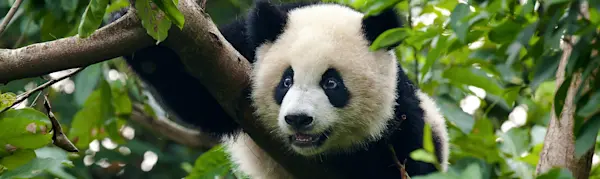
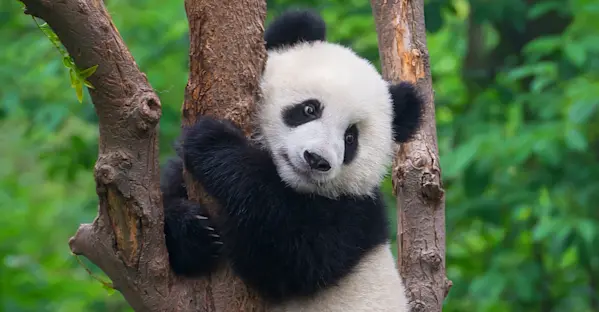
Close encounters with China’s beloved giant pandas are in store today as we visit two panda conservation facilities in Dujiangyan. Dujiangyan Panda Base, which opened in 2013 with the arrival of 10 pandas, focuses on rescue, disease control and prevention, and rehabilitation of injured and ill wild pandas. It has expanded its mission, and its numbers, to encompass care for senior and disabled pandas as well as healthy pandas that are part of the preventive research program. A highlight of our time is a special opportunity to volunteer in their care (though it is not guaranteed and depends on the status of the pandas at the time of our visit). Conditions permitting, we’ll have the chance to interact with pandas at close range as we help their keepers care for them, including tasks such as preparing their food and cleaning enclosures.
This afternoon, visit Dujiangyan Panda Valley, a new facility that is both a panda research and breeding base and a center for conservation education. This quiet setting, landscaped with flowers, provides a natural environs where pandas are gradually habituated and returned to the wild. Reintroduction training experts from around the world gather here for collaborative research. We may see pandas in transitional concrete-block “dens” that are learning to live on their own in the surroundings that mirror their wild habitat. We often have a chance to photograph many red pandas here as well.
Today we visit Gengda Wolong Panda Center in the Wolong Nature Reserve, a base that integrates scientific research, captive breeding and reintroduction of pandas into the wild. More than 30 pandas reside at the center, which includes a 680-acre bamboo forest. Get close-up photos of giant pandas in this natural habitat that features a striking mountain backdrop. Then continue to Rilong, a Tibetan village famous as a base camp for climbing 20,505-foot Mount Siguniang. Translating to Four Sisters Mountain, this imposing massif encompasses four separate peaks and is often referred to as the “Chinese Alps.” In Rilong, we are immersed in Tibetan culture, with traditional architecture on display and yak butter tea for sale by local vendors. This high-altitude village, 10,000 feet above sea level, is the center of the Jiarong Tibetan culture, found only in this region of Sichuan province. The rural Jiarong people are known for their intricately embroidered costumes and agricultural lifestyle, and we find many subjects for creating memorable cultural images.
Early risers may catch glorious landscape shots of the sunrise behind the peaks in Rilong, a vista renowned for its singular beauty. We spend the day photographing the dramatic scenery of nearby Siguniangshan National Park. Entering the 25-mile-long Shuangqiao Valley, snow-capped peaks rise in every direction, with Four Sisters Mountain towering above. The valley floor is 10,000 feet above sea level, and the highest mountains nearly double that. Explore the colorful geological features and mirror-like lakes of this subalpine terrain, following boardwalk trails that weave among occasional pagodas and prayer flags. This high-altitude forest is also native habitat for the endangered red panda. Deeper into the valley, we reach the Ginsenguo flatland, with a viewing deck overlooking highland swamps and snowy peaks, and Jiujia Lake, which is actually a group of four seasonal lakes and nine perennial ones—the legendary bathing pools for the “four sisters.” After a full day of photography in the park, travel back down the valley to spend a second night in Rilong.
Discover Jinjiashan Nature Reserve on foot today as we hike through a forested landscape of dramatic karst formations.
Depart this morning for Labahe Nature Reserve located southwest of Chengdu in the Hengduan Mountains, stopping en route for magnificent mountain vistas, birding opportunities and lunch. Once we reach our destination and check in to our hotel, it’s time to enter the reserve for further photography adventures. Labahe is one of China’s top spots to capture images of the elusive and endearing red panda, and while sightings are never guaranteed, we often find excellent chances to photograph them in these alpine forests. As the day draws to a close, we may get shots of water deer coming down to a salt lick just outside our hotel.
A full day is dedicated to photographing wildlife, especially red pandas, in the Labahe reserve. Although giant pandas also live here, we are much less likely to see them. Comprised of mixed forests and pockets of dense bamboo, the reserve’s diverse vegetation and altitude create ideal habitat for the red panda, which is adapted to environments above 7,000 feet. A wide variety of other mammals and birds thrives here, too, and we hope to capture images of Tibetan macaque, Chinese leopard cat, hog badger, serow, sambar deer, golden takin, and red and white giant flying squirrels. Notable birds include the golden-breasted fulvetta, Lady Amherst’s pheasant, crimson-breasted woodpecker and three-toed parrotbill. In our private vehicle, we have the freedom to explore different parts of the reserve, including opportunities for striking landscape photography from higher mountain locations.
Enjoy a leisurely last morning before we depart Labahe Nature Reserve and drive back to the outskirts of Chengdu, where our hotel is conveniently located at Tianfu Airport for homeward departures tomorrow. This evening, join your Expedition Leader, local guide and traveling companions to celebrate our adventures at a farewell dinner.
After breakfast at our hotel, a transfer is included to the nearby airport terminal to meet departing flights as our China photography odyssey comes to a close this morning.