

2026—2027 Itinerary
Itinerary
Day 1: Arrive in Argentine Patagonia, gateway to the Southern Patagonian Ice Field
Base in El Calafate, gateway to Los Glaciares National Park
Join your Expedition Leader and fellow travelers for a welcome dinner in El Calafate
Our Patagonia journey begins in Argentina’s adventure capital of El Calafate, where we meet our Expedition Leader and traveling companions at a welcome dinner. On the edge of the Southern Patagonia Ice Field, El Calafate was originally a hub for wool traders in the early 20th century. It became an important tourism base when Los Glaciares National Park was created in 1937 and remains so today.

Day 2: Get close to the mighty Perito Moreno Glacier
Cruise iceberg-strewn Lago Argentino by private boat
Approach Perito Moreno Glacier's face, watching for calving ice
Hike boardwalks along a secluded glacier shoreline
Board a private boat for a cruise on Lago Argentino, the country’s largest lake and the third-largest in South America. Icebergs frequently litter its teal-blue waters, as the lake is fed by several glaciers that flow down from the 6,500-square-mile Southern Patagonian Ice Field, one of the most extensive non-polar glaciated areas in the world. The biggest, and one of Patagonia’s premier highlights, is Perito Moreno Glacier, towering 240 feet above the lake’s surface and spanning nearly 3 miles. We approach its jagged blue face at close range, hoping to see an iceberg calve from the imposing wall of ice. Winding down nearly 19 miles from the perpetual snowfields of the Andes to its terminus in the huge lake, Perito Moreno is the most famous of the more than 50 outlet glaciers spilling from the ice field, and one of very few advancing glaciers on the planet. We disembark for a short hike along a secluded shoreline, following a maze of boardwalks offering varied vantage points on the glacier and icebergs drifting on the lake. Return to El Calafate to spend a second night.
Day 3: Cross into Chilean Patagonia
On a scenic drive across open steppe, cross from Argentina into Chile
Watch for guanacos, rheas and condors beneath jagged Andean peaks
Settle into remote Estancia Cerro Guido, your base for exploring Chilean Patagonia
Depart El Calafate this morning and cross the border into Chile, driving south on a scenic route over rolling steppe, with Patagonia’s jagged peaks an ever-present backdrop. Keep an eye out for wildlife, which we frequently spot on the way to Estancia Cerro Guido, where we spend the next three nights. On arrival at the estancia—the Spanish name for a large private tract of land devoted to raising sheep or cattle in Patagonia— we check in to our lodge and gather for an orientation to this impressive conservation project.
Established by European pioneers at the end of the 19th century, this is the largest cattle ranch in the history of Chilean Patagonia, still a working livestock and agricultural enterprise on nearly a quarter-million acres. Dedicated to conservation leadership, the ranch has sought to achieve coexistence between livestock and wildlife, demonstrating that both can flourish in harmony. Improving the condition of its grasslands has attracted native fauna, including grazing guanacos. Given its location on a biological corridor with Torres del Paine National Park, wildlife on its vast expanse is abundant, and we frequently spot gray fox, Andean condor and Darwin’s rhea, a large flightless bird that is a relative of the ostrich and stands three feet tall. If we are especially lucky, we may also spot a puma—they are making a comeback, with concerted conservation efforts.
Each evening, sit down to a memorable dinner featuring the native flavors of Patagonian gastronomy, highlighting fresh ingredients sourced from the ranch. Then tuck into luxuriously appointed accommodations in restored 1920s cottages built by original English pioneers, with décor reflecting the era.

Day 4: Witness puma conservation in action
Join Cerro Guido's puma research team in the field
Head into Las Condoreras to look for wild pumas
Learn how Estancia Cerro Guido balances wildlife conservation and ranching
Today holds an exciting adventure as we learn in depth about Cerro Guido’s impressive conservation values, goals and achievements. On a conservation-focused safari, we participate in Cerro Guido’s puma research project, launched in 2019. Rising early, head into the field with professional puma researchers dedicated full-time to studying pumas that live in a particular sector of the ranch called Las Condoreras. "Puma" is the name the Incas gave to this agile predator, which is also known as a cougar or mountain lion. Through observation with binoculars, review of camera traps, presentation of video material and informative talks, the research team shares their daily work with us, noting achievements and explaining challenges. We’ll learn a great deal about Patagonia’s most magnificent feline predator as well as the varied wildlife of the region and how to facilitate coexistence between livestock and these native dwellers in the wild. An important element of that project is the role of the estancia’s Great Pyrenees and Maremma guard dogs—shepherd breeds trained to handle and protect cattle in a way that deters pumas from approaching. Of course, we keep a close watch for elusive pumas, although sightings are highly unpredictable and we do not always see them. However, we are sure to see other wildlife during our overland exploration of the ranch, and we will come away inspired by the efforts being made to restore not just pumas but an entire balanced ecosystem.
Day 5: Discover gaucho traditions on a classic Patagonian ranch
Hike the open grasslands beneath Patagonia's peaks
Watch skilled gauchos and sheepdogs work the ranch's flocks
Savor a traditional Patagonian asado featuring lamb roasted over an open fire
Start the morning with an easy guided hike near our lodge. The scale of the surrounding open range and mountain peaks is on full display as we traverse the grasslands on foot, drinking in the vastness of our environs and looking for native wildlife along the way. Next, our focus turns from ecology and biodiversity to the human history of Estancia Cerro Guido, as we delve into the living legacy of the rich gaucho heritage synonymous with the region. Gauchos are the traditional Patagonian cowboys who look after cattle and sheep, roaming the pastures on horseback, and we learn about their traditions on a cultural tour of the ranch today. Tour the stable, learn how sheep dogs work the herds, and watch a sheep-shearing demonstration. We also visit the orchard, greenhouse and organic gardens where produce is grown to supply the kitchen that provides our fresh farm-to-table meals. Lunch today is a highlight, as we savor a classic gaucho barbecue of lamb roasted on a spit over an open fire.
Day 6: Into the wild heart of Torres del Paine
Cross the Patagonian steppe into Torres del Paine National Park
Look for guanacos, condors and, with luck, wild pumas
Stay at Patagonia Camp's forest yurts by Lago el Toro
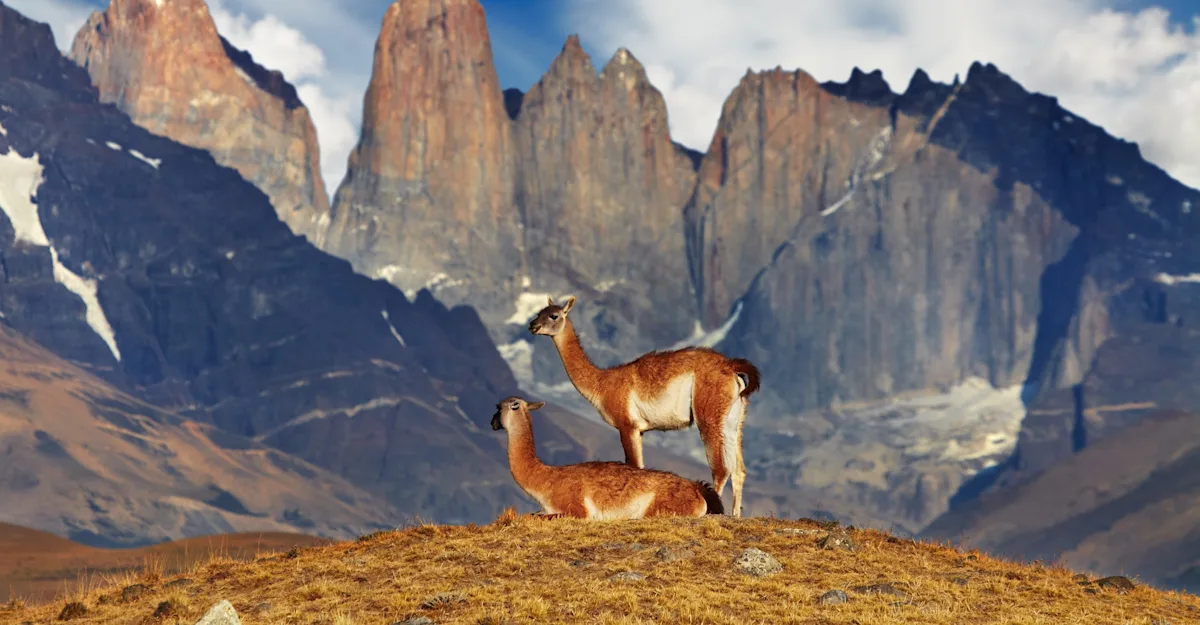
Today we cross the steppe to reach Chile’s Torres Del Paine National Park, stopping at overlooks to admire the staggering views. A UNESCO Biosphere Reserve, the park is home to a host of wildlife including guanaco, fox, huemul (South Andean deer), armadillo, and a growing number of pumas. An impressive array of birdlife is here, too: look for eagles, hawks, rheas, buzzards, owls, flamingos and South American condors back from the brink of extinction. Dominating the horizon are the famous Torres del Paine—the Towers of Paine—dark igneous rock spires millions of years old. Notice how the ecosystem changes as our journey continues and we move from sprawling tawny steppe into rolling mountain foothills covered in native beech forest.
Our destination is Patagonia Camp, a “rustic luxury” outpost on Lago el Toro surrounded by 84,000 acres of private land adjacent to the national park. This unique ecolodge is comprised of 20 spacious yurts tucked within the forest, with views from private decks. Comfortably spaced apart for seclusion, the deluxe yurts feature the appointments of a fine hotel. Common amenities include a large shared lounge yurt, a dining room built of warm native wood with woven wool textiles, and expansive wooden terraces overlooking the lake and mountains beyond. This afternoon holds our first chance for an excursion into the wild nature surrounding us. We've hired a puma tracker to enter the park before us, scouting the terrain for signs of these elusive cats, whose numbers are on the rise here. The tracker will be in radio contact with our Expedition Leader, so we can be apprised right away if a sighting may await.

Days 7 to 8: Explore Torres del Paine National Park
Hike to viewpoints on the granite Paine massif
Explore in small groups with local guides matched to your interests
Follow the shoreline of brilliant blue Lake Pehoe to Salto Grande Falls
Our stay at Patagonia Camp offers a host of options and flexibility to tailor excursions around personal interests and Patagonia’s notorious wind-and-weather whims. We’ll have two Sprinter vans for our group’s private use, plus two local guides who will join our Expedition Leader, allowing us to split up according to varied activity preferences.
A range of walks and hikes offer opportunities to observe the Paine massif from different angles, with roaming guanacos, Andean condors and native flora in the foreground. Classic Magellanic subarctic forest species are on display here—lenga, ñire and coihue, a tall evergreen that can reach 140 feet. We may spy the Magellanic woodpecker and, if we’re lucky, the huemul, a rare Chilean deer that is a national symbol found on the coat of arms on Chile's flag. Guests who want to tackle more challenging hikes to famous national park destinations such as the French Valley, Base of the Towers or Mirador Condor will have an opportunity to do so. Mellower hike options with rewarding views include Mirador Los Cuernos, a vista overlooking the famous outcrop of dark granite horn-like spires. There are also easy outings that depart directly from camp, including Los Azules lookout and Toro’s Waterfall. Those who prefer more independence can also choose self-guided walks from camp.
Lakes and waterfalls are highlights of Torres del Paine, with brilliant blue Lake Pehoe reflecting the serrated peaks like a mirror. We follow its shoreline to Salto Grande Falls, which thunders down from Lake Nordenskjold above. In the northern part of the park, the view from Laguna Azul offers a different angle on the imposing towers. We may also stop at Cascada del Rio Paine to admire this series of terraced waterfalls. As we explore, keep an eye out for wildlife, especially along the Sendero de La Fauna—the animals' trail—so named for the many guanacos that frequent the route. It winds through a favorite puma hunting ground where we may see remains of camelids that the tawny cats have preyed upon. High rock formations flank the path, providing dwellings and lookouts for these stealthy felines. While pumas are notoriously elusive, we have seen them more frequently in recent seasons.
Day 9: Depart Puerto Natales after your Patagonia adventure
Transfer to Puerto Natales for your departing flight
Depart Patagonia Camp this morning with a transfer to your flight departure point: Puerto Natales, about a 75-minute drive. Guests can schedule their departure for any time on the final day.