

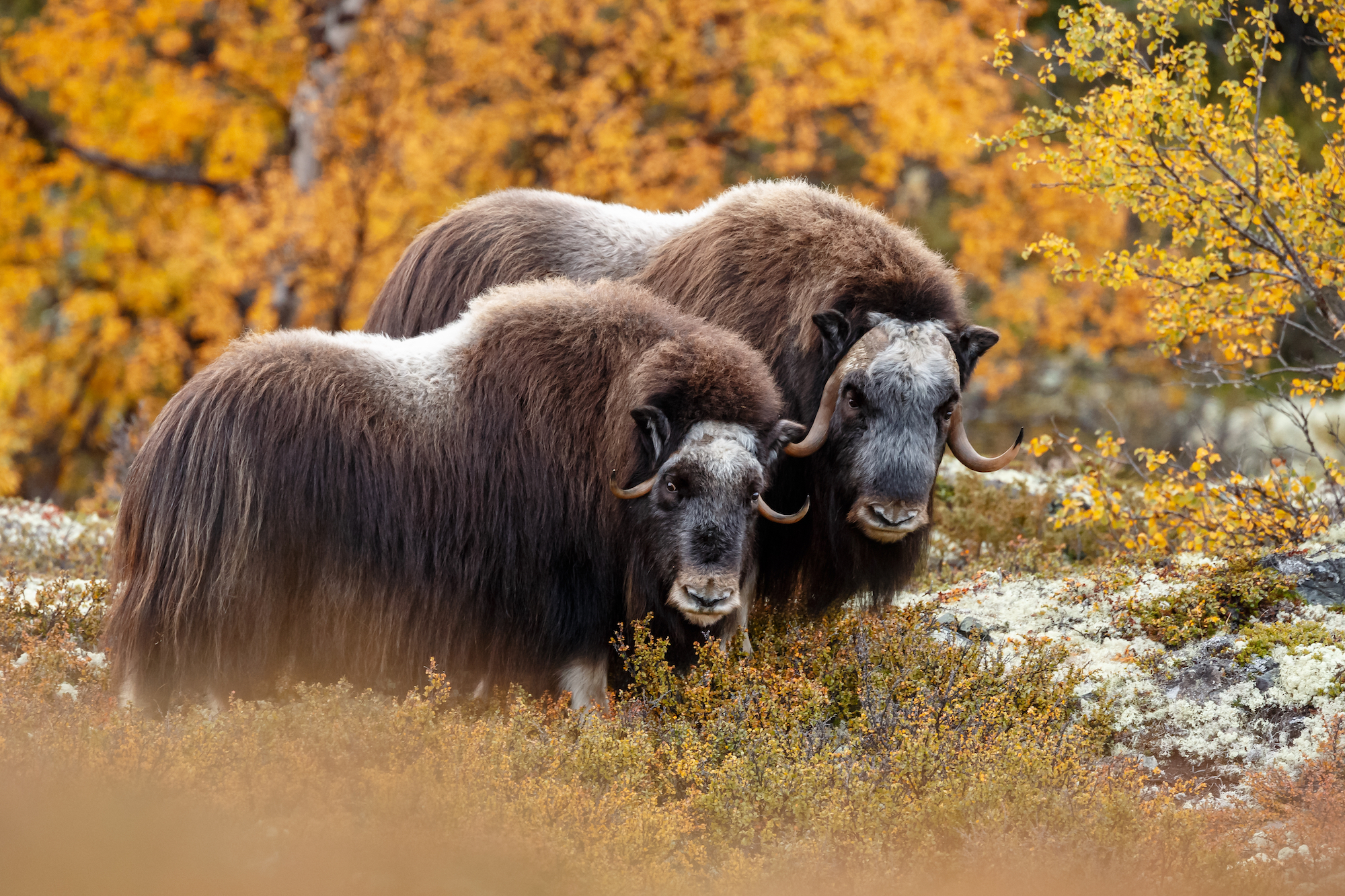
The guide beckons us to a ridgetop on Prince of Wales Island in northern Canada. As we reach the top, he motions for everyone to be absolutely quiet. Because just over the rise is a herd of two dozen muskox that are so far oblivious to our presence.
It’s the middle of September, the hottest time of year in the High Arctic. But the daytime temperature is still well below freezing, with swirls of fog beneath a slate-gray sky that threatens snow flurries later today. With the permafrost below the tundra temporarily melted, the ground is soggy and difficult to step across without water ebbing over the top of your boots. Yet the muskox seem perfectly at ease in conditions that most humans would consider bleak and inhospitable.
We’re downwind and watch them for nearly an hour. The young ones frolicking across the tundra and every so often checking in with their mothers, the males arrayed around the edge of the herd, grazing yet ever alert for danger. Which eventually arrives in the form of a white apparition in the fog, moving closer and closer until a young male polar bear comes into view.
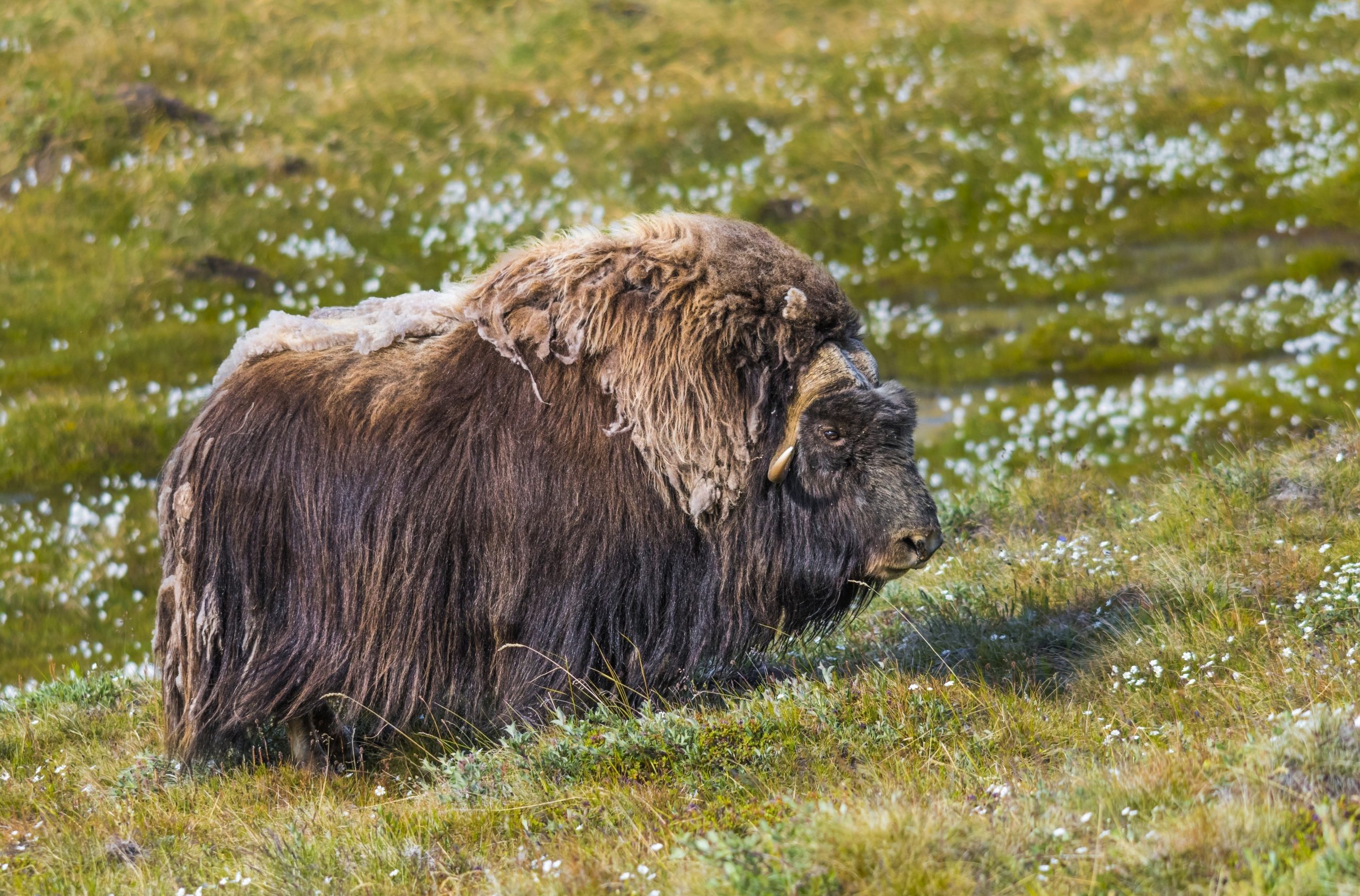
A muskox in Greenland
The bruin is on the opposite side of the muskox but looking straight at us on the ridgetop. Sniffing the air, trying to determine the identity of these strange looking creatures, likely the first humans the bear has ever seen. The guide sets off a flare, not to protect the muskox—you’ve gotta let nature take its course—but because the bear is also a threat to us.
By now, the muskox have formed one of their famous defensive cordons to confront the predator, which doesn’t seem the least bit fazed by that first flare. It takes a second blast for the curious (and probably hungry) bear to turn tail and disappear back into the fog. The threat at least temporarily avoided, the muskox return to their frolicking and grazing.
Muskox aren’t the only large mammal that can survive and thrive in such brutal conditions. Over on the other side of the planet, in the high-altitude and equally chilly trans-Himalayan region, lives the yak.
It’s not hard to tell them apart. Muskox tend to be smaller and shorter, with bobbed tails hidden in their thick fur, and low-slung horns that can be swung from side to side to confront wolves or polar bears—their main predators. Yaks tend to be larger and taller, with long, horse-like tails and upturned horns similar to cattle and more likely used on one another (males battling during the mating season) than against possible predators like the snow leopard.
However, both are members of the Bovidae family, a widely dispersed group that also includes bison, cattle, antelopes, sheep and goats. While those other cloven-hoofed ruminants tend to dwell in more temperate climates, muskox and yaks have found their niche in extremely chilly environments thanks to adaptations like their long, thick coats.
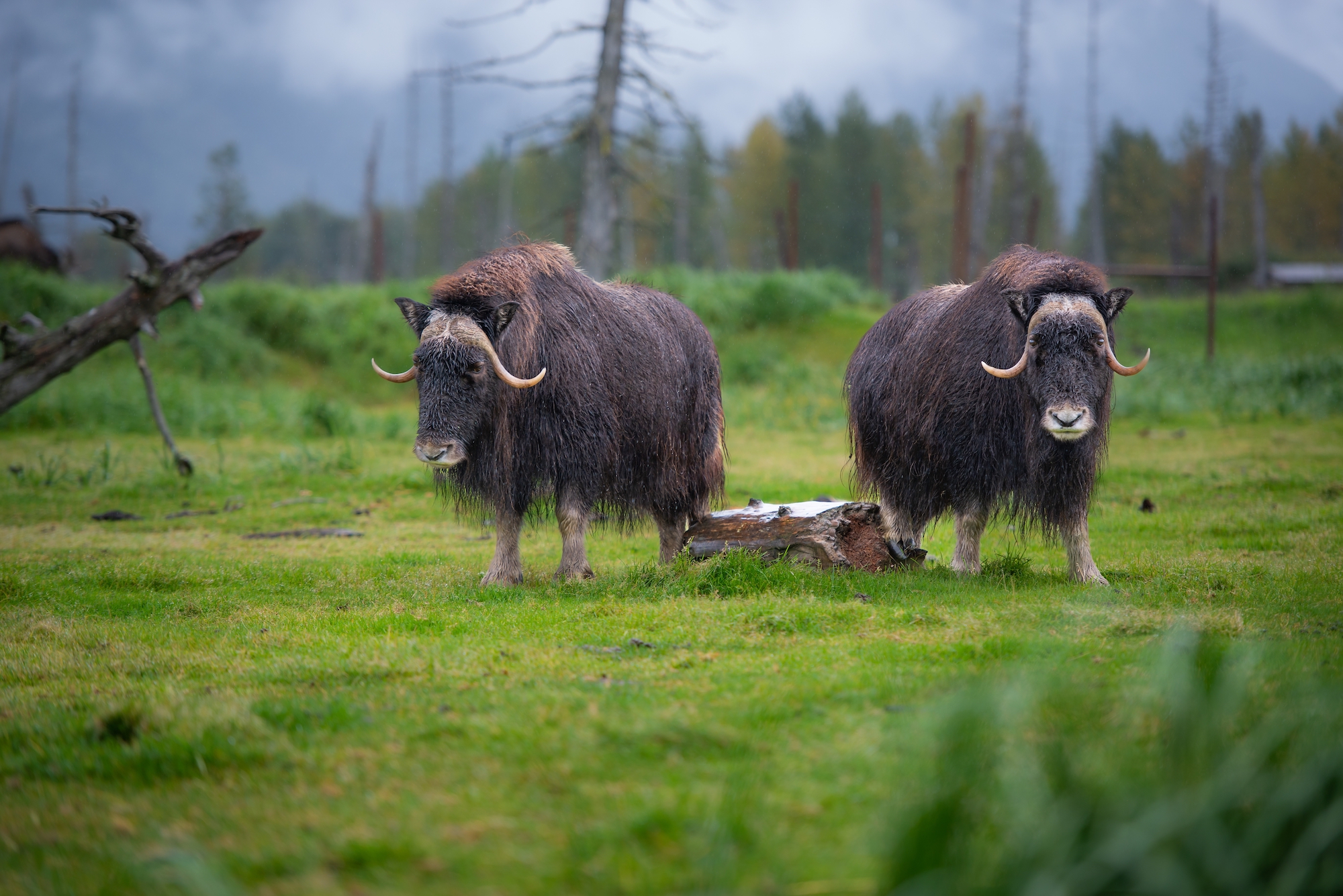
Muskox in Alaska
Ugly Moose or Bearded One?
Ovibos moschatus may not be the noblest looking animal. Yet muskox deserve far more respect than they’ve traditionally received from humans. The Cree people of northern Canada called them mâthi-môs (“ugly moose”). Because of a pungent odor released during the mating season, 17th-century British explorers dubbed them muskox, which is sort of like calling them stinky cattle. On the other hand, the Inuit people, who have long revered the beast and depended on muskox for their own survival, gave them a descriptive name—umingmak or “bearded one.”
Owing to the lack of ancient muskox fossils in North America, it’s believed they migrated into the western hemisphere from Asia via the Bering Land Bridge during the Pleistocene era, long before the first humans made the same trek. “Muskox were around when there were saber-toothed tigers and woolly mammoths,” says veteran Canadian wilderness guide and photographer Jerry Kobalenko. “They’re basically prehistoric creatures awaiting the next ice age.”
Like the glaciers that once covered much of North America, the muskox range has receded considerably over the past 10,000 years, and they are now primarily confined to remote areas above the Arctic Circle. The global population is estimated at between 80,000 and 150,000 animals, two-thirds of them in Canada and the rest scattered between Alaska, Greenland, Norway and the Siberian region of Russia. But that hasn’t always been the case.
For thousands of years, the Indigenous people of Greenland, Alaska and the Canadian Arctic hunted the shaggy beasts for food, clothing and other uses. But the harvest was sustainable, and the muskox population remained stable. But with the arrival of European explorers, hunters and settlers, they were nearly extinct by the early 20th century. They disappeared completely in Alaska and were reduced to around 500 individuals in Canada.
“As the buffalo [bison] diminished and the buffalo pelts were no longer available to rich people for their carriages and so on, they began using muskox,” says Kobalenko. “The wealthy of Toronto and Montreal would all have muskox fur on their sleighs in winter.” Another factor in their near extinction, says Kobalenko, was explorers killing around 1,200 muskox just to feed their Arctic expeditions. “That number doesn’t seem large when you’re dealing with beef cattle, but it’s a lot when you’re dealing with an animal that has to eke a living out of a very marginal environment.”
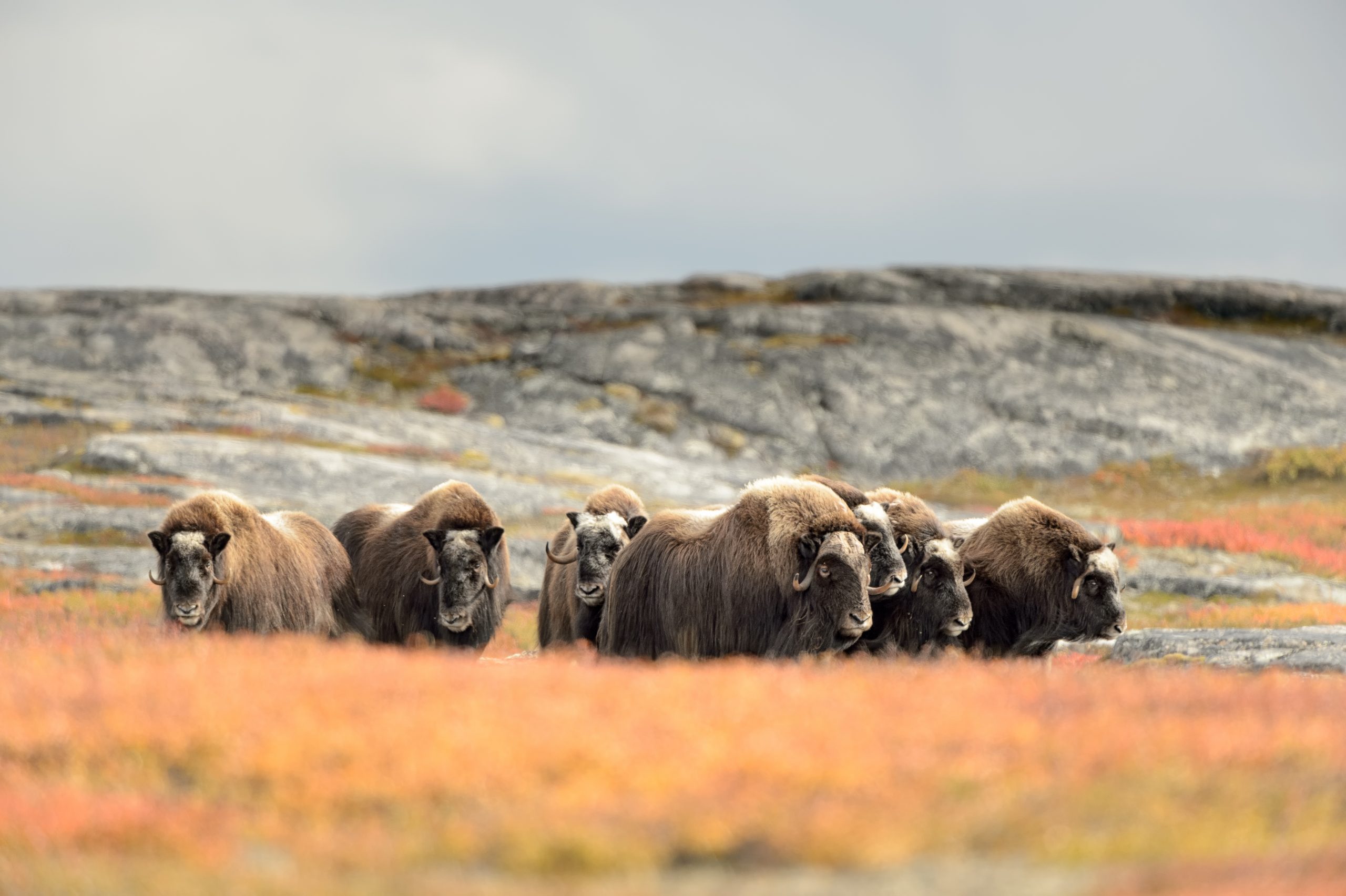
A herd of muskox
Ironically, it was also humans who saved the muskox. Realizing the animals were on the verge of disappearing, the Canadian government banned hunting in the 1920s and shortly after created a sanctuary for muskox and other Arctic animals twice the size of Belgium in the Nunavut territory. Meanwhile, the U.S. government hired a Norwegian trapper to capture a herd of Greenland muskox, 34 animals that were shipped by sea and rail to Alaska (via New York City and Seattle).
Those efforts were the foundation of the muskox herds you find today in both areas, including the Musk Ox Farm near Palmer, Alaska. Founded in 1964 by anthropologist John Teal with assistance from the University of Alaska, the farm offers educational guided tours of a spread that’s now home to more than 60 muskox.
The farm harvests muskox qiviut (soft under-wool) that gets spun into super-fine yarn dyed in various organic colors, beanie hats and scarves sold online and in the farm gift shop to pay for upkeep and fund outreach programs. One of the original outreach efforts was a series of workshops to teach Indigenous women modern qiviut spinning techniques to make garments to supplement their incomes. That program evolved into the Oomingmak Musk Ox Producers’ Cooperative, which now includes around 250 Native Alaskan women sewing the clothing by hand.
“Our founder recognized that trying to bring cash into that economy is a very challenging,” says Mark Austin, executive director of the nonprofit that runs the farm. “What he was hoping to do was bring a geographically appropriate form of agriculture to the far north. He didn’t want to bring a goat and build a barn in remote Alaska that was going to take care of the goat. He wanted an animal that didn’t need a special barn, special food, special care, so that an Alaskan family that’s living a subsistence lifestyle might actually keep a few musk oxen. That was his hope and dream.”
Over on the other side of North America, muskox remain an integral part of Greenland culture and lifestyle. The herds are scattered across the vast island, mostly in remote areas but also a herd near the international airport and former U.S. air base at Kangerlussuaq.
Former Greenland prime minister and wildlife advocate Aleqa Hammond relates how Inuit hunters from western Greenland once crossed the frozen-over Baffin Bay each winter to hunt muskox on Ellesmere Island in modern-day Canada. That 60-mile trip across the treacherous sea ice is no longer possible because of climate change. However, Greenland has compensated by bolstering its own numbers by relocating muskox closer to populated areas on the island’s west side.
“In terms of a resource, Greenland prioritizes the muskox because it contributes to household economies in a very important way,” Hammond explains. “It is the fastest growing stock in the world, and they are doing so well in Greenland. It’s one of the most popular meat sources now. And the wool is very, very attractive, the most expensive in the world, waterproof and water resistant, and it doesn’t weigh anything.”
She adds that muskox help compensate for the lack of cattle ranching in Greenland due to the Arctic climate. And even though they occupy the same terrain as reindeer, they have different diets and don’t compete for food. In that way, “muskox are a perfect animal for Greenland,” says Hammond.
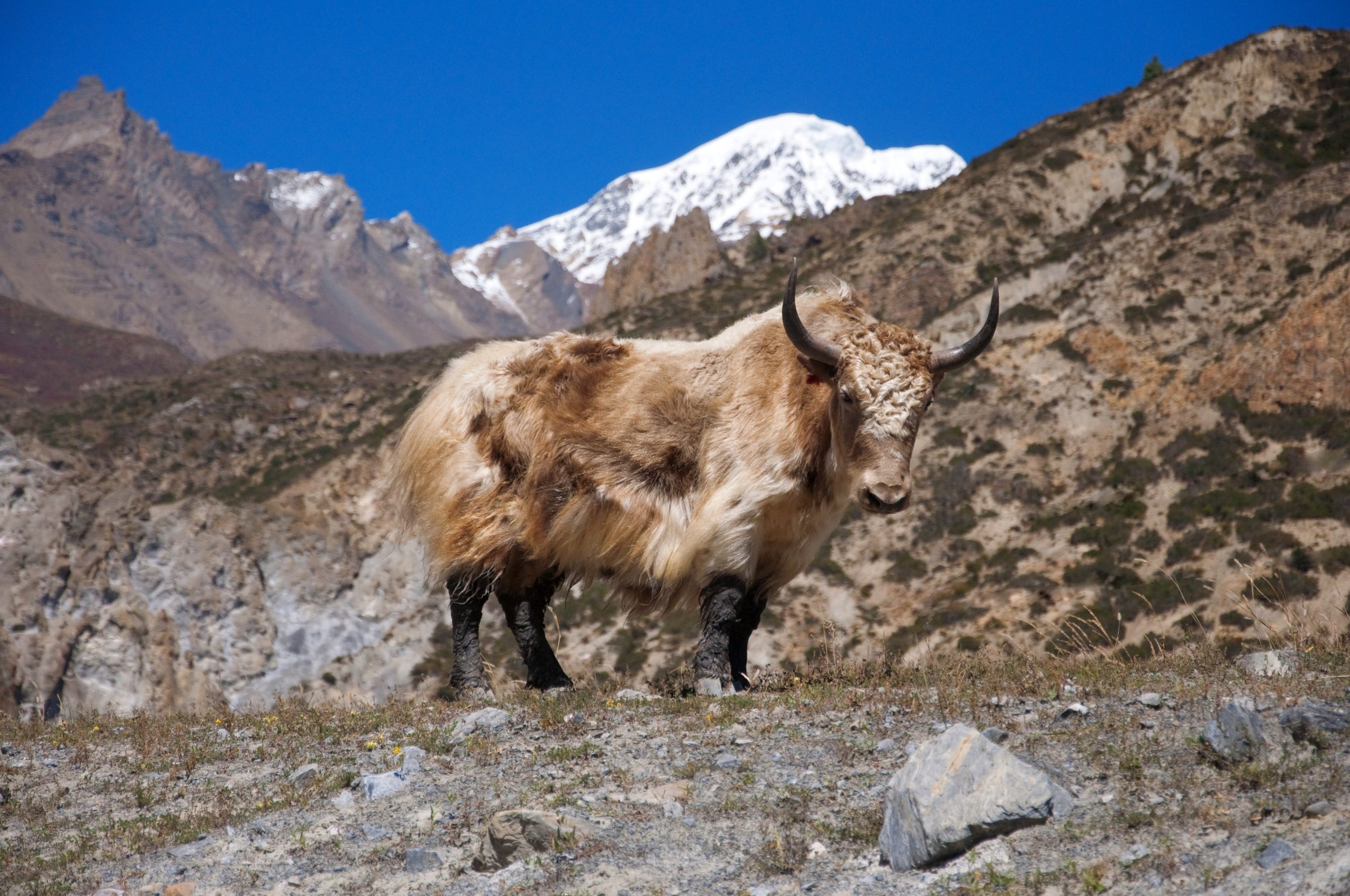
A Nepalese long-haired yak
Yaking It Up in the Himalayas
The hairy beast that survives and thrives in extreme cold is the yak of Asia’s trans-Himalayan region. Analyzing recent archaeological finds and DNA, researchers at Washington University of St. Louis have determined yaks were first domesticated around 2,500 years ago. In fact, they’ve been beasts of burden so long that two distinct subspecies have evolved—the domesticated yak (Bos grunniens) and the wild yak (Bos mutus).
The animals are found primarily in Bhutan, Nepal, the Tibet Plateau, Mongolia and the Himalayan regions of India and Pakistan, where they have multiple uses. They provide milk, meat, cheese and butter. Their thick, warming wool is spun into clothing and carpets. Their dung is used to stoke kitchen stoves and campfires. As a beast of burden, they can pull a plow across a field or lug cargo over lofty mountain passes that would debilitate a horse or mule.
Domestic yaks generally live between 11,500 and 13,100 feet above sea level. However, their wild cousins can roam as high as nearly 20,000 feet. The secret to its survival at extreme altitudes is genetic evolution, in particular three genes that help yaks avoid hypoxia, edema and other types of altitude sickness.
Their long, shaggy hair and dense, wool-like undercoat help them ward off cold that can reach as low as -50°F. From ropes and tent fabric to blankets, rugs and garments, yak hair is worked into numerous everyday items. The animals also have a third type of hair, a super-fine coat that gets shed in the spring or early summer. Often compared to cashmere in terms of softness, the down-like hair is spun into yarn for the finest clothing and has even entered the world of high fashion.
Beyond functional uses, yaks are also essential to festivals, faith and folklore. Yak racing (with a human jockey) features at several festivals in the trans-Himalayan region, and Mongolians have created a variant called yak polo. The ancient kingdom of Mustang in Nepal stages a spring festival that revolves around drinking raw yak blood, which is thought to cure various ailments because yaks feed on many medicinal herbs (only minimal blood is drawn from each beast).
Yet nowhere seems to match Bhutan when it comes to admiration for the noble beast. “Yaks are very loved and respected in Bhutan, especially in the highlands,” says a spokesperson for the Bhutan Tourism Board. “They hold sentimental value too; families treat their yaks as members of the family even.”
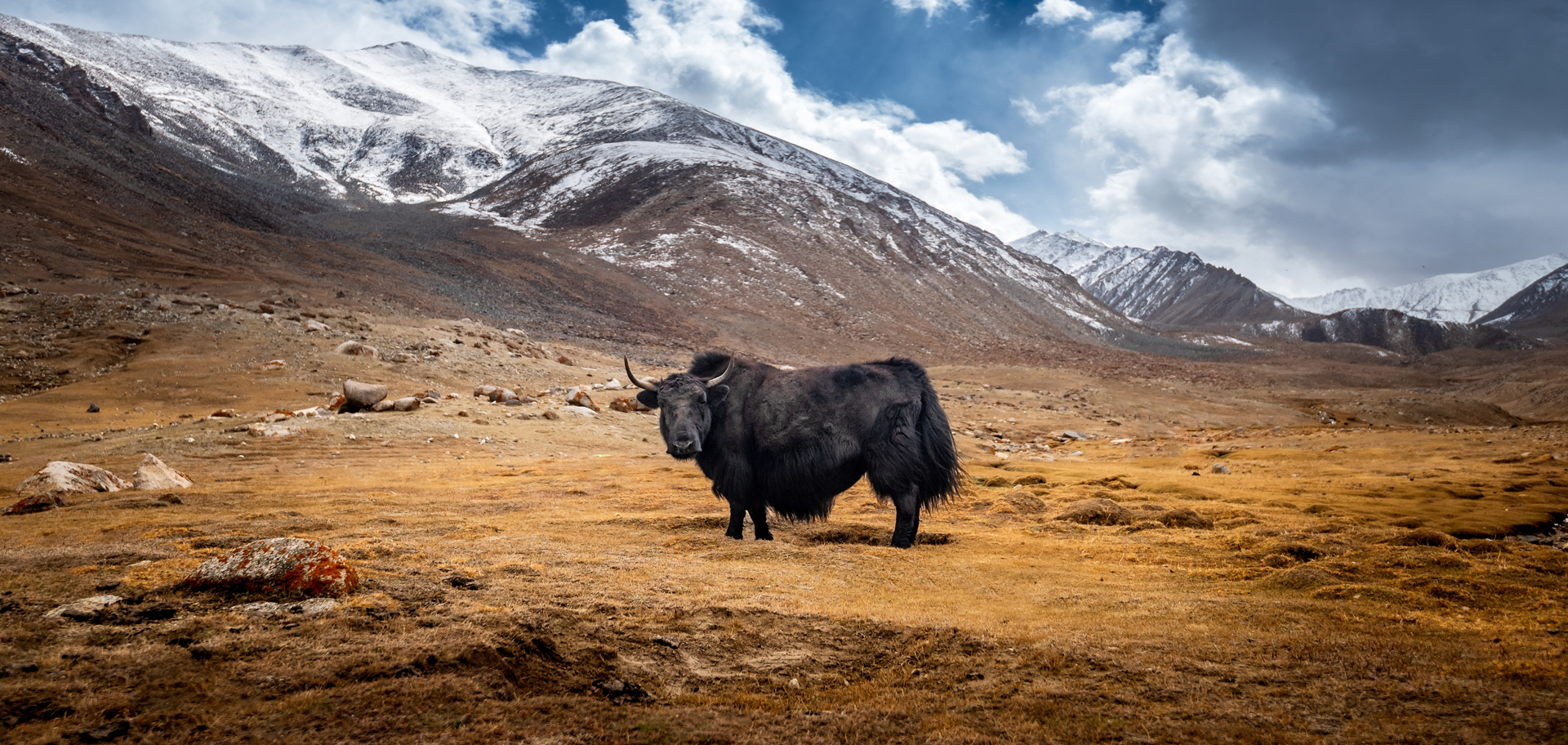
A yak in the Himalayas
Yaks feature hugely in Bhutanese folklore, including a popular tale that relates how long ago both the yak and the water buffalo were best friends living in the country’s southern foothills. They looked similar and had around the same amount of body hair. When the yak decided to venture into the mountains in search of salt (one of its favorite foods), he borrowed the buffalo’s hair to make his own much longer and keep warm in the highlands.
The Royal Highland Festival in Laya is one of several events featuring yak dancing, a complicated choreography with 19 steps that reflects the lives of both yaks and their human herders. A recent hit pop song and video tells the story of a farmer who pines after his lost yak. The beast also features in Bhutanese cinema as the star of movies like Norbu, My Beloved Yak and Lunana: A Yak in the Classroom.
Alaska Zoo in Anchorage is one of the few wildlife collections that showcases both animals. The zoo currently has three muskox, including a bull, a mother and her daughter, and five yaks, including an adult steer, the adult cows and one steer calf.
Zoo curator Sam Lavin says that while they’re fed similar diets (primarily hay and mineral block complemented by summer grazing), they display unique behaviors. “Neither species is overly friendly, but the yaks enjoy human interaction more than the muskox.” On the other hand, she says, “the muskox are more interactive with their enrichment and quick to use their horns. The yaks don’t care as much about the enrichment unless it has to do with hay.”
Despite similar natural habitats, Lavin says that muskox are more likely to get bent out of shape in hot weather. “We turn on sprinklers for the muskox in the summer if it gets above 70°F.”