
Live From Churchill: October 28, 2009
A daily field report on polar bears from our guide Steve Selden in our Churchill, Manitoba office! Check out our polar bear tours here.
More of the same, weather-wise…temps around 32°F with scattered flurries. Cloudy skies lightened later in the day, then finally gave way to dense thick fog that smothered the Churchill area. The gradual warming trend has led to some melting of the ice over the scattered ponds allowing for moisture levels in the air to rise. Fortunately, before the precipitation came, all the travelers were safely settled in their dinner venues enjoying Churchill’s fine northern cuisine.
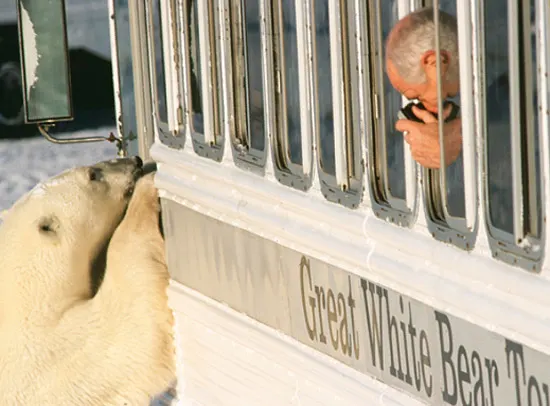
News from the tundra in the Churchill Wildlife Management Area (CWMA) focuses on the mothers and cubs that are showing up on the land. Guides Scott and Karen with their respective groups remained stationary in their polar rovers out just past the lodge on the trail to Gordon point. Guide Karen reports watching a mom and two two-year old cubs, one male and one female, resting peacefully near their rover while intermittent nursing occurred. When a lone male bear appeared, mom became nervous and the cubs stood up to see him. The family proceeded, led by mom, to run across the track in front of the rover then back to the rear of the vehicle and off onto an icy pond. The male subsequently remained in the area and then stood up against the rover’s wheel and peered inside. Mmmmm, Nanaimo bars! On the way back to launch, Scott’s folks spotted a Lemming and a beautiful Snowy Owl hot on the trail.
Back toward town, near the entrance to the airport, departing groups and guides waited anxiously as Conservation Officers wheeled out an unconscious large male polar bear from the bear compound — D-20 as it’s known to locals — on a flat-bed cart, positioned him on top of a thick net, and secured the net around him. With perfect timing, a bear lift awed our guests just before they boarded our charter aircraft bound for Winnipeg. As the helicopter hovered and landed, the officers and crew hooked a 100-ft. line connected to the net to the underside of the helicopter. There is actually a job title in the helicopter business known as Chief Hooker. Within minutes the chopper hauled the suspended net through the air over the crowd as shutters whizzed feverishly. Remarkably, a 700lb bear became a mere speck in the sky within seconds. The bear is destined for a location about 45 miles North just past Seal River. The animal will be released and will slowly awaken unharmed and clear of Churchill…at least for now. Bears who make their way into the Polar Bear Jail are held a minimum of 30 days during the season and then released away from town to protect them and the people of Churchill. At press time there are currently 12 polar bears being held in the compound. There have been a total of 163 occurrences (interactions with bears by officers) to date this year.