

In the autumn of 1973, wilderness writer and naturalist Peter Matthiessen joined preeminent field biologist George Schaller high in Nepal’s Himalayan Mountains on a journey that would soon become legendary. While Schaller was there to study the mating habits of the bharal, or Himalayan blue sheep, Matthiessen was on a quest for spiritual enlightenment—one paired with the hope of glimpsing one of the region’s most elusive animals: the snow leopard.
This strenuous two-month expedition resulted in one of his best-known books, The Snow Leopard—a work that continues to enlighten and inspire readers today.
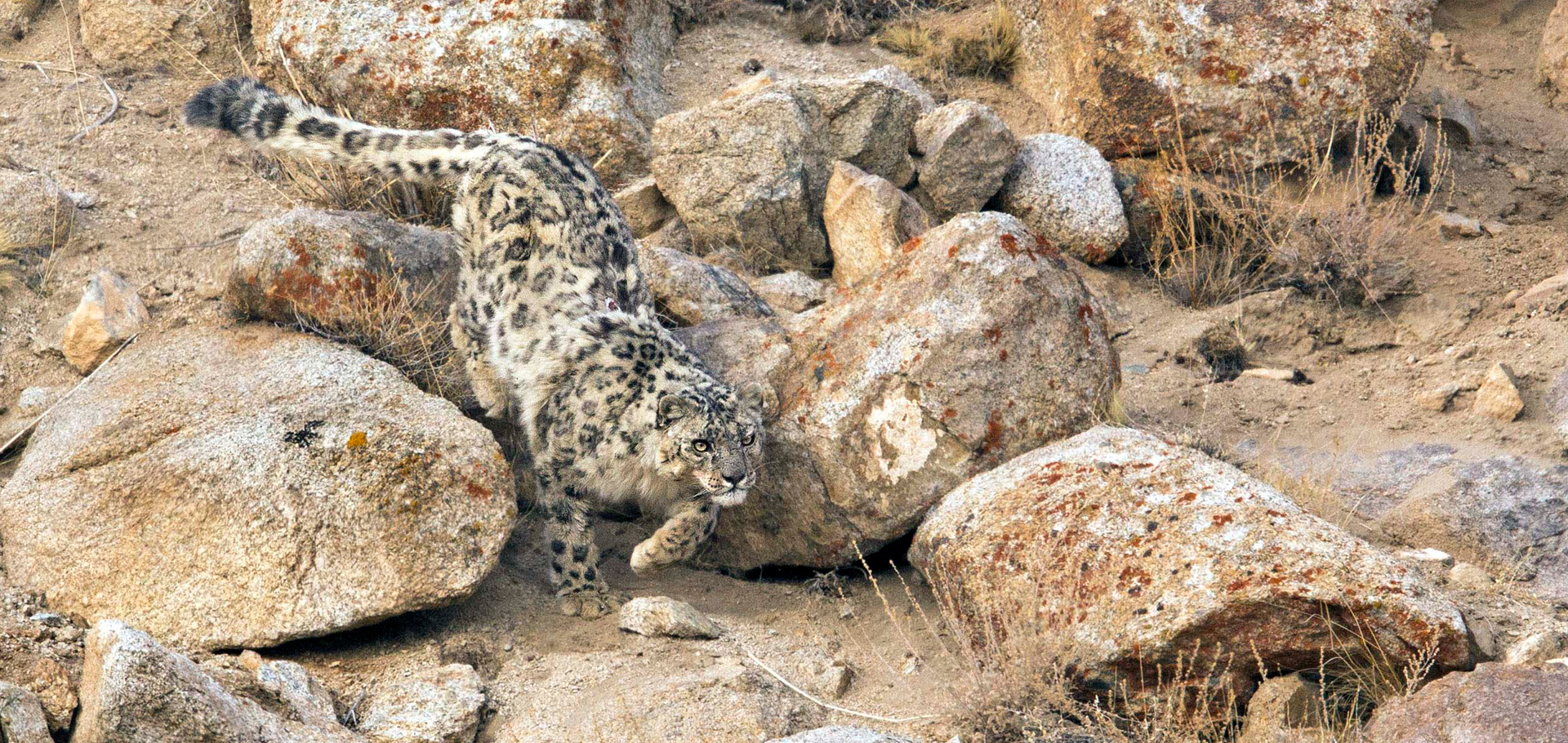
It’s no secret that big cats stir the imagination, from the lions of Kenya’s Maasai Mara to the jaguar that reigns over South America’s Pantanal. Snow leopards are no exception. For decades, so little was known about these shy, solitary cats that inhabit the world’s highest mountains that they took on an almost mythical status. Local communities call them the “gray ghost” or the “ghost of the mountains” because they are so rarely seen.

© Surya Ramachandran
In fact, when Matthiessen embarked on his expedition, only two Westerners had reported seeing a snow leopard over the previous 25 years. One of them was Schaller, who was also the first to photograph a snow leopard in the wild. In 1971, his images appeared in National Geographic, offering the world its first glimpse of this elusive cat in its natural habitat.
The Elusive Snow Leopard
Getting a photograph of a wild snow leopard is no easy task, though it has become more feasible in recent years. Expert trackers know what to look for—fresh scat, tracks pressed into snow and subtle scent-marking patterns along ridgelines.
Since The Snow Leopard was first published in 1978, much more has been learned about these elusive cats. Snow leopards can reach about seven feet in total length, including the tail, and typically weigh between 50 and 90 pounds. They are most active at dawn and dusk, moving quietly across steep terrain.
Unlike other big cats, snow leopards cannot roar. Instead, they chuff, growl and yowl. They prefer rugged, high-elevation landscapes above the treeline, where thin air and harsh weather define the environment. Their thick fur—pale gray to smoky white with dark rosettes—blends seamlessly with rock and snow, making them exceptionally difficult to spot.
Where to See Snow Leopards in the Wild
According to leading conservation organizations, about 4,000 to 6,500 snow leopards remain in the wild, though the true number is still uncertain. They inhabit alpine and subalpine terrain across 12 countries in Central and South Asia, including Mongolia, Afghanistan and Bhutan.
Schaller captured his now-famous images in Pakistan’s Chitral Valley—another region where snow leopards persist. Populations also inhabit the Altai Mountains, where Russia, Mongolia, China and Kazakhstan converge.
One of the best places to search for snow leopards today is India’s Ladakh region, part of the greater Himalaya. India’s first national snow leopard assessment recorded 477 individuals in Ladakh—the highest number for any region in the country. Hemis National Park, in particular, is recognized as one of the most reliable places in the world to look for them, with one of the highest population densities documented in a protected area.

© Surya Ramachandran
India’s Ladakh Region Awaits
For an exceptional opportunity to explore this remote landscape and photograph snow leopards, join Nat Hab’s Snow Leopard Quest Photo Expedition. Set in the high Himalaya of northern India, Ladakh is framed by jagged peaks and dotted with Buddhist monasteries, meditation caves and isolated villages shaped by centuries of Tibetan cultural influence.
With a small group size of eight and a flexible daily schedule, Nat Hab offers participants an excellent chance to observe snow leopards without disturbance. You may see one descending to hunt bharal, ibex, marmots or hares along steep slopes, or resting along a high ridgeline, nearly indistinguishable from the rock.
Keep your camera ready.
Getting a Good Photograph
The chances of capturing a snow leopard photograph increase the longer you spend in its habitat. Nat Hab’s expert trackers work tirelessly to follow the cats’ movements across vast terrain. While conditions can be rugged, the reward of seeing a snow leopard in the wild is profound. With luck, you may even spot a cub.
Ladakh’s wildlife extends well beyond snow leopards. Look for urial, golden eagles and bearded vultures riding thermals overhead. You may also encounter the Himalayan wolf, adapted to life in cold, high-altitude environments.
The region itself offers rich visual rewards—narrow valleys lined with prayer flags, winding rivers cutting through stark terrain and historic palaces set against a dramatic mountain backdrop.
Although Matthiessen never saw a snow leopard during his 1973 expedition, that was never the sole purpose of his journey. As a 2018 New Yorker article notes, if he had simply wanted to see one, he could have visited a zoo much closer to home.
Instead, Matthiessen understood that the true value lay in the search itself. The possibility of encountering a snow leopard in its natural environment—not guaranteed, never staged—imbues the experience with meaning. Even without a sighting, the journey across some of the world’s highest and most remote landscapes becomes its own reward.
Ready to see and photograph snow leopards in the wild? Learn more about our Land of the Snow Leopard adventure and our photo-focused Snow Leopard Quest Photo Expedition. Or explore our photo expeditions around the globe.