

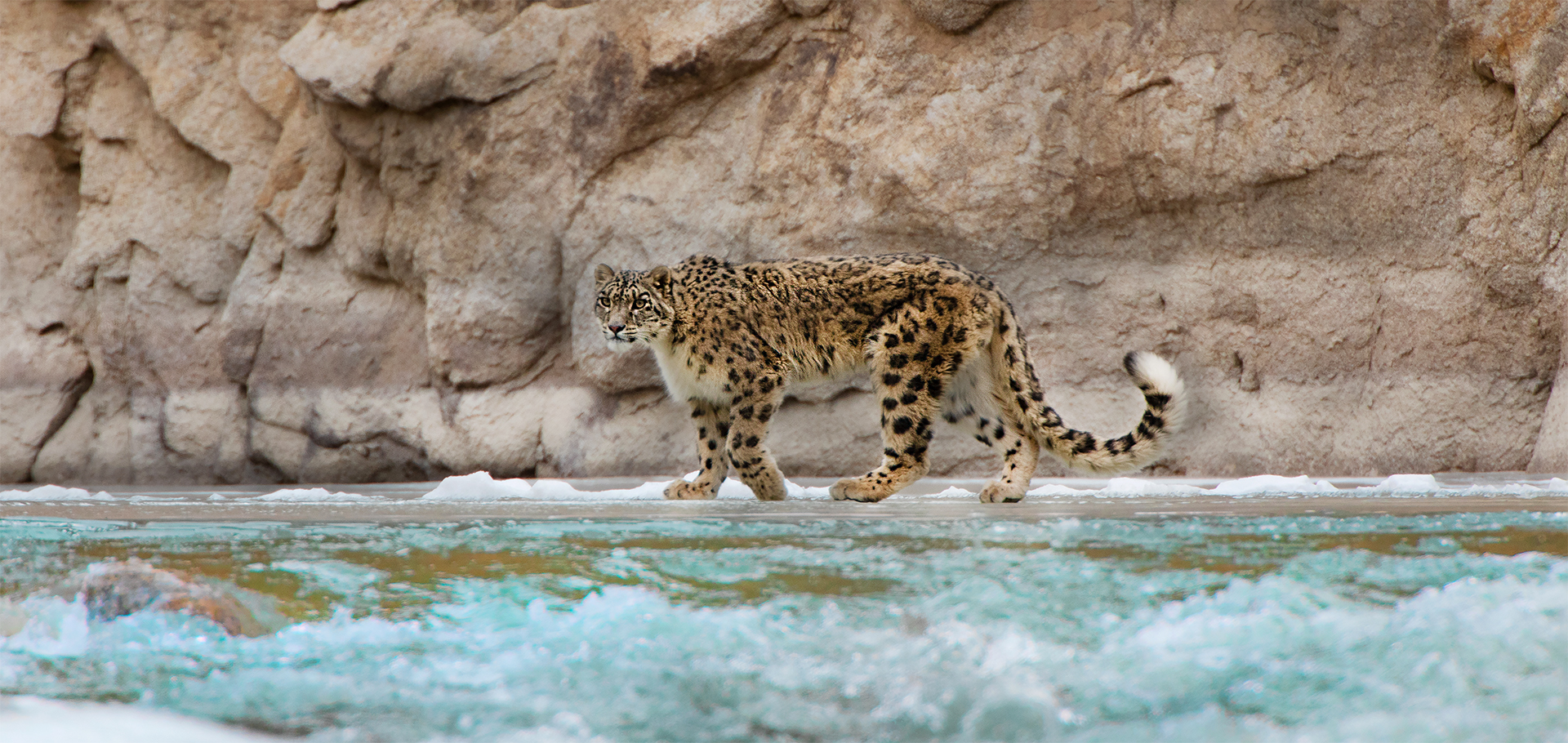
For millennia, the snow leopard has roamed the mountains of Central Asia among blue sheep, ibex, marmots, pikas and hares. Its thick white-gray coat, patterned with dark rosettes, provides camouflage against steep slopes, broken cliffs and snow-covered ridges.
The snow leopard’s range extends across roughly 770,000 square miles in 12 countries. Yet the cats are sparsely distributed and notoriously difficult to find in their remote high-altitude habitat, earning them the nickname “gray ghosts of the mountains.”
Once considered virtually impossible to see in the wild, snow leopards are becoming more accessible to patient travelers as scientific research, community partnerships and conservation programs expand across their historic range.
Conservation Creates Opportunities to Spot Snow Leopards
In northern India, conservation organizations including World Wildlife Fund work with local communities to protect snow leopards, their prey and the mountain ecosystems both people and wildlife depend on. Nat Hab’s Snow Leopard Quest Photo Expedition travels into Ladakh, where experienced local spotters search the ridges in and around Hemis National Park for signs of these elusive cats.
There are many stories to photograph in the land of the snow leopard, from its austere high-altitude terrain and wildlife to Buddhist monasteries, Ladakhi villages and the people who have lived among these mountains for generations.

Photographer Ralph Lee Hopkins, Grand Himalaya Range, Ladakh, India
Here are six types of images to pursue on a photographic journey into snow leopard country:
1. Spot Snow Leopards in and Around Hemis National Park
The most sought-after photograph is of a snow leopard roaming free in its natural habitat. But how do you find an animal whose survival depends partly on remaining unseen?
Individual snow leopard home ranges vary widely according to sex, prey availability, terrain and habitat quality. In some landscapes, a single cat may range across hundreds of square miles. Their low population density, solitary behavior and natural camouflage make snow leopards especially challenging to locate.
India’s first nationwide scientific assessment, conducted from 2019 through 2023 and released in 2024, estimated the country’s snow leopard population at 718. Ladakh held the largest estimated share, with 477 individuals across the territory’s potential snow leopard range.
The rugged cliffs and broad, snow-covered expanses of Hemis National Park protect extensive snow leopard habitat. Nat Hab travelers search the surrounding mountains with experienced local spotters who scan high ridges, rocky outcrops and narrow ravines for movement, tracks and other signs.
For your first defining shot, aim to photograph a snow leopard resting on a ledge, crossing a slope or moving along a ridgeline. The cats are generally observed from a considerable distance, so patience, a long lens and realistic expectations are essential. Their camouflage can make even a visible snow leopard difficult to distinguish from the surrounding rock, but that relationship between predator and landscape is part of the photograph’s story.

© Nat Hab Expedition Leader Surya Ramachandran
Basic Tips for Photographing Snow Leopards
Use a telephoto lens to isolate the cat and reveal its rosettes, long tail and powerful frame. When distance and terrain allow, create wider compositions that show how thoroughly the snow leopard blends into its mountain habitat.
Include cliffs, ravines or snow-covered ridges to provide context and scale. A small cat positioned within a broad landscape can communicate more about its remote environment than a tightly cropped portrait.
In Ladakh, winter and early spring generally offer the best opportunities to search for snow leopards. The cats and their prey may move to lower elevations, and tracks can be easier for spotters to detect in the snow.
Snow leopards are often most active around dawn and dusk, though sightings can occur throughout the day. Remain prepared as light and conditions change, since a resting cat may begin moving with little warning.

2. Photograph High-Altitude Landscapes
The land of the snow leopard can be stark, rugged, and majestic. Winding canyons, frozen rivers, rocky outcrops and alpine slopes provide habitat for snow leopards and their prey—and a range of possibilities for landscape photography.
The mountains of Ladakh rise in layers of weathered rock, snow-covered summits and deep river valleys. Their appearance changes throughout the day as low sunlight reaches across the ridges and shadows settle into the ravines.
Photographing the terrain around sunrise and sunset can produce warm light across otherwise cool-toned scenes. Midday can be equally useful, particularly when subdued light reduces the stone and snow to nearly monochromatic shades.

Work with Light and Composition
Use a wide-angle lens to photograph sweeping panoramas, but look for foreground elements that create depth. Rock formations, prayer flags, riverbanks, wildlife tracks and the walls of Ladakhi buildings can lead the eye into the wider landscape.
Frozen rivers and winding roads can serve as leading lines, while overlapping ridges convey the scale of the Himalaya. Watch how shadows reveal folds in the terrain that may appear flat under direct light.
Long exposures can soften moving clouds or open water, when present, while the surrounding peaks remain sharply defined. A tripod also allows you to work deliberately in low light and maintain detail across the frame.
Consider creating a series rather than relying only on broad views. Pair the full landscape with closer images of wind-sculpted snow, weathered stone, tracks or plants surviving in sheltered places.

3. Photograph Blue Sheep, Tibetan Wolves and Other Mountain Wildlife
Snow leopards share this high-altitude ecosystem with wildlife adapted to cold temperatures, steep terrain and limited vegetation. On Nat Hab’s expedition, travelers may search for:
Blue Sheep (Bharal): Despite their name, blue sheep are more closely related to goats than sheep. Their gray-blue coats blend into rocky slopes, where they move with agility across steep cliffs. They are among the snow leopard’s most important prey species in the Himalaya.
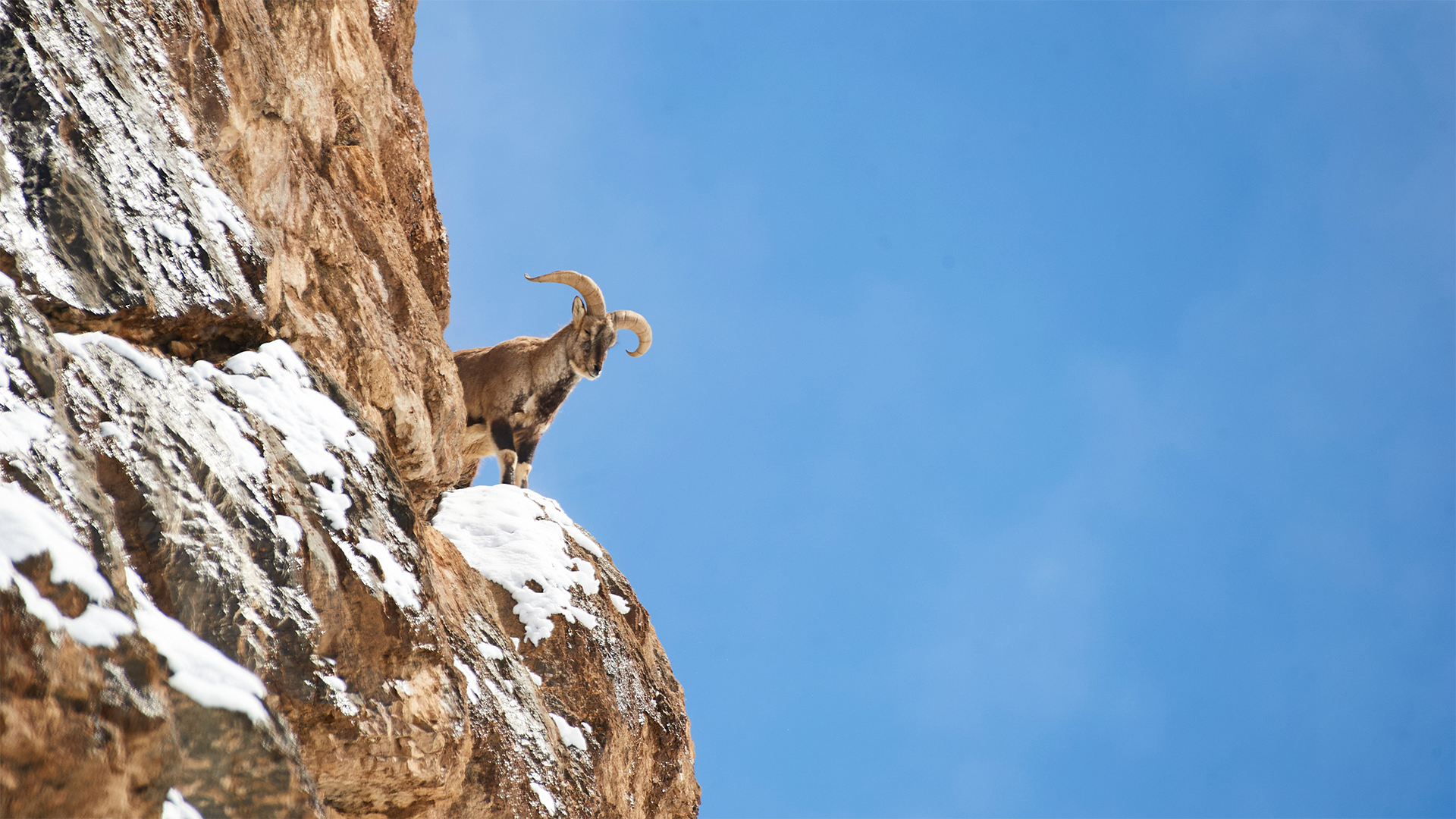
Blue sheep
Tibetan Wolf: These high-altitude wolves travel through open valleys and mountain slopes in search of blue sheep, hares and other prey. Their pale coats provide camouflage in the dry, muted terrain.
Urial: Native to the mountains of Central and South Asia, these wild sheep are recognized by the males’ curved horns. They graze on open slopes and move into rugged terrain when threatened.
Asiatic Ibex: Long, backward-curving horns distinguish male ibex, which are skilled climbers capable of navigating broken cliffs and narrow ledges. They are less commonly encountered in the expedition area than blue sheep.
Red Fox: The red fox’s thick winter coat and bushy tail help it survive the cold. It hunts rodents, pikas and birds and may also scavenge when food is limited.

Red fox © Nat Hab Expedition Leader Surya Ramachandran
Himalayan Hare: Often active in low light, these hares feed on grasses and other vegetation and provide prey for snow leopards, wolves, foxes and birds of prey.
Pika: Small relatives of rabbits, pikas live among rocky slopes where they collect grasses and other plants. Listen for their sharp calls, which may reveal their location before they are visible.
Himalayan Marmot: These large burrowing rodents inhabit alpine meadows but spend the coldest months underground in hibernation. They are more likely to be observed during warmer seasons than on a winter snow leopard expedition.
Each species occupies a different place in the mountain food web. Scan ridges, scree slopes and valley floors while guides and spotters search for movement.
Wide compositions can show how wildlife navigates the terrain, while a telephoto lens allows you to photograph behavior without approaching too closely.

Ibex © Nat Hab Expedition Leader Surya Ramachandran
Use a fast shutter speed to freeze blue sheep crossing a steep slope or wolves moving through open country. For resting or feeding animals, slower shutter speeds may be sufficient, allowing you to reduce ISO or increase depth of field.
Observe before pressing the shutter. Repeated movements, changes in posture and interactions among animals can help you anticipate the strongest moment.
Learn more from our Himalayas Wildlife Guide.
4. Photograph Ladakh’s Monasteries, Markets and Villages
Leh, once an important Silk Road trading center, stands approximately 600 miles north of Delhi but feels far removed from India’s lowland cities. Poplar trees, prayer wheels, mud-brick buildings and Buddhist monasteries rise above the Indus River Valley.

Nat Hab guest sharing photos in Mangyu Village, Ladakh, India © Ralph Lee Hopkins
For centuries, Leh was a crossroads for trade among Tibet, Kashmir, India and China. Caravans carried salt, cashmere wool, indigo, silk and other goods across the surrounding passes. Ladakhi culture reflects these longstanding connections, and Buddhism and Islam have coexisted in the region for centuries.
At approximately 11,500 feet, Leh is also where Nat Hab travelers begin adjusting to the elevation. Excursions into the Indus Valley may include Thiksey Monastery, a 15th-century Buddhist complex built in tiers along a hillside. During Nat Hab’s expedition, travelers visit the monastery for a traditional monk’s blessing.

Monks at Sunrise, Thiksy Tibetan Buddhist Monastery, Ladakh © Ralph Lee Hopkins
For your fourth set of photographs, focus on cultural details that establish a sense of place. Look for prayer flags moving across a mountain pass, butter lamps inside a monastery, mud-brick walls warmed by afternoon light or carved and painted architectural details.
In Leh, photograph the activity of a local market, where everyday commerce offers a different perspective on life in Ladakh. In Rumbak, wider views can show how traditional stone, mud and timber buildings sit within the surrounding alpine landscape.
When photographing people, seek permission before raising your camera. A portrait can focus on expression, clothing or a person’s work, while an environmental portrait can connect the subject to a market, monastery, lodge or village setting.
The snow leopard may be the primary focus of the expedition, but photographs of Ladakh’s people and cultural traditions provide essential context for understanding the region the cats inhabit.
Tips for Photographing People and Culture
Manage high-contrast light: Sunlight at high altitude can create bright highlights and deep shadows. Check your histogram, expose carefully for important details and watch for areas where white clothing, walls or snow may lose texture.
Choose your depth of field: A wide aperture such as f/2.8 to f/5.6 can separate a person from a busy background. A narrower aperture may work better when the surroundings are an important part of the story.
Look beyond formal portraits: Hands turning a prayer wheel, monks walking through a courtyard, food being prepared or goods arranged at a market can communicate daily life without requiring a posed image.
Ask permission: Respect local preferences, restrictions within religious sites and anyone who does not wish to be photographed. Your Expedition Leader and local guides can help navigate cultural expectations.

Leh Tsemo Fort, Ladakh
5. Photograph Ladakh’s High-Altitude Birds
Hundreds of bird species have been recorded across the broader Leh and Ladakh region. The birds present during a particular journey vary with elevation, habitat and season, but winter travelers may search for raptors and other species adapted to open mountain terrain.
Potential subjects include:
Golden Eagle: This large raptor patrols mountain slopes and open valleys for hares, pikas and other prey. Watch ridgelines and the sky above cliffs for soaring birds.
Bearded Vulture: Also called the lammergeier, the bearded vulture is recognized by its long, narrow wings and wedge-shaped tail. It feeds largely on bone, which it may carry into the air and drop onto rocks to break into smaller pieces.
Himalayan Snowcock: This well-camouflaged mountain bird lives on steep rocky slopes at high elevations. Its calls may reveal its presence before it can be picked out against the terrain.

Himalayan Snowcock
Red-Billed Chough: Glossy black plumage and a curved red bill distinguish this agile flier, often seen maneuvering in groups around cliffs, monasteries and high mountain passes.
Horned Lark: This ground-dwelling bird inhabits open country and can be difficult to notice until it moves or takes flight.
Your fifth set of photographs might capture a golden eagle or bearded vulture crossing a mountain backdrop. Rather than filling the entire frame with the bird, leave room around it to show the scale of the surrounding sky and peaks.
For a perched bird, look for a clean background and an alert posture. For birds in flight, consider the direction of movement and leave additional space in front of the subject.

Bearded Vulture
Tips for Photographing Birds of Prey
Use sufficient reach: A telephoto lens allows you to photograph distant birds while maintaining space between you and the subject. A 400mm or longer focal length may be helpful, though available light, the bird’s size and its distance will determine what is practical.
Begin with a fast shutter speed: For birds in flight, a starting point of approximately 1/2000 to 1/4000 second can help freeze motion. Larger, slowly soaring birds may allow a lower shutter speed, while small or erratic birds may require more speed.
Keep the aperture open: A wide aperture helps gather light and separate the bird from the background. Auto ISO can compensate as conditions shift, but monitor image noise and exposure.
Use continuous autofocus: Subject-detection autofocus, wide-area tracking or continuous autofocus modes can help follow a moving bird. Choose a focus area you can reliably keep on the bird, preferably around its head.
Consider background and scale: Snowy peaks, dark rock faces and open sky each create a different photograph. Check the edges of the frame and avoid distracting lines crossing the bird.
For a standard bird-in-flight photograph, begin with:
- A shutter speed of 1/2000 to 1/4000 second
- A wide aperture, such as f/4 or f/5.6
- Auto ISO
- Continuous autofocus
- High-speed burst mode
- Image stabilization appropriate for panning
- The lens focus limiter engaged, when useful
These are starting points rather than fixed rules. Adjust according to the bird’s speed, available light and the performance of your camera and lens.
Still portraits require different settings. For a perched bird, you might begin at f/5.6 and 1/1000 second with Auto ISO, then lower the shutter speed if the subject remains still.
For a backlit bird, positive exposure compensation may preserve detail in the body, though it could brighten the sky. Review your histogram and highlights rather than relying on a single setting. Some visible noise is generally easier to address than motion blur across the bird’s eyes or feathers.

Golden Eagle
6. Document Snow Leopard Conservation
Despite their adaptations to extreme environments, snow leopards face threats from poaching, declining wild prey, retaliatory killing, habitat fragmentation, infrastructure development and climate change.
Conservation programs work with local communities to protect livestock, reduce conflict, strengthen livelihoods and expand scientific knowledge of snow leopard populations. Photography can help explain why these efforts matter and how the survival of the cats is connected to the people who share their mountain habitat.
Key challenges facing snow leopards include:
Poaching and Illegal Trade: Snow leopards are killed for their pelts and body parts, while the illegal hunting of wild sheep and goats can reduce the prey available to them.
Human-Wildlife Conflict: When snow leopards kill domestic livestock, herders can suffer significant financial losses. Without effective protections or compensation, cats may be killed in retaliation.
Declining Wild Prey: Competition with livestock and unsustainable hunting can reduce populations of blue sheep, ibex and other natural prey.
Habitat Fragmentation: Roads, mining, development and other infrastructure can disrupt movement through the vast connected landscapes snow leopards require.
Climate Change: Rising temperatures are altering vegetation, water availability and prey distribution in high mountain ecosystems. The effects vary across the snow leopard’s range but may compound existing pressures on both wildlife and local communities.

Snow leopard walking along the Indus bank grasses of the Ramganga River © Nat Hab Expedition Leader Surya Ramachandran
Tips for Photographing Conservation Stories
Show the shared landscape: Photograph villages, livestock, corrals and mountain habitat to illustrate how closely people and snow leopards live, even when the cats themselves remain unseen.
Document practical solutions: Predator-resistant livestock pens, community-owned lodges, researchers, wildlife spotters and local conservation programs can show how protection works on the ground.
Look for relationships: A portrait of a herder with livestock, a spotter scanning a ridge or lodge staff welcoming travelers can connect conservation to individual lives.
Photograph with care: Avoid staging human-wildlife interactions or entering sensitive areas simply to produce a stronger image. Follow the guidance of local experts and place the well-being of people and wildlife first.
Build a visual narrative: Combine landscapes, wildlife, portraits and details to create a fuller account than any single image can provide.
On Nat Hab’s Snow Leopard Quest Photo Expedition, travelers spend seven days based at a private mountain lodge in snow leopard territory adjacent to Hemis National Park. Experienced local spotters search the surrounding ridges each morning, while private vehicles provide flexibility to respond when a cat is located. Between excursions, travelers photograph bharal, Tibetan wolves and other mountain wildlife and refine their techniques during evening image reviews and workshops with their Photo Expedition Leader.
Share the Story of the Snow Leopard
Snow leopards are classified as vulnerable. Scientists estimate that approximately 3,920 to 6,390 remain in the wild, though the difficulty of surveying their remote habitat means considerable uncertainty remains.
Their future depends on conserving connected mountain landscapes, protecting wild prey, reducing poaching and retaliatory killing and supporting communities that live alongside them. Climate change adds another layer of pressure by altering the cold, dry ecosystems on which both wildlife and people depend.
From snow leopards and blue sheep to Ladakh’s high mountain landscapes, monasteries and villages, these six types of photographs can build a visual account of a journey through snow leopard country. What story will you share?
To learn more, explore WWF’s resources on snow leopard conservation and wildlife protection in the Himalaya.
