




2028 Itinerary
Itinerary
Day 1: Photograph one of the world’s rarest penguins at a private conservation reserve
Visit a private rehabilitation reserve for endangered yellow-eyed penguins
Look for northern royal albatross along the Otago Peninsula
Gather for a welcome dinner at historic Larnach Castle
Arrive in Dunedin for the start of our New Zealand Photo Expedition. The town boomed during a series of gold rushes in the 19th century and today remains one of the country's most important commercial centers. This afternoon, meet your Expedition Leader and fellow photographers, then head to the Otago Peninsula Eco Restoration Alliance, formerly known as Penguin Place, a private conservation reserve and rehabilitation center for endangered yellow-eyed penguins. The reserve was founded in 1985 when just eight breeding pairs inhabited the property. This is a special opportunity to photograph this penguin species, found only in New Zealand, and one of the rarest in the world, with fewer than 4,000 remaining. We’ll also look for a chance to photograph the northern royal albatross. This evening, gather for a welcome dinner at Larnach Castle, built in 1871.

Day 2: Search for elusive brown kiwi after dark on Stewart Island
Photograph waterfalls, rainforest and a rugged shoreline in the little-visited Catlins
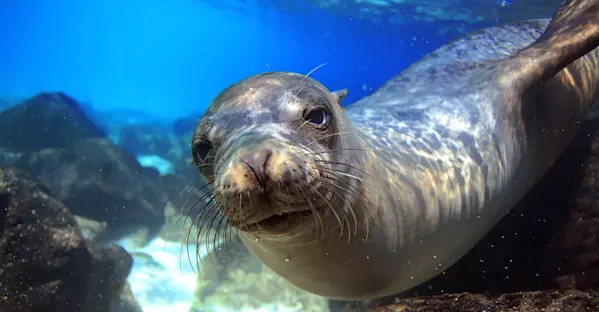
Watch for sea lions, fur seals, Hector’s dolphins and native birds along the coast
Join a guided night walk for a chance to photograph nocturnal brown kiwi
Set off this morning through the little-visited Catlins, a rugged coastal zone that is one of the most sparsely populated areas of New Zealand. Hemmed by a rockbound shoreline, this windswept region holds photo opportunities encompassing lush woodlands, a petrified forest, hidden lakes and cascading waterfalls. Large tracts of rainforest are filled with native flora, including tree ferns, rata, kahikatea, miro, kamaha and silver beech, while the coast is defined by stark cliffs, sea caves, rock stacks and sandy bays. Wildlife is plentiful—have your long lens ready for seabirds and forest-dwelling birds including tui, bellbird, fantail and native pigeon, plus New Zealand sea lions, fur seals and Hector's dolphins offshore.
Reaching Invercargill this afternoon, New Zealand's southernmost city, we board a short flight to idyllic Stewart Island, 19 miles offshore, where we spend two nights. Much of this rugged granite island lies within Rakiura National Park, whose Maori name means “Land of Glowing Skies.” Its rainforests shelter many native plants, which we photograph on nature walks through the unique habitat. The island is a haven for birds, and we listen for the songs of parakeets, bellbirds, tui and kaka. Tonight, we are on a quest for images of the elusive brown kiwi, which we seek on a guided walk after dark. Little-visited Stewart Island is one of the best places in New Zealand to find and photograph these elusive nocturnal creatures.

Day 3: Capture images of rare birds and southern stars from island sanctuaries
Cruise by private boat for close-range photography of albatrosses, shearwaters and penguins
Explore predator-free Ulva Island for native birds, including South Island saddlebacks
Learn astrophotography techniques from your Photo Expedition Leader beneath dark southern skies
On a private boat excursion off Stewart Island this morning, photograph the multitudes of pelagic seabirds that live and breed in these coastal waters. We expect to see a great variety at close range—albatrosses, shearwaters, shags, skua and several penguin species including yellow-eyed, little and Fiordland crested. Take an intimate nature walk with a local naturalist who has worked closely with Stewart Island native and birder extraordinaire Ulva Goodwillie, the namesake of the Ulva Island sanctuary.
On Ulva, just a short boat ride away from neighboring Stewart Island, explore pristine trails and beaches, photographing rare bird species that no longer exist on the main islands, such as the South Island saddleback. Ulva has been carefully managed to be free of invasive predators and pests since 1997, allowing native wildlife to flourish as it did prior to the arrival of introduced species. The small island has also never been logged, offering photographers an immersion in an untouched rainforest that provides shelter for Ulva's healthy bird population. After dark, we focus on astrophotography under some of the planet’s darkest skies. Our Expedition Leader is an expert coach on exposure tips to create thrilling images of the stars. And if we're very lucky, we might get to capture the aurora australis in the southern sky when it’s visible.
Day 4: Focus your lens on endangered birds at a conservation sanctuary
Photograph rare flightless takahē at Te Anau Bird Sanctuary, along with kaka, parakeets and pateke
Learn how New Zealand’s Takahē Recovery Program helped bring the species back from the brink of extinction
Hone your photography skills during an afternoon workshop with your Photo Expedition Leader
After a short flight back to the mainland from Stewart Island, continue this morning to Te Anau. This picturesque village on Lake Te Anau, the largest of New Zealand's southern glacial lakes, is the gateway to Fiordland National Park. Backdropped by the Kepler and Murchison ranges, most of Lake Te Anau lies within the boundaries of the park and the Te Wahipounamu World Heritage Site. This afternoon, visit Te Anau Bird Sanctuary to photograph the rare flightless takahe, an endemic bird with showy blue-black and olive-green plumage and a large red bill. The sanctuary is one of two that have been integral to the success of New Zealand's Takahe Recovery Program, which has pioneered conservation techniques to bring this endangered bird back from the very brink of extinction. As of 2023, about 500 are in existence. The sanctuary is also home to indigenous kaka (a mountain parrot species), parakeets, pateke (brown teal), tui, wood pigeon and more. Our schedule this afternoon is light, allowing time for photo editing and a workshop with our Expedition Leader.

Day 5: Photograph Fiordland from the water and air on private excursions
Cruise Milford Sound by private charter beneath sheer peaks and waterfalls
Fly by chartered helicopter over the Southern Alps with three secluded landings
Photograph a traditional haka during a private Maori cultural experience
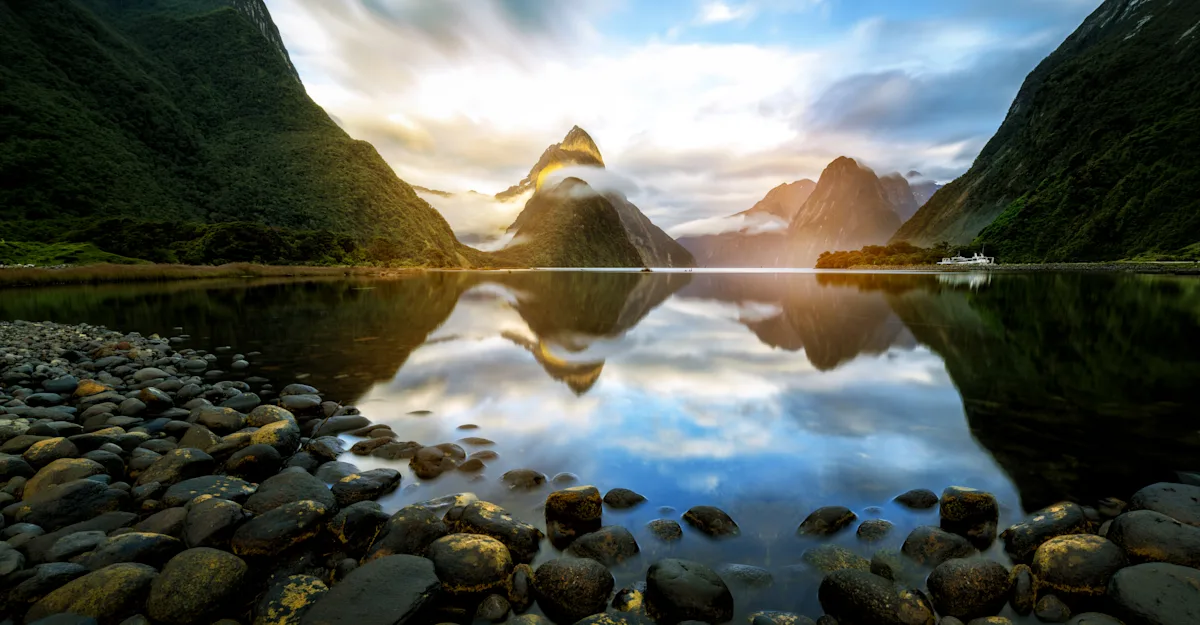
This morning, one of the world's most spectacular drives unfolds: follow the winding Milford Road through Fiordland National Park to the sea, stopping at various scenic photo spots. It's no wonder this mythical-looking land of pointed peaks and sheer rock walls, tall waterfalls and drifting mists was chosen as one of the main settings for the film adaptation of J.R.R. Tolkien’s The Fellowship of the Ring. Once we reach the head of the fjord that is Milford Sound, board a chartered boat for a private cruise around this glacier-carved wonderland. As we ply the steep-walled inlets that wind beneath a perpetual cap of snow and ice, shoot the ribbons of water that plummet from on high. If we're lucky, the mists will clear to reveal pyramid-shaped Mitre Peak rising two-thirds of a mile straight out of the sea. Keep your eyes lower, too, to scan the sea for fur seals, crested penguins and bottlenose dolphins. Our Expedition Leader, an expert on New Zealand wildlife and geography as well as photography, interprets all we see.
Then board a chartered helicopter (weather permitting) for a stunning flight over the Southern Alps to Queenstown. As we lift off, shoot Milford Sound from the air, with multiple waterfalls pouring down the near-vertical peaks surrounding the fjord. We'll get an aerial vantage on alpine lakes, ice fields and rainforests and make three secluded landings, which may include a remote west coast beach, a glacier and a lake.
From Queenstown it's less than hour to Wanaka, with more scenic drama around every bend in the road. En route, stop at Arrowtown, a photogenic gold-mining town tucked within a river valley surrounded by mountains. Established in 1862, its heritage buildings line the town streets, including tiny miners’ cottages. From here, we climb the Crown Range Road, New Zealand's highest paved highway. Once we pass the historic hamlet of Cardrona, site of the Central Otago Gold Rush of the 1860s, the vast blue expanse of Lake Wanaka comes into view, portal to Mount Aspiring National Park. The basin filled by Lake Wanaka was gouged out by the Wanaka Glacier, born high in the ice fields that crown the jagged peaks in the distance. Once we're settled in at our lakeside hotel, a special experience is in store: a local Maori welcome featuring a traditional Haka performance we are invited to photograph. This authentic encounter is designed to connect guests on a more personal level with the Indigenous heritage and present-day Maori culture of Aotearoa (New Zealand).

Day 6: Explore Lake Wanaka from remote islands to dark night skies
Cruise privately to predator-free Mou Waho Island to photograph flightless buff weka
Capture images of the famous Wanaka Tree and the surrounding landscape on foot
Practice astrophotography with coaching from your Photo Expedition Leader
Our day opens with a three-hour private boat excursion on Lake Wanaka. Cruising into the sparkling waters, we quickly leave any sign of civilization behind, surrounded only by tawny hills rising on all sides, with higher peaks beyond. We step ashore on remote Mou Waho Island, a predator-free nature reserve that’s home to the rare flightless buff weka—a curious, amiable bird that has been extinct on the mainland since 1920. A guided bush walk to the top of the island reveals a hidden lake on the summit, a photogenic spot where we’ll enjoy a cup of tea with the panorama of the Southern Alps on display before us. Our tour of the island reveals an impressive conservation success story, as we find out how invasive species—including the weasel-like stoat—were eradicated to preserve the buff weka as well as the mountain stone weta, a prehistoric insect as big as a person's thumb.
This afternoon, more photo highlights await, including the famous Wanaka Tree, a lone willow standing by itself in the water that has become an icon of New Zealand. Take a short hike with our Expedition Leader to photograph more of the Wanaka environs on foot, or choose to relax or wander the town on your own before dinner. Later tonight, we head out to a very dark location away from the lights of town for night sky photography: Wanaka has some of the darkest, starriest skies on Earth.
Please note: Beginning in September 2029, we will add one extra day in Wanaka for additional photography in the region, making our itinerary 14 days long.
Day 7: Photograph waterfalls and rainforest along wild Haast Pass
Follow forest trails to Thunder Creek Falls and Fantail Falls in Mount Aspiring National Park
Capture the turquoise Blue Pools and rushing Haast River at the Gates of Haast
Cross the Southern Alps to the windswept Tasman Sea and secluded Lake Moeraki
Leaving Wanaka's golden mountains behind, traverse moss-draped beech forest as we cross Haast Pass this afternoon into the heart of the West Coast glacier country. We spend several hours around the pass in the heart of Mt. Aspiring National Park, taking advantage of the many sublime nature subjects. The lush scenery is glorious, and trails lead from road’s edge along turquoise streams into the rainforest to dramatic waterfalls, including Thunder Creek Falls and Fantail Falls. Capture the ethereal clarity of the famous Blue Pools, and photograph the Gates of Haast, a rocky gorge that funnels the rushing Haast River between steeply forested mountains. Haast Pass is one of three main passages across the Southern Alps and was once an important Maori trading route. Paralleling the river as we descend the pass, we ultimately reach the Tasman Sea and the windswept sand dunes of New Zealand's wild West Coast. Turning north, we follow the dramatic coastal route before cutting inland to Lake Moeraki for a two-night stay at a secluded wilderness lodge in this exceptionally scenic region, which remains lightly visited.

Day 8: Search for rare rainforest penguins on New Zealand’s wild West Coast
Kayak Lake Moeraki and learn about New Zealand’s endangered long-finned eels
Walk through tree fern forest to photograph Tawaki penguins at Monro Beach
Look for bioluminescent glowworms along forest tracks after dark
Lake Moeraki lies at the heart of a natural paradise in the Te Wahipounamu–South West New Zealand World Heritage Area. Virtually unchanged since the Polynesians discovered New Zealand, this dramatic landscape has been shaped by successive glaciations into fjords, rocky coastlines, sheer cliffs, waterfalls, lakes, rivers and ancient forests. From our lodge base, photograph highlights of our natural environs on locally guided excursions, including kayaking on Lake Moeraki. Our hosts also take us to meet New Zealand's endangered long-finned eel, a slow-growing species that swims all the way to the deep ocean trenches near Tonga to breed.
A walk on a lush trail among head-high tree ferns takes us to the wild expanse of Monro Beach, with its rock pillars and wave-sculpted driftwood. Here, we look for rare Tawaki penguins to photograph. Found only on the southwest coast and islands of New Zealand, they are also called Fiordland crested penguins and are the only penguins that live in the rainforest. About 2,000 pairs remain, with 10% of the population found along the shores of Lake Moeraki. At night, we look for glowworms, whose bioluminescence is visible in secret locations along the forest track near the lodge.
Day 9: Photograph glaciers, kiwi and West Coast landscapes
Capture sunrise over Lake Matheson before traveling north into glacier country
Go behind the scenes at the West Coast Wildlife Center to photograph two of the world’s rarest kiwi species
Frame Southern Alps peaks reflected in Peter’s Pool near Franz Josef Glacier
Rise early this morning to photograph sunrise over Lake Matheson, a short drive from our lodge. north today, more of New Zealand’s magnificent scenery unfolds as we follow the west coast into glacier country. Westland Tai Poutini, one of New Zealand’s two World Heritage Site national parks along with Aoraki Mount Cook, holds many of the country's highest mountains, turquoise lakes, braided rivers and massive glaciers. Spawned in the ice fields of the Southern Alps, they wind down like frozen highways into primeval rainforest, almost reaching the ocean. We stop for photos at Peter’s Pool, a kettle lake left by the receding Franz Josef Glacier, which reflects the steep peaks that rise around it. In the nearby town of Franz Josef, we have a behind-the-scenes tour of the West Coast Wildlife Center for photos of highly endangered wildlife cared for here. Get close-ups of the Haast tokoeka and the rowi—the two rarest kiwi species in the world, with fewer than 650 of each remaining—plus little blue penguins (korora) and the tuatara, an ancient reptile that predates the dinosaurs.
Continue to Hokitika, a historic river port born out of the 1860 gold rush, where we spend two nights in a beachfront hotel on the Tasman Sea. Today, the laid-back small town is known for an indigenous greenstone called pounamu, or New Zealand jade, prized by the Maori for its strength, durability and beauty, and used for weapons, tools and personal ornaments. Walk along the sandy beach to photograph plentiful driftwood formed into imaginative sculptures.

Day 10: Capture the sculpted landscapes of New Zealand’s West Coast
Photograph the blue-green Hokitika River winding through its steep-sided gorge
Explore the layered Pancake Rocks and towering blowholes of Paparoa National Park
Walk the Pororari River Track through a limestone gorge and subtropical forest
The dramatic geology of the West Coast is on full display today as we photograph a range of landscapes and scenic features that showcase it. Spend the morning at Hokitika Gorge, a supremely photogenic gem where the Hokitika River flows through a canyon lined by white granite and limestone walls. Walk across the swing bridge over the brilliant blue-green river, where rock pulverized by glaciers and suspended in the water creates an almost surreal color. The viewing platform offers excellent views up and down the gorge, with a clear vantage on how the water has eroded the stone.
Continue to Paparoa National Park and Punakiki Pancake Rocks, where hard limestone and soft sandstone have been sculpted by the sea into flat, layered shapes that look like stacked pancakes. At high tide, ocean swells force water through underground tunnels amid the formations, creating blowholes that rocket more than 50 feet high. We also walk the Pororari River Track through another dramatic limestone gorge and the Truman Track through dense subtropical forest.
Before we turn inland, Irimahuwhero Lookout offers dramatic shots of the coastline, where foamy white waves meet sandy shores edged by lush forest. Our route then climbs over the Craigieburn Range, where endemic scree plants and giant weta insects thrive. Arthur’s Pass Wilderness Lodge awaits, a deluxe ecolodge set among mountain beech forest and surrounded by Arthur’s Pass National Park, where we spend three nights.

Days 11 to 12: Photograph high-country wildlife and landscapes at Arthur’s Pass
Capture working sheepdogs in action on a private 4,000-acre high-country property
Paddle Lake Pearson for views of the surrounding high-country mountains
Search for endangered kea and photograph native beech forest with a local naturalist
Our luxury ecolodge lies at Arthur’s Pass lies at the heart of a spectacular 4,000-acre property where half the land is dedicated to protecting rare plants and animals and the other half is a working sheep station, where some 3,000 sheep are raised for fine merino wool. We learn about the region's natural history and agricultural heritage, gaining a firsthand look at sheep farming as we photograph agile sheepdogs at work, hand-feed tame sheep, and learn about shearing and the production of merino wool, renowned for its use in creating soft, fine-gauge garments. On a private kayaking excursion on Lake Pearson, capture mountain landscapes from this serene high-country lake. There are also several options for forest hikes with a local naturalist on trails around the lodge to capture images of moss-cloaked beech trees and unusual moa shrubs as you learn about the native ecosystem. We also have our best chance to photograph the kea, an endangered alpine parrot endemic to this part of New Zealand, that is often seen in this area.
Day 13: Conclude your New Zealand photo expedition in Christchurch
Enjoy a final activity around Arthur’s Pass Wilderness Lodge before driving to Christchurch
Tour Christchurch briefly before transferring to the airport for homeward flights
After a last activity around the lodge this morning, depart Arthur’s Pass this morning and drive to Christchurch. New Zealand's oldest city, Christchurch is noted for its British character and Victorian architecture, although much of the latter was lost in the devastating 2010 and 2011 Canterbury earthquakes. After a brief city tour, head to the airport to meet departing flights.