

Itinerary
Please Note: Flexibility is a hallmark of our expeditions, and the day-by-day itinerary can change as we adapt to weather and local conditions, take advantage of rare wildlife sightings or allow photographers to linger ashore through the golden hour of light. This itinerary can also be run in reverse, where we visit the Antarctic Peninsula first before heading to South Georgia and the Falklands.
Important Note re: Flights: Some departures aboard theNational Geographic Explorerand theNational Geographic Endurancebegin with a direct flight to or from Santiago, Chile to the Falklands, spending one less day at sea but including an additional day in South Georgia. Please reference the dates page or call for more details.
Itinerary
Day 1: Explore your South American gateway before sailing south
Tour Recoleta and visit the final resting place of Eva Peron during an afternoon in Buenos Aires
Or explore Santiago’s Plaza de Armas and take in views of the surrounding Andes
The ship you select for your Antarctica, Falklands & South Georgia expedition cruise determines the starting and ending point of your journey. Guests traveling aboard the National Geographic Explorer or National Geographic Endurance (on certain departures) arrive and depart via Buenos Aires, Argentina. Guests traveling aboard the National Geographic Resolution (on certain departures) arrive and depart via Santiago, Chile.
With an early morning arrival in Buenos Aires, Explorer guests check in at the Alvear Art Hotel (or similar) and Endurance guests check in at the Alvear Icon Hotel (or similar). Buenos Aires is Argentina’s capital, set on the Rio de la Plata. This is one of Latin America’s largest metropolitan areas, and a top tourist destination known for its cosmopolitan lifestyle, vibrant cultural melange and a European-style architecture that reflects its colonial heritage and the influence of many 19th- and early-20th-century immigrants. After a morning at leisure to catch our breath, enjoy a guided afternoon tour of city, including Beaux Arts palaces, visit Recoleta—the final resting place of Argentina's iconic first lady, Eva Perón—and enjoy a private visit to El Zanjon de Granados, one of the city’s premier museums.
Following an early morning arrival in sophisticated Santiago, Resolution guests check in at the centrally located Ritz Carlton Santiago (or similar). Santiago is nearly surrounded by the Andes, which form an inspiring backdrop for an afternoon tour of Chile's vibrant capital. After a relaxing morning, we explore the Plaza de Armas, the main square and nearby Presidential Palace, taking in expansive views from the hills and parks that dominate this leafy city. In the early evening, gather for an informal reception and a drink at the hotel.
Day 2: Reach Ushuaia and board your expedition ship
Fly by private charter over the southern Andes to Tierra del Fuego
Cruise the Beagle Channel by catamaran, weather permitting
Board your expedition vessel and set sail from the southern tip of South America
Travel by private chartered flight to Ushuaia, surveying the peaks of the southernmost Andes below before landing at the tip Tierra del Fuego at the very bottom of South America. There’s no mistaking the "end of the world" feeling about the most southerly city on Earth, which is the point of embarkation for expeditions to the Antarctic Peninsula. If weather permits, we will enjoy lunch on a catamaran cruise in the Beagle Channel, where steep peaks rise out of the sea, before embarking our expedition ship and setting sail.
Accommodations


Day 3: Enter the Southern Ocean beneath circling seabirds
Learn from the naturalists, scientists and historians aboard through lectures and presentations
Cross the roiling latitudes of the Antarctic Circumpolar Current
Look for black-browed albatrosses and other seabirds over the open water
Days at sea are an opportunity to learn and relax. Our expedition ship has a full complement of naturalists, scientists and historians on board who enthusiastically share information about geology, climate, wildlife and human exploration in Antarctica and the southern polar region. Lectures and slideshows add to our appreciation of all we see and experience during the voyage. This morning, we awaken in the "Furious Fifties," a notorious part of the Southern Ocean marked by the roiling Antarctic Circumpolar Current. The experience can be misty and gray or calm and clear, but our escorts while crossing this legendary portion of the sea will surely include a host of seabirds, including the black-browed albatross.
Accommodations
Days 4 to 6: Explore windswept shores alive with penguins and albatrosses
Look for Magellanic, gentoo and rockhopper penguins along the rugged coast
Watch for Peale’s dolphins riding the bow waves near the islands
Visit Stanley, the tin-roofed capital with its Anglican cathedral and whalebone arch
Also called the Islas Malvinas by Argentina, which contests Britain's claim to the colony, the windswept Falklands archipelago is a study in stone, sand and peat, with rugged cliffs battered by the ocean. Its isolated shores are home to marine mammals and prodigious birdlife—including the world’s largest albatross colony. Flightless steamer ducks, blue-eyed shags and several penguin species, including Magellanic, gentoo and rockhopper, are abundant, and Peale's dolphins often ride our bow waves near the islands. Though the Falklands are still disputed territory, culturally they are British through and through. English and Scottish immigrants arrived with sheep in the 19th century, and wool is produced to this day. The photogenic capital of Stanley is full of quaint tin-roofed houses, rose gardens, pubs and other emblems of Falkland colonial heritage—including an Anglican cathedral with an organic whalebone archway.
Accommodations
Days 7 to 8: Follow Shackleton’s route toward South Georgia
Cruise south as whales move through the surrounding waters and seabirds circle overhead
Hear the ship’s naturalists preview South Georgia’s wildlife
Learn the story of Shackleton and the crew of the Endurance
We continue cruising south, with whales swimming beneath the waters and sea birds circling above. The ship's naturalists prepare us for the exciting days ahead with presentations about South Georgia’s wildlife and the inspiring story of Sir Ernest Shackleton and the crew of the Endurance . Take advantage of the ship’s leisure and recreation opportunities, including a fitness center, sauna, massage therapy at the spa, and a library filled with books about Antarctic natural history and polar exploration.
Accommodations
Days 9 to 13: Walk among vast king penguin colonies on remote South Georgia
Land by Zodiac on beaches and glacier-carved fjords where fur seals may approach
See king penguin colonies stretching across the landscape
Visit Grytviken’s former whaling station and the grave of Sir Ernest Shackleton
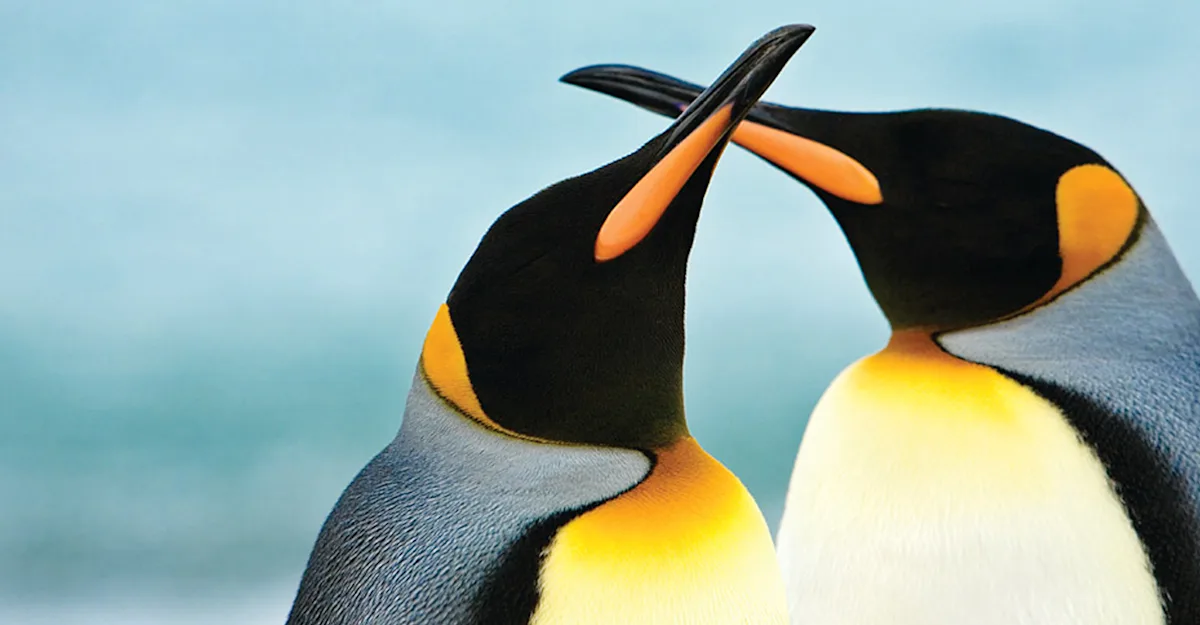
Remote South Georgia is best known for the riveting saga of Sir Ernest Shackleton’s ill-fated 1914 expedition aboard the sailing ship Endurance . The magnitude of Shackleton’s heroic trek across South Georgia to secure the rescue of his crew can only be fully grasped on a visit to the island, with its spine of glaciated peaks rising precipitously from the sea. J. Gunnar Anderson, who encountered the island in 1902, described it as “mighty fells with snowy crowns and sharp, uncovered teeth, around the valleys through which enormous, broad rivers of ice came flowing to the sea.” Yet the land, for all its ruggedness, is rich in animal life. Zodiac trips permit visits to desolate beaches and glacier-carved fjords, and curious fur seals often approach the boats. Millions of king penguins live here, in colonies stretching to the horizon. South Georgia’s waters are home to blue, sperm, fin, sei and southern right whales, though they were nearly wiped out in the 20th century when whaling was still a commercial industry. At the former whaling outpost of Grytviken, abandoned processing factories lie derelict, and elephant seals have taken over the grounds. Those who wish to pay respects to the legendary explorer can visit the grave of Shackleton, who died here in 1922.
Accommodations
Days 14 to 15: Watch for the first icebergs on the approach to Antarctica
Scan for icebergs from the Bridge as the ship crosses historic polar waters
Join naturalists and historians for talks on Antarctic wildlife and exploration
Explore the onboard library’s collection of polar and regional titles
As we sail for Antarctica, head up to the bridge to watch for icebergs and observe expert navigators at work as our skilled captain and officers ply these historic waters. Each day, the ship's naturalists and historians offer talks that add depth to our polar experience. Take advantage of community spaces including the lounge, the observation room with its collection of games and binoculars, and a chance to delve into the intrigues of the library’s collection of regional titles.
Accommodations
Days 16 to 19: Explore the Antarctic Peninsula by Zodiac, kayak and on foot
Sail among cliffs, glaciers and icebergs, with a possible passage through the Lemaire Channel
Search for whales, seals and seabirds beneath the long austral summer daylight
Walk near colonies of chinstrap, gentoo and Adelie penguins
A grand and otherworldly kingdom of ice, rock, sea and sky, the Antarctic Peninsula is the northernmost part of the continent. The first explorers laid eyes on it in the early 19th century, and it has since held a storied place in the annals of global adventurers. Covered under a nearly perpetual ice sheet, the peninsula rises in a line of serrated peaks. Glaciers pour into their valleys, flowing into the massive ice shelves that hug the sea. Though this frigid land hosts no permanent population, it is the site of a vital international scientific research community. The peninsula’s relatively mild climate in comparison to the rest of the icebound continent explains its status as the preferred location for most research stations, as well as a destination for tourist vessels.
During our visit, we sail through the Lemaire Channel, where vertical cliffs hem in a narrow passage filled with a magnificent parade of bobbing icebergs. Almost constant summer daylight provides ample opportunity for flexible exploration of this frozen white frontier by Zodiac, kayak and on foot, with the guidance of the ship’s seasoned expedition experts. Millions of animals thrive here, and visitors find a rich assortment of marine life including Weddell, Southern elephant, crabeater and leopard seals, and minke, humpback, sei and fin whales, as well as orcas. Zodiacs allow us to get close to wildlife and make landings on shore, where we walk among noisy colonies of four resident penguin species—chinstrap, emperor, gentoo and adelie. A proliferation of seabirds includes kelp gulls, various petrels, snowy sheathbills, skuas, shags and Antarctic terns.
Accommodations
Days 20 to 21: Cross the legendary Drake Passage toward South America
Sail between the Antarctic Peninsula and Cape Horn
Pass through the Antarctic Convergence, a productive marine zone rich in krill
Watch for wandering albatrosses, Cape petrels and dolphins around the ship
The Drake Passage is legendary among mariners and a milestone in any adventurer's personal travel history. Named for the 16th-century English privateer Sir Francis Drake, whose ship was blown far off course in these waters, this 600-mile-wide channel that separates Cape Horn from the Antarctic Peninsula is notorious for its frequent high winds and rough seas. Without a significant land mass, the Antarctic Circumpolar Current flows unimpeded, carrying a tremendous volume of water through the passage. Midway across, the Antarctic Convergence mixes cold, northward-flowing waters with the relatively warmer south-flowing waters, creating a highly productive marine zone for Antarctic krill, the favored food source for whales, seals, penguins, squid, albatrosses and other seabirds. Our ship is likely to be escorted through the passage by dolphins, Cape petrels and wandering albatrosses.
Accommodations
Day 22: Return to Ushuaia before flying to your gateway city
Disembark your expedition vessel with time to explore the mountain-framed port
Fly by private charter to Buenos Aires or Santiago for homeward flights
After breakfast, disembark in Ushuaia with time to explore this rugged mountain town before a private chartered flight returns us to Buenos Aires or Santiago (the same destination in which you started your expedition with the exception of some Endurance departures) for homeward flights.