





June 2027 Itinerary — Nat Hab's Bear Camp
Itinerary
Day 1: Gather in Alaska’s Interior before your journey into Denali and Lake Clark
Begin in Fairbanks, gateway to Alaska’s vast northern wilderness
Join your Expedition Leader for a welcome dinner and introduction to the wildlife and landscapes ahead
Our grand Alaska adventure begins in Fairbanks, Alaska's "Golden Heart City." Capital of the vast Interior, Fairbanks retains its frontier flavor with pioneer saloons, paddlewheelers and outlying mining camps. Fairbanks is also home to the flagship campus of the University of Alaska system, where the famous Geophysical Institute is headquartered, leading research in the study of permafrost, earthquakes, sea ice and the aurora borealis. Meet your Expedition Leader at a welcome dinner this evening, who offers an orientation to all the adventures to come.

Day 2: Follow the Denali Park Road deep into the backcountry
Travel beyond Polychrome Pass into the remote interior of the national park
Watch for moose, caribou, Dall sheep and grizzlies along the way
Reach Denali Backcountry Lodge, isolated within the six-million-acre wilderness
This morning, drive south through boreal forest along the Nenana River to Denali National Park. At 6 million acres—larger than the state of Massachusetts—Denali is one of the world’s great wilderness preserves. The park's namesake is the highest peak in North America, towering 20,310 feet over alpine tundra and taiga that provide habitat for abundant wildlife. The mountain's name—Denali—means "The High One" in the Athabascan language.
After an extended road closure in the interior of Denali National Park as a result of a major landslide in 2021, it is once more possible to drive to the remote backcountry at the end of the 92-mile-long park road. We begin that journey at the park entrance, following an epic wilderness route through spruce forest, across vast braided rivers and onto open tundra, admiring massive views of the Alaska Range peaks from Polychrome Pass and beyond. Along the way, look for wildlife along the edge of the taiga forest, on the gravel bars where rivers drain glacial runoff, and on open slopes in the distance. If we’re lucky, we could see all of Alaska’s Big Five: moose, caribou, Dall sheep, grizzlies, and more rarely, wolves. Keep in mind, though, that it takes a great deal of habitat at this latitude to sustain wild animals, and unlike in Africa, they are fewer in number and more spread out. After a scenic day on our northern safari, we reach our destination, Denali Backcountry Lodge, isolated in a vast expanse of primal wilderness. Spending two nights here, wrapped in silence, is an exclusive experience very few visitors to Alaska get.

Day 3: Explore Denali’s tundra, lakes and wildlife-rich valleys
Hike with your Expedition Leader and local naturalists in search of wildlife
Kayak Wonder Lake beneath the Alaska Range, with possible views of Denali
Fish the clear waters of Moose Creek
From our base at Denali Backcountry Lodge, a host of activities offers a chance to learn about the natural and cultural history of our environs, including the wildlife that thrives here, the Athabascan people who lived off this land for 10,000 years, and the pioneers who mined for gold in nearby Kantishna at the turn of the 20th century. Take a hike in search of wildlife with our Expedition Leader and lodge naturalist guides. Paddle a kayak on Wonder Lake, offering the iconic postcard shot of Denali’s massive white hulk rising behind. Try your hand at fishing in Moose Creek. Ride a mountain bike. And just drink up the profound beauty and silence of wild country on a scale few people will experience in their lifetime. At the end of our day of adventure, return to the lodge for a hearty dinner featuring fresh seasonal and regional fare. Afterward, head to the campfire to roast marshmallows for s’mores.
Day 4: Fly past Denali’s glaciers and the wild valleys of the Alaska Range
Depart the backcountry by chartered bush plane along Denali’s icy flanks
Look for wildlife roaming the glacier-fed valleys below
Cross Broad Pass on the drive south to Anchorage and Cook Inlet
After lunch, depart our wilderness lodge and fly back to the park entrance via chartered bush plane. Weather permitting, we’ll have stunning eye-level views of the icy flanks of Denali en route. As we fly over the tangled veins of glacier-fed rivers, broad valleys and steep mountainsides, look for wildlife roaming below. Once we land near the park entrance, board a spacious mini-bus for our journey south to Anchorage. Crossing the Alaska Range, our route climbs above tree line over Broad Pass, then descends to follow the Susitna River through thick stands of birch, balsam poplar, willow and spruce. Eventually, we reach Anchorage on Cook Inlet, backdropped by the glacier-crowned peaks of the Chugach Range. With a population of roughly 300,000, Anchorage is Alaska's largest city and its primary commerce and transportation hub.

Day 5: Ride the Alaska Railroad to a private island in Kenai Fjords
Travel by glass-domed railcar along Turnagain Arm and through the Kenai Mountains
Cross Resurrection Bay by boat to secluded Fox Island
Kayak along the island’s coast, watching for marine wildlife
Rise early today to travel the most scenic section of the historic Alaska Railroad, built in the early 20th century. The state-owned railroad’s mainline is 470 miles long, connecting Seward in the south with Fairbanks up north. From our dome car, enjoy a classic train journey along Turnagain Arm as we keep an eye out for tidal bores that create waves big enough for local surfers to ride. To the north lie the ice-clad peaks and lush glacial valleys of the Chugach Range, harboring the northernmost temperate rainforest in North America. The corridor we follow winds through the Kenai Mountains–Turnagain Arm National Heritage Area, a designation that recognizes the area's unique cultural, geographic and historical features. Once we cross Moose Pass, the rail line drops back to the coast, ending at its southern terminus, the Port of Seward on Resurrection Bay.
In Seward's small boat harbor, look for sea otters often seen bobbing among the yachts and docks. Here, we board a boat for the voyage to private Fox Island on the edge of Kenai Fjords National Park. Our isolated location, fronting a wild pebble beach backed by steep forested mountains, reveals the pristine side of Alaska most visitors miss. The Kenai Fjords region is famed for its sea kayaking, and an optional paddling excursion late this afternoon is likely to reveal some of the area’s prolific marine life.

Day 6: Cruise among whales, seabird cliffs and tidewater glaciers
Explore Kenai Fjords by private boat in search of humpbacks, orcas and sea otters
Photograph puffins, bald eagles and other seabirds along the rugged coast
Approach a tidewater glacier, watching for ice calving from its blue face
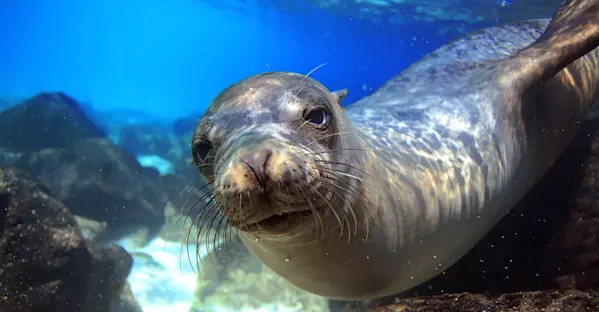
Iconic images of Alaska are on display today from our private chartered boat as we explore a marine realm where vestiges of the Ice Age linger. Our small vessel allows us to approach wildlife at close range, and Kenai Fjords National Park provides excellent opportunities for viewing humpback whales, orcas, Dall's porpoise, sea lions, sea otters and bobbing puffins. Weave among islands and rocky cliffs where seabirds nest, and look for bald eagles in the treetops above. Jagged glaciers wind from the mountain heights to the sea, and we may observe icebergs calving with a thunderous crash from a glacier's towering blue face. Following our all-day outing, our boat returns us to our secluded lodge on Fox Island for another night of peace and solitude in the coastal wilderness.
Day 7: Cross the Kenai Peninsula from Resurrection Bay to Kachemak Bay
Return by private boat from Fox Island to Seward
Travel past salmon rivers, mountain ranges and Cook Inlet on the road to Homer
Explore the galleries, shops and working waterfront of the Homer Spit
After a last morning on serene Fox Island, board our private boat for the return journey up Resurrection Bay to Seward, where you'll have some free time to wander around this historic harbor town. From Seward, we head south on a spectacular drive to Homer. The mountain ranges of the Kenai Peninsula rise one after another, sourcing some of Alaska's richest salmon rivers. Homer is known as “the End of the Road” in Alaska, and we follow it all the way down to the harbor on the Homer Spit. Homer is renowned as the Halibut Fishing Capital of the World, and we may see fishing crews unloading their catch—the biggest halibut can be eight feet long and up to 500 pounds! While halibut are one of Alaska’s most valuable fisheries, Homer also offers excellent fishing for several salmon species, lingcod and rockfish. We’ve got some free time to wander the spit, a long, narrow strip of land that juts into Kachemak Bay. The spit is where we find most of Homer’s shops, art galleries, seafood restaurants and beaches, and our hotel lies at the very tip of it: Land’s End, overlooking and island-studded marine realm that's home not only to coveted sport fish but also sea otters, seals, porpoises, sea lions, orcas, whales, bald eagles and puffins.

Day 8: Fly across Cook Inlet to Nat Hab’s private brown bear camp
Explore the forests and meadows of Inspiration Ridge Preserve with a guide
Travel by private charter to a remote camp surrounded by Lake Clark National Park
Watch brown bears graze on sedge and dig for clams along Chinitna Bay
Accessible only on a privately guided walk, Inspiration Ridge Preserve is a mosaic of forests, peat bogs, meadows, ponds and creeks that comprise 700 acres of critical wildlife habitat for a multitude of species, including a visiting summer population of sandhill cranes. Other wildlife at home here include moose, brown and black bears, lynx, muskrat, swifts and eagles. The Center for Alaskan Coastal Studies manages the preserve, and one of its staff will join us to interpret all we experience. Along our path high above Homer below, take in a stunning panorama of Kachemak Bay and the Kenai Mountains, wander through dense spruce canopies and fields of magenta fireweed, and learn about ongoing monitoring projects and research partnerships.
Then, is it possible to say we’ve saved the best for last? Well, it all depends on how you weigh the wonders of Alaska, but our brown bear adventures begin this afternoon and will surely be a highlight of your trip. Via chartered flight across Cook Inlet, we reach Nat Hab's Alaska Bear Camp, where we spend the next two nights. The views from our private bush plane are stunning as we pass snow-clad volcanoes and glaciers winding down from vast icefields. The terrain below, where the Aleutian and Alaska ranges meet, comprises some of the world's most critical brown bear habitat. Look for bears in the meadows and along the shoreline as we come in for a landing, taxiing down the beach along Chinitna Bay.
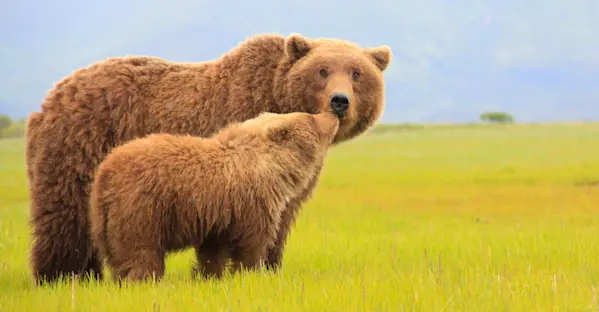
Bear Camp is located on a historic homestead, a private 15-acre inholding of coastal land surrounded by Lake Clark National Park and Preserve. These 4 million protected acres of wilderness are the ancestral homelands of the Dena'ina people, preserving an intact ecosystem at the headwaters of the largest sockeye salmon fishery in the world. Accessible only by plane or boat, Bear Camp offers an unparalleled immersion in pristine brown bear habitat. From our comfortable new cabins, we have immediate access to some of the best, most consistent bear viewing opportunities anywhere in Alaska, due to the season-long availability of food. In late spring, protein-rich sedge grass supports rapid growth, and bears are often seen browsing in the meadow behind camp, as well as digging clams from the beach. Accustomed to our non-threatening presence, they see us humans merely as part of the scenery, allowing us to move safely in their midst on guided outings, at times watching them from just a few yards away.

Day 9: Walk among coastal brown bears beneath the peaks of Lake Clark
Observe bears at close range as they forage, rest and interact
Explore the coast and meadows bordering Lake Clark National Park
Move safely through bear habitat with seasoned naturalists
There's simply no wildlife encounter to match being among bears at close range in their wild home. Against a backdrop of sheer-sided peaks rising above the green valley floor, the bears are sometimes near enough that we can hear them chewing their food and communicating with one another in woofs, purrs and growls. Alaska's mighty brown bears—the coastal version of the interior grizzly bear (which is the same species, Ursus arctos )—are the largest land predators in North America. Adult males can weigh up to 1,500 pounds!
While the bear activity we witness can vary according to seasonal and weather conditions, there's always something interesting going on. And while bears are usually plentiful right in the vicinity of camp, we also go into adjacent Lake Clark National Park for added variety. At every turn, we explore the area in the careful company of our seasoned bear naturalists who offer thorough coaching in respectful "bear etiquette.” Our low-impact presence ensures that we never disturb the bears, and they in turn grant us comfortable access to watch them go about their daily routines.
Day 10: Spend a final morning with Chinitna Bay’s brown bears
Watch bears along the tidal flats and sedge meadows near camp
Return to Homer by chartered bush plane
Gather for a farewell dinner on the Homer Spit
We have one last chance this morning to marvel at the bears, admiring their majesty and whimsy alike. Few travelers have such an encounter with the raw beauty and profound silence of a landscape this size—these things alone would make for a life-transforming experience. But the chance to watch Alaskan brown bears, incomparable icons of the wild, on their turf, their terms...it's a wonder to have bears welcome us into their world. We depart as ambassadors for the bears, our time among them leaving an indelible mark on us, inspiring us to do all we can to protect them. Leaving Bear Camp behind, we board our small bush plane once more to return to Homer, where we have a bit of free time to browse along the spit or wander the beach before gathering for our farewell dinner to celebrate our adventures.
Day 11: Depart Homer after your Alaska wildlife journey
Transfer to the airport for homeward flights or an extension
Our Alaska adventure comes to a close today as we transfer to the Homer airport for departing flights.