


Itinerary
Itinerary
Day 1: Arrive in Windhoek before your two-country safari
Take in Windhoek’s blend of colonial and contemporary architecture during your transfer
Join your Expedition Leader for a welcome dinner and preview of the safari ahead
Our Botswana and Namibia safari begins in Windhoek, Namibia's capital. This appealing city blends contemporary and colonial architecture in a cosmopolitan setting. Meet your Expedition Leader on arrival and transfer to our boutique hotel in one of Windhoek’s leafy, tranquil neighborhoods. Over a welcome dinner, get acquainted with your traveling companions and learn about the vast landscapes we’ll be exploring during the next two weeks.
Days 2 to 3: Climb some of the world’s tallest dunes in the Namib Desert
Fly into the private 90,000-acre Kulala Wilderness Reserve
Ascend the towering dunes of Sossusvlei
Look for oryxes, springboks and ostriches on desert walks and wildlife drives
Board a morning flight to the private 90,000-acre Kulala Wilderness Reserve, where the massive golden dunes of Sossusvlei rise a thousand feet from the floor of the world’s oldest desert. The word namib in the Nama language means “vast,” an apt name for this ancient sand sea shaped by currents, waves and wind. Sossusvlei means “dead-end marsh”—the salt and clay pan where the mass of dunes rises to prevent the Tsauchab River from flowing to the Atlantic Ocean. Framed by intense blue skies, the world’s tallest dunes glow deep carnelian at dawn, changing minute by minute as the sun climbs, to rose, burnt orange and ochre.
Within Sossusvlei, Namibia’s largest conservation area, look for ancient petrified dunes that formed as far back as a billion years ago. Surprisingly, we find plenty of desert-adapted wildlife, including springbok, oryx, ostrich, spotted and brown hyena, bat-eared fox and aardwolf. The rare dune lark’s entire habitat is confined to this sandy expanse. Discover the desert’s silent magic on short walks and safari drives, then return to the comfort of our secluded camp to experience some of Africa’s most arresting vistas, including vermilion sunsets and unparalleled stargazing.
Days 4 to 6: Track desert elephants and explore the remote Skeleton Coast
Search for Namibia’s largest population of desert elephants by 4x4
Explore the Hoanib River wilderness from camp and wildlife hides
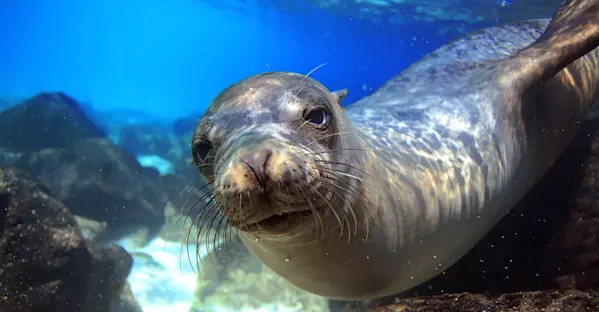
Visit the Skeleton Coast and its Cape fur seal colony, weather permitting
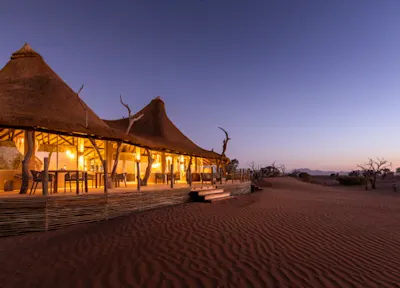
Fly north to Namibia’s Skeleton Coast, whose evocative name references the dried bones of wrecked ships that lay half-buried on beaches battered by fierce Atlantic storms. Our destination, Hoanib Skeleton Coast Camp, is a hospitable outpost amid one of Africa’s last great wildernesses, offering the utmost privacy and isolation. Set in one of the most fragile ecosystems on Earth, the low-impact camp enjoys a scenic location at the confluence of two tributaries of the dry Hoanib River in the northern part of the private million-acre Palmwag Concession, next to Skeleton Coast National Park. Few safari locales offer the level of isolation found here in one of the most remote regions of the Kaokoveld.
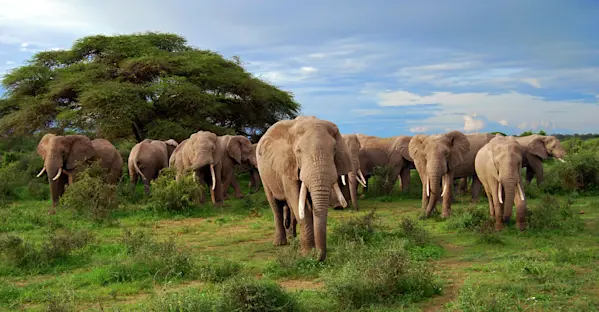
We spend three days immersed in these rugged mountains, vast plains, dune fields and dry riverbeds, with one excursion to the coast itself. Our bewitching environs are inhabited by a remarkable array of desert-adapted plants and animals, and we explore via 4x4 drives and hides for wildlife viewing. Almost miraculously, a multitude of species thrives in the stark inland environment, including Namibia’s largest population of desert elephant. We also hope for sightings of giraffe and lion, oryx, springbok and steenbok. On a guided bush walk (safety permitting), look for scrub hare and inquisitive ground squirrels. During our stay we have one opportunity to visit the Skeleton Coast, driving out and flying back (weather permitting; coastal fog is a regular presence here). A colony of Cape fur seals is often present on shore, and we may spot black-backed jackal and elusive brown hyena near the beach. Birdlife is diverse, with many southern African endemics, and we're likely to spot jaegers and skuas.
Days 7 to 9: Enter Botswana’s predator-rich Linyanti wilderness
Fly by private charter from Namibia into Botswana
Watch for large elephant herds gathering in the Linyanti woodlands
Search for lions, leopards, African wild dogs and other predators on day and night wildlife drives
Leaving the dry Namib Desert, we fly by private chartered aircraft over the border to Botswana before continuing to the Linyanti Reserve, one of the best game-viewing regions in Botswana. Elephants thrive in the mopane woodlands, especially in winter when they number in the thousands. From our base at Savuti Camp, day and night drives may reveal all the large predators as well as impala, zebra, giraffe, wildebeest lechwe, tsessebe and other plains animals.
Days 10 to 11: Glide through the waterways of the Okavango Delta
Explore reed-lined channels by mokoro when water levels permit
Look for wattled cranes, Pel’s fishing-owls and other wetland birds
Watch for red lechwes, hippos and crocodiles along the waterways
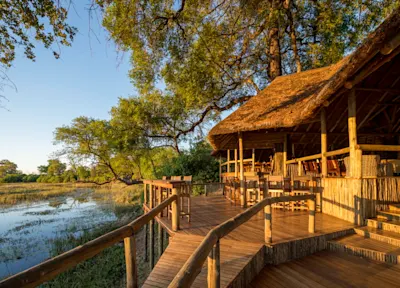
After a final game drive in the wilds of Linyanti, transfer by light aircraft to enter another realm entirely, the Okavango Delta, Earth’s largest inland water system. The delta’s headwaters lie in the western highlands of Angola, joining with other rivers in Namibia and Botswana to pour over the Kalahari Desert, where a green maze of channels and lagoons sprawls amid the sands and dry savanna. When rains create rising floodwaters, the delta is a vast network of waterways and islands that are home to a profuse collection of wildlife, with abundant hoofed game and the predators that pursue them. Our exclusive safari camp is located in the heart of the Okavango, surrounded by a mosaic of wetlands that sustains many rare birds. Look for the wattled crane, Pel’s fishing owl, jacana, rail, crake and moorhen. Depending on water levels, we explore the constantly shifting marsh by mokoro, the traditional poled dugout canoe of the delta, offering a chance to observe wildlife at eye-level in complete quiet. Following the reed-fringed channels, we may spy water-adapted antelope, such as red lechwe, browsing in the grasses, along with hippo and crocodile. We'll also hope to do a guided walk for an intimate perspective on the smaller wonders that surround us. Please note: Water levels and activities may vary based on fluctuating annual rainfall.
Days 12 to 14: Search for big cats across the private Chitabe Concession
Explore woodlands, floodplains and open savanna on wildlife drives
Look for lions, leopards, elephants and buffalo across the concession
Search for cheetahs, African wild dogs and other predators
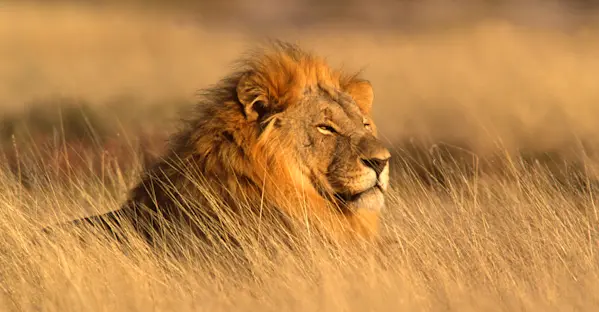
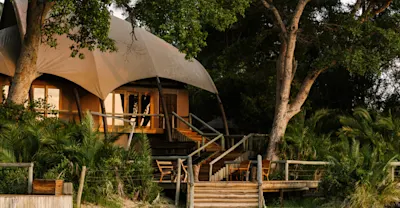
Depart by light aircraft for our deluxe bush camp, a private oasis on the Chitabe private concession. Although the nearby Gomoti River provides essential water for wildlife, this sector of the Okavango is relatively dryer and conducive to exploring on overland wildlife drives. Surrounded by woodlands and acacia forests separated by small and open savannah plains and islands of ilala palms, we’re likely to see four of the Big Five—lion, leopard, elephant and buffalo. We’ll also look for cheetah, hyena, wildebeest, zebra, wild dog and a wide array of antelope.
Day 15: Depart Botswana after your desert and delta safari
Fly to Maun for homeward flights or onward extensions
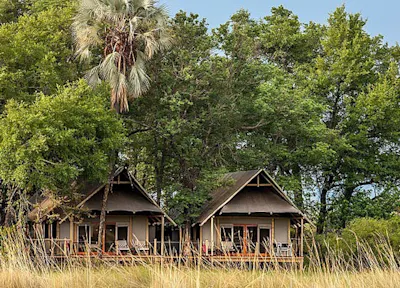
Our grand Namibia & Botswana safari comes to a close as we depart by air for Maun to connect with homeward flights, or to continue with onward extensions.
Click here to view the seasonal variations of weather and wildlife viewing in Botswana.