

Itinerary
Itinerary
Day 1: Arrive in India’s capital before your tiger photo expedition
Photograph luminous Bangla Sahib and its bustling community kitchen
Frame the descending arches of Agrasen ki Baoli stepwell
Arrive in New Delhi and transfer to our luxury hotel in the leafy heart of Lutyens' Delhi, with its broad boulevards, historic homes and government enclaves. The district is named after British architect Edwin Lutyens, who was responsible for much of the architectural design and building during the period of the British Raj, when India was part of the British Empire from the 1920s to 1940s.
This afternoon, set out on a photographic odyssey through sprawling New Delhi. Our tour begins at Gurudwara Bangla Sahib, one of the country's most revered Sikh temples. We'll capture its luminous white architecture, reflections in the holy pool, and the movement of worshippers and volunteers in the bustling community kitchen that generously serves more than 10,000 free meals each day, cooked using donated ingredients from Sikh farmers. Continue to Agrasen ki Baoli, an ancient stepwell whose repeating arches and long descending staircase offer striking opportunities for geometric compositions, leading lines and studies of light and shadow. On a scenic drive through Lutyens’ Delhi, photograph city icons as we pass the India Gate, the President of India’s residence and the new Parliament building erected in 2023.
At the National Gandhi Museum, document excerpts from the life and principles of Mahatma Gandhi via a rich collection of original relics, books, journals and documents, photographs, audio-visual materials and other memorabilia closely connected with Gandhi and India's struggle for independence. If the museum is closed on a Monday, we will visit Humayun’s Tomb instead, practicing wide-angle shots and close-ups of intricate carving detail at this 16th-century Mughal architectural masterpiece, a UNESCO World Heritage Site. Return to our hotel with time to refresh before a welcome dinner this evening, plus an orientation by our Expedition Leader to all the India photography adventures that lie ahead.

Day 2: Journey into one of India’s richest Bengal tiger reserves
Drive through rural Madhya Pradesh to Bandhavgarh National Park
Photograph village markets and roadside tea stalls along the way
Settle into a deluxe ecolodge on the edge of tiger habitat
Transfer to the airport very early this morning for our flight south to Jabalpur. Continue on a half-day's drive through the countryside of Madhya Pradesh to reach Bandhavgarh National Park. The journey offers vignettes of everyday Indian life—village markets, roadside tea stalls and ox-drawn carts—and we will pause, when appropriate, for candid cultural images. By afternoon, we arrive at our ecolodge set in the forest just outside the park boundary. An essential stop on any serious India safari, Bandhavgarh is renowned for one of the country's highest concentrations of Bengal tigers. Originally established as a national park in 1968, Bandhavgarh was declared a protected tiger reserve under Project Tiger in 1993. At 444 square miles, it is a relatively small park with a thriving tiger population, offering visitors a good chance of encountering them, as well as other distinctive Indian wildlife. After settling in to our lodge, if time permits, we'll set out on a short wildlife drive in open 4x4 safari vehicles. Our Expedition Leader helps you dial in camera settings for fast-moving wildlife and changing light as we start searching for our first Bengal tiger.

Days 3 to 4: Photograph Bengal tigers across Bandhavgarh’s forests and grasslands
Photograph tigers in one of the world’s highest-density tiger habitats
Spend a full day on safari with a special permit to maximize photography opportunities
Capture images of spotted deer, langurs and colorful birdlife with personalized field coaching
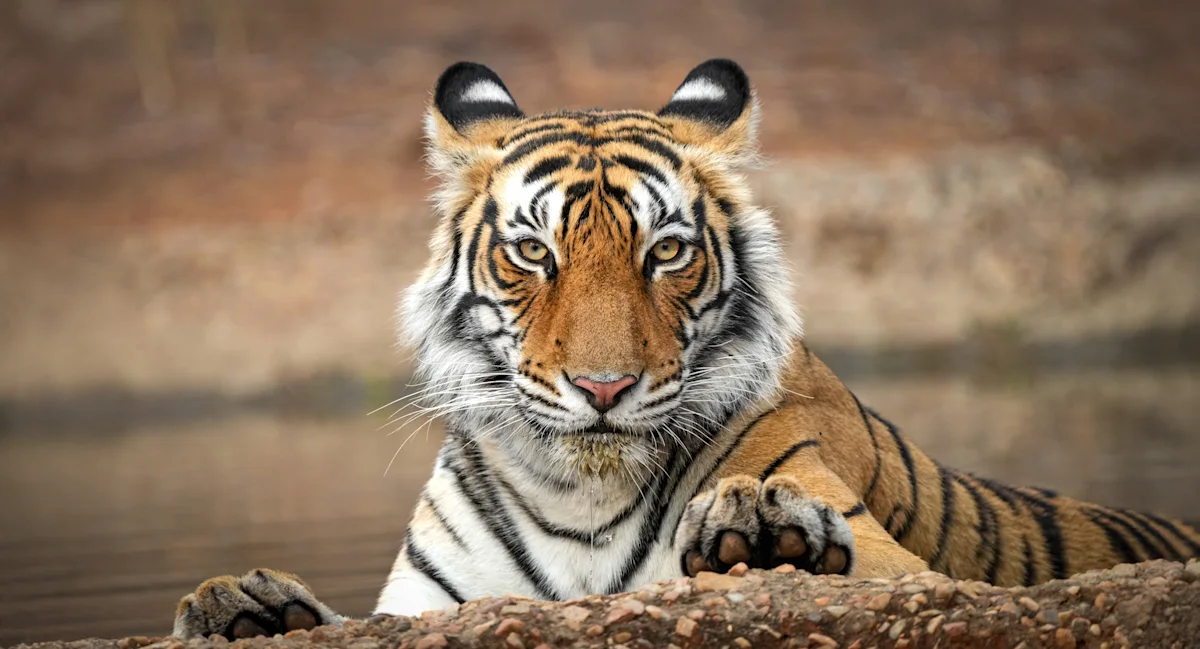
The next two days are devoted to intensive exploration of Bandhavgarh National Park in pursuit of exciting wildlife images. Covered with sal and mixed deciduous forest, thickets of bamboo and expansive grasslands that line the stream valleys, the park’s hilly terrain harbors one of the world's highest densities of tigers. Bandhavgarh was once a prime hunting reserve for the Maharajas of Rewa, where Maharaja Raman Singh alone shot an astounding 111 tigers by 1914. Today it is a pacesetter in tiger protection. With tigers at the apex of the food chain, Bandhavgarh’s rich biodiversity includes a multitude of other wildlife. We expect to photograph a broad sampler of its 37 mammal species, among which are leopard, jungle cat, civet, wild boar, sambar, spotted deer, muntjac (barking deer), gaur, sloth bear and Asiatic jackal. Some 250 bird species, 70 different butterflies and various reptiles round out the diverse wildlife population.
We have extended time in the field on morning and afternoon game drives, and one day will include a full-day safari, tapping our exclusive permit that allows us extra time in the park. Across Bandhavgarh’s varied landscapes, search for Bengal tigers plus the park’s full array of wildlife: spotted deer stepping through morning mist, sambar grazing in meadows, langurs framed by backlit dust, and diverse birdlife, including showy peacocks. Your Expedition Leader and local naturalist guides work together to position our vehicles for optimal angles and unobtrusive wildlife viewing. On our full-day safari, picnic meals in designated zones allow us to remain all day, so we can stay close to promising areas, follow tracks and alarm calls without interruption, and document the subtle changes in light and animal behavior throughout the day.
Your Expedition Leader provides guidance on photographing fast-moving subjects, managing batteries and memory cards on long days, and using environmental elements—light, dust, vegetation—to elevate your wildlife storytelling. Back at the lodge, gather for informal photography discussions and review techniques such as tracking autofocus, panning, exposure compensation for striped fur, and composing sequences that capture a scene’s unfolding narrative.
Day 5: Enter Kanha’s sal forests, bamboo thickets and open meadows
Photograph rural life en route to Kanha National Park
Explore the landscapes associated with Kipling’s The Jungle Book
Frame Kanha’s varied forest and grassland habitats
A half-day’s drive takes us from Bandhavgarh to Kanha National Park. Along the way, capture photos in passing of forested landscapes and village scenes that offer glimpses of daily life in rural Madhya Pradesh. Situated in the Satpura Hills of central India, Kanha National Park covers 750 square miles of rich and varied wildlife habitat. Its lush sal and bamboo forests, grassy meadows and ravines provided inspiration to Rudyard Kipling for his famous collection of stories in The Jungle Book. Kanha was established as a national park in 1955 and forms the core of the Kanha Tiger Reserve, created in 1974 under India's Project Tiger. The park's landmark achievement is the preservation of the rare barasingha, an endangered swamp deer with 12-point antlers, saving it from near-extinction. Strict conservation programs for the overall protection of the park's fauna and flora make Kanha one of the most exemplary national parks in Asia.
From our luxurious ecolodge base in India's tiger heartland, learn in depth about the Bengal tiger and its habitat, and observe how conservation travel directly benefits local communities and the tiger reserve. Following lunch on arrival, gain an introduction to the region on an initial short safari in the park. From our open 4x4 vehicles, search for rare barasingha (swamp deer), gaur, langur, wild boar, vibrant birdlife and, with luck, our first glimpse of a tiger in Kanha. Back at the lodge, enjoy dinner outdoors (weather permitting), with a briefing by your Expedition Leader on tomorrow’s adventures.

Days 6 to 8: Photograph Bengal tigers and barasingha across Kanha
Search for tigers on morning and afternoon wildlife drives
Photograph endangered barasingha grazing in Kanha’s meadows
Spend a full day on safari with a special permit to maximize wildlife encounters
Scenic Kanha, once a hunting ground for imperial rulers and viceroys, is now one of India’s most important conservation reserves. With prime habitat for Bengal tigers and their prey, Kanha offers some of India’s best tiger photo opportunities, plus a diverse collection of other wildlife. We spend three days pursuing images in this premier national park, searching for tigers and other wildlife from open 4x4 vehicles. Explore Kanha's diverse landscapes of sal forests, bamboo thickets and rolling meadows on a series of morning and afternoon game drive and one full-day photo safari.
Open meadows where herbivores graze attract tiger, leopard and dhole (wild dog) to the edges of the clearings, and we'll hope to find some of these predators on the hunt. The Banjaar River bordering the park provides a steady water source for wildlife. Dense jungle interspersed with vast grassy meadows called maidans support a range of species similar to those in Bandhavgarh. Other mammals we might photograph include the magnificent 12-point barasingha (swamp deer), common langur, gaur (the world's largest wild ox), wild boar, macaques, langurs and a rich array of birds. Early morning light filters through the forest in dramatic shafts—ideal for portraits and environmental compositions—while the sun's late-afternoon glow creates warm tones for action shots and animal close-ups.
On one day, our special permit allows us to remain in the park for a full-day safari, with picnic meals en route. Such uninterrupted time increases our chances of encountering wildlife as it moves between locations. We can follow fresh tracks, respond immediately to alarm calls, and remain in promising areas as light and animal movements shift throughout the day. Our Expedition Leader offers guidance on advanced fieldcraft, helping us anticipate the direction of movement, composing subjects against clean backgrounds, and adapting to strong midday light.
Between game drives, return to our ecolodge to rest and review images in an relaxed, collaborative environment. Optional midday discussions cover topics such as metering for striped fur, improving composition confidence, managing camera settings for fast-changing conditions and building a cohesive set of images across the wider expedition. On one evening, after we gather for dinner, join in some festive dancing around the campfire during a cultural presentation at our lodge.
Day 9: Travel from Kanha to the historic city of Lucknow
Drive to Raipur, photographing rural life along the roadside
Fly to Lucknow, capital of Uttar Pradesh
Settle into a hotel overlooking the Gomti River
Depart Kanha this morning and drive a half-day to Raipur, capturing photos of daily rural life as it unfolds along the roadside. From Raipur we fly to Lucknow, the capital and largest city in the state of Uttar Pradesh in northeast India, where we arrive early this evening and check in to the 5-star Taj Mahal Hotel. This regal property on the Gomti River that provides a restful oasis after a long day of travel as we transit from one region of the country to another.
Day 10: Reach Dudhwa’s Terai grasslands near the Nepal border
Drive to a tiger reserve well beyond India’s conventional safari circuit
Photograph swamp deer across Dudhwa’s grasslands
Stay at Jaagir Manor, an 80-year-old hunting lodge converted into a retreat
Drive a half-day from Lucknow to Dudhwa National Park, a thriving wildlife enclave well off the conventional safari circuit with uncrowded conditions to pursue outstanding wildlife photography. The 190-square-mile park in the state of Uttar Pradesh lies on the Indo-Nepal border, protecting some of the last pristine expanses of Terai forest and grasslands in the Upper Gangetic Plains. Originally established as a wildlife sanctuary for the endangered swamp deer (barasingha), with its magnificent 12-point rack, it later became a tiger reserve in 1987. Today, tigers, leopards and many deer species abound, and the park has also successfully reintroduced a healthy population of one-horned Indian rhinoceros from Assam and Nepal, once hunted nearly to extinction. Other mammals include Asian elephant, sloth bear, wild boar, honey badger, langur, rhesus monkey, golden jackal, jungle cat, fishing cat, and more than 400 bird species. Among the avian highlights are hornbill, red jungle fowl, Bengal florican, fishing eagle, serpent eagle and paradise flycatcher.
On the outskirts of the park, we stay at Jaagir Manor, an 80-year-old former hunting lodge turned heritage eco-retreat. The colonial manor house offers luxury accommodations in period-1940s style, its focus today on hosting guests keen to conserve the wild species that were formerly targets.

Days 11 to 13: Photograph tigers, rhinos and Tharu culture in Dudhwa
Photograph tigers and prolific wildlife on multiple wildlife drives
Capture images of one-horned rhinos reintroduced to Dudhwa’s grasslands
Visit a Tharu village to photograph Indigenous culture and daily life
Multiple game drives offer diverse opportunities to photograph the prolific wildlife of Dudhwa National Park, part of an extensive arc of protected areas in the marshy lowlands along the Indo-Nepal border. This relatively undiscovered gem among Indian safari-goers is one of three large interconnected forested sanctuaries that form the Dudhwa Tiger Reserve, and the lush area today is the core of a viable tiger population. Some of the land was formerly used to grow sugarcane and returned to its natural state, while other tracts of native forest, predominantly sal and teak, are intermixed with extensive tall grasslands and wetlands inundated by rivers flowing down from the Himalaya.
The inspiring force behind the creation of the reserve was Billy Arjan Singh, a famous hunter-turned-conservationist who had a vision in the 1960s to introduce several zoo-born tigers and leopards back into the wild. Ultimately, his efforts led to the establishment of Dudhwa National Park by Prime Minister Indira Gandhi in 1977, and Singh was awarded World Wildlife Fund’s gold medal, its premier award, in 1996 for his conservation work.
During our stay, we will also have opportunities for cultural photography on a visit a local Tharu village, one of several in the area that are home to the Indigenous tribal people of the region. We’ll also take a nature walk in the forests surrounding our lodge for an intimate view on our environs, with chances to photograph smaller wildlife species and birdlife. On our final evening, revel in memories of our Indian safari adventures as we gather for a farewell dinner with our Expedition Leader.
Day 14: Return to Delhi after your India photo expedition
Fly from Lucknow to Delhi
Relax at your hotel before homeward flights
It’s time to make the return drive to Lucknow this morning, then catch a 75-minute flight back to Delhi. Upon arrival at the Delhi airport, we transfer to our nearby hotel, just minutes away. An overnight stay is included along with a transfer to the international airport to meet departing flights, most of which leave late this evening.