

Itinerary
Itinerary
Day 1: Begin your circumnavigation of Iceland in Reykjavik
Explore Iceland’s capital independently beneath the long summer daylight
Board your expedition ship late in the day, with dinner served aboard
Arrive at Keflavik International Airport and transfer to Reykjavik, Iceland's capital, about a 45-minute drive. Lying less than two degrees below the Arctic Circle, Reykjavik is the world’s northernmost capital. Its high latitude location provides 22 hours of sunlight at high summer, with the near-perpetual light creating a lively, energetic atmosphere. Explore on your own today before boarding your expedition ship late this afternoon, with dinner served aboard.
Accommodations


Day 2: Explore Iceland’s remote Westfjords and seabird-rich Vigur Island
Hike along a fjord to a towering waterfall in the remote Westfjords
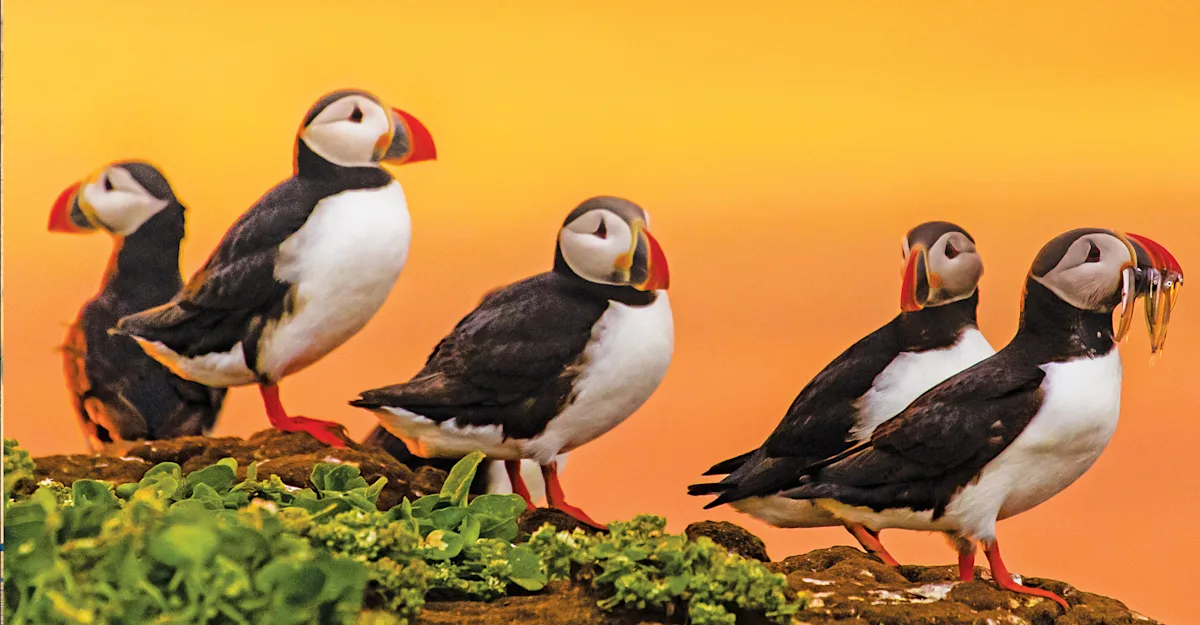
Look for puffins, black guillemots, Arctic terns and eider ducks on Vigur Island
Meet the family that stewards the island’s seabird colonies and gathers eiderdown
Explore the dramatic Westfjords region of Iceland today. Lying just south of the Arctic Circle, the far-flung Westfjords embrace Iceland's most northwesterly point. Exceptionally remote and peaceful, much of this corner of Iceland can only be accessed on foot or by sea. Erik the Red, father of Leif Eriksson, was among the first in a thousand-year line of settlers who survived on a peninsula here, living on herring and seabird eggs. Hike along the base of a fjord to a towering waterfall before entering the fjord network of Isafjardardjup, known for its wealth of wildlife, including whales, seals, and cliffs covered with huge colonies of cacophonous nesting seabirds. We land at Vigur Island, a birder’s paradise home to a multitude of species including puffins, black guillemots, Arctic terns and eider ducks. The walkable island has only a handful of inhabitants—a farmer and his family who are active stewards of the seabird colonies and collect eiderdown from resident ducks’ nests to sell for cushions and duvets.
Accommodations
Day 3: Discover the history and traditions of Iceland’s herring coast
Visit the Herring Era Museum, Europe’s largest maritime and industrial museum
Watch a traditional herring-salting demonstration and sample the finished product
Join a local forestry group to learn how forests are established and maintained in Iceland
Today we call at Siglufjordur, Iceland's northernmost mainland settlement. The small town was the center of the country's once-thriving herring industry in the mid-20th century. We stop at the Herring Museum, which focuses on the wealth once provided by these small silver fish and how they were processed. Though the museum receives relatively few visitors in this remote location, it is the largest marine and industrial museum in Europe and has received the European Museum of the Year award. Our visit includes a salting demonstration and tasting. Though the herring are mostly gone today, the town's economy is still fishing-based. Then we join the local forestry association for a conservation-focused field tour in their local woods, learning what it takes to maintain and develop a forest in Iceland.
Accommodations
Days 4 to 5: Explore East Greenland’s ice-filled fjords and wild coastline
Cross the Denmark Strait and cruise among fjords fed by calving tidewater glaciers
Go ashore to hike or explore by Zodiac and kayak, conditions permitting
Watch for humpback whales, seals and less commonly seen Arctic wildlife
Strike out across the Denmark Strait to the rugged coast and wild shores of Eastern Greenland. Known for its large volume of tidewater glaciers that flow down from the ice sheet, calving tremendous amount of ice into the fjords, this little-visited region offers an encounter with raw Arctic wilderness unmatched on conventional encounters with Greenland. We explore multiple fjords aboard ship as well as on landings, where hiking, kayaking or Zodiac cruising may all be possibilities. It's easy to imagine what it would have been like to be an early maritime explorer in these wild waters, as the scenes are little changed since Europeans first laid eyes on them, although these environs have been inhabited by Greenlandic Inuit and their Thule prececessors for thousands of years. Spend time on the bridge or at the ship’s railing, scouring the sea's surface and shoreline for Arctic wildlife—we often see humpback whales and seals, and less often, beluga whales. Rarely, even an elusive narwhal or polar bear may make an appearance.
Accommodations
Day 6: Explore waterfalls, volcanic landscapes and birdlife in northern Iceland
See Godafoss plunge over a broad, horseshoe-shaped lava cliff
Walk among Lake Myvatn’s steam vents, lava formations and pseudo-craters
Choose an alternative exploration of Asbyrgi Canyon, Dettifoss or the coast
Return to Iceland and land at Husavik this morning, Iceland’s oldest settlement and the site of the first house built on the island. It’s also our gateway to the geological wonders of Iceland’s northern reaches, including the remote Highlands. Depart for a full day of overland exploration, first visiting one of the largest waterfalls in Iceland, Godafoss, the "waterfall of the gods." The dramatic cataract plunge 40 feet over an ancient lava cliff shaped like a horseshoe, stretching 100 feet across. We also visit Lake Myvatn and environs, the most geothermally active area in Iceland. Lake Myvatn fills the remnant of a crater formed during a massive eruption 2,300 years ago, and the region around it is an introduction to world-class field geology. On display in the dynamic environment are various volcanic features, including pseudo-craters, lava formations, steam vents and hot springs. The lake is also one of the premier birdwatching areas in the world, with marshes providing habitat for huge numbers of migratory birds during the summer, with more than 115 species on view. Alternatively, choose an adventurous journey into Asbyrgi Canyon, said to be formed from the hoof of the Norse god Odin’s eight-legged horse. The canyon is filled with waterfalls, and a stop is included to witness Dettifoss, the second most powerful waterfall in Europe. Or stay along the coast for slower-paced activities including forest bathing, bird watching and a soak in the GeoSea bath.
Accommodations
Day 7: Cross the Arctic Circle and search Iceland’s northern waters for whales
Go ashore by Zodiac on Grimsey, an island that straddles the Arctic Circle
Look for nesting Arctic terns, fulmars and puffins along the coast
Watch for humpback, minke, fin and other whales while sailing south
Sailing northward into the land of the midnight sun, our destination is the tiny island of Grimsey, located about 30 miles off Iceland's north coast. Known as the land of a hundred people and a million seabirds, Grimsey lies exactly on the Arctic Circle. We go ashore by Zodiac and celebrate being officially in the Arctic once more, in the company of nesting Arctic terns, fulmars and puffins in burrows, all busily bathing, courting and fishing. This afternoon we are at sea, sailing around the northern corner of Iceland to start our voyage south. These waters offer some of the world's best whale watching, so you'll want to be out on deck to look for them as we cruise. Icelandic seas are home to 24 different whale species, and in this area, we may see humpback, fin, minke, sei, blue, sperm, northern bottlenose and long-finned pilot whales, as well as orca, harbor porpoise and white-beaked dolphin. Our naturalist guides are by your side to help you spot and identify the abundant marine life.
Accommodations
Day 8: Walk among puffins and mountain landscapes in eastern Iceland
Watch puffins move between their burrows and the sea from a boardwalk through the colony
Hike toward the summit of Svartfell or bike into the surrounding backcountry
Explore the village with a local guide, stopping for eiderdown and local drinks
Our destination today is Borgarfjordur Eystri, regarded as one of Iceland's most wild and beautiful fjords. Surrounded by the Dyrfjoll Mountains, which rise more than 3,700 feet from the sea, the region is renowned for its stunning hiking terrain. Challenge yourself with a hike to the summit of Svartfell, standing over 1,000 feet above sea level, or bike into the backcountry to take in a different perspective on the surrounding mountain range. Join a local guide on a walk through the small village, including a stop at the local eiderdown shop and a chance to taste the local libations. Borgarfjordur Eystri, is also reputedly home to one of numerous “elfin communities” that thrive in Icelandic mythology. The fjord takes its name from the Icelandic elf-queen, Alfaborg, who is said to live nearby. But it is the fjord’s puffin residents that capture our attention most vividly: Here we find one of Iceland’s largest Atlantic puffin colonies. A boardwalk weaving through the busy colony allows easy access, and since the puffins are accustomed to human presence, we are able to get exceptionally close photos as they move in and out of their hillside burrows.
Accommodations
Day 9: Explore Iceland’s young volcanic archipelago
Cruise past Surtsey, an island formed by eruptions between 1963 and 1967
Climb to the Eldfell crater, where heat remains beneath the ground
Learn how seawater was used to slow the lava advancing toward Heimaey’s harbor
Overnight, our ship has rounded the southern side of Iceland to reach the Westman Islands. Formed by undersea volcanoes between 5,000 and 10,000 years ago, the islands comprise one of the planet's youngest archipelagos. We cruise past the newest island, Surtsey, which was formed by volcanic action from 1963 to 1967. The world witnessed its creation on film, and Surtsey was declared a UNESCO World Heritage Site from its birth, providing the world with a pristine natural laboratory in which to observe how plant and animal life colonize new land. In 1973, the island of Heimaey, the largest and only populated island in the Westmans, was devastated by lava flows from Eldfell Volcano, which destroyed half its town and nearly closed off its harbor. An emergency operation to cool the advancing lava with sea water held it at bay. We visit the volcano crater, where the earth is still hot, and survey impressive views of the broad area once engulfed by lava.
Accommodations
Day 10: Complete your circumnavigation of Iceland
Disembark your expedition vessel in Reykjavik after breakfast
Transfer to Keflavik Airport for homeward flights
Our circumnavigation of Iceland is complete today as we return to Reykjavik to disembark. After breakfast, a transfer to Keflavik Airport is included to meet homeward flights.