



Itinerary
Please note: Alternating trips run in the opposite direction, starting in Bozeman and ending in Jackson. All inclusions are the same.
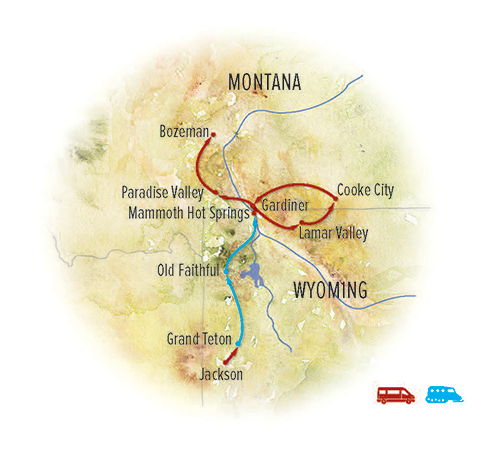
Our Yellowstone wildlife tour begins in the Old West town of Jackson, which sits at the edge of Grand Teton National Park in the shadow of the mountain range’s jagged spires. This evening, meet your Expedition Leader and fellow adventurers at an informal welcome dinner and orientation.
Our winter safari begins in the broad valley of Jackson Hole as we look for bald and golden eagles, bighorn sheep, coyote, bison, mule deer, moose and elk. After lunch at the National Museum of Wildlife Art in Jackson, travel by horse-drawn sleigh through the National Elk Refuge. Gliding over the snow that blankets the valley floor, we capture close-up photos of the massive herd that winters here, with thousands of animals roaming the range.
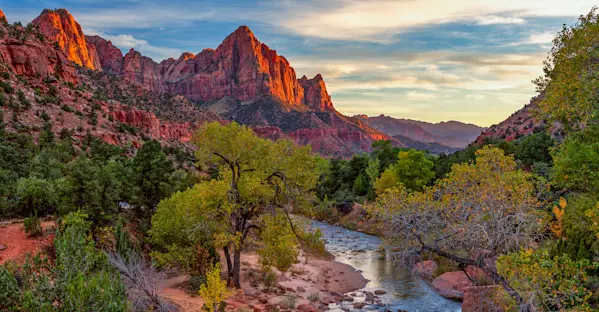
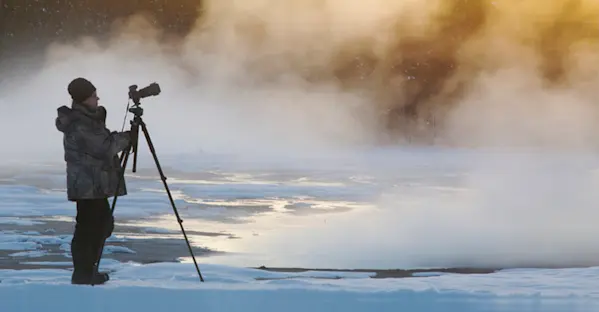
A traverse of Grand Teton National Park offers a panorama of the iconic peaks rising above the Snake River.. Reaching the boundary of Yellowstone, we board heated snowcoaches that convey us into the pristine winter splendor of America's first national park. We stop at West Thumb Geyser Basin on the edge of Yellowstone Lake, looking along the way for moose, river otters and trumpeter swans before arriving at Old Faithful Snow Lodge. Because winter access to the park's interior is limited to snow vehicles, an overnight stay here is a coveted experience. In silent seclusion, witness the park's most famous geothermal feature, Old Faithful geyser, erupt in a crystalline veil of spray. And on a clear night, we may even get to watch it shoot skyward by the light of the moon.
Today we traverse Yellowstone’s interior by snowcoach on our transfer from Old Faithful to Mammoth Hot Springs. This over-the-snow journey gives us access to remote geothermal areas, where steaming features remain active even in the coldest months. As we pass through Hayden Valley, an open expanse of prime wildlife habitat, look for bison, red fox, coyote and other animals adapted to winter and active on the landscape. Along the way, our guides share insights into Yellowstone’s seasonal ecology, with ample chances to photograph wildlife and the wintry white landscape. Arriving at Mammoth Hot Springs in the afternoon, we often see elk near the white travertine terraces. Here, thermal water flows over limestone formations shaped by mineral deposits and heat-loving microorganisms called thermophiles, which create vivid color patterns across the rock. As evening approaches, continue into the Northern Range, a key corridor for winter wildlife. Bison are frequently spotted, their heavy coats cloaked in frost, and it's here that we begin our search for gray wolves, which roam this region year-round.
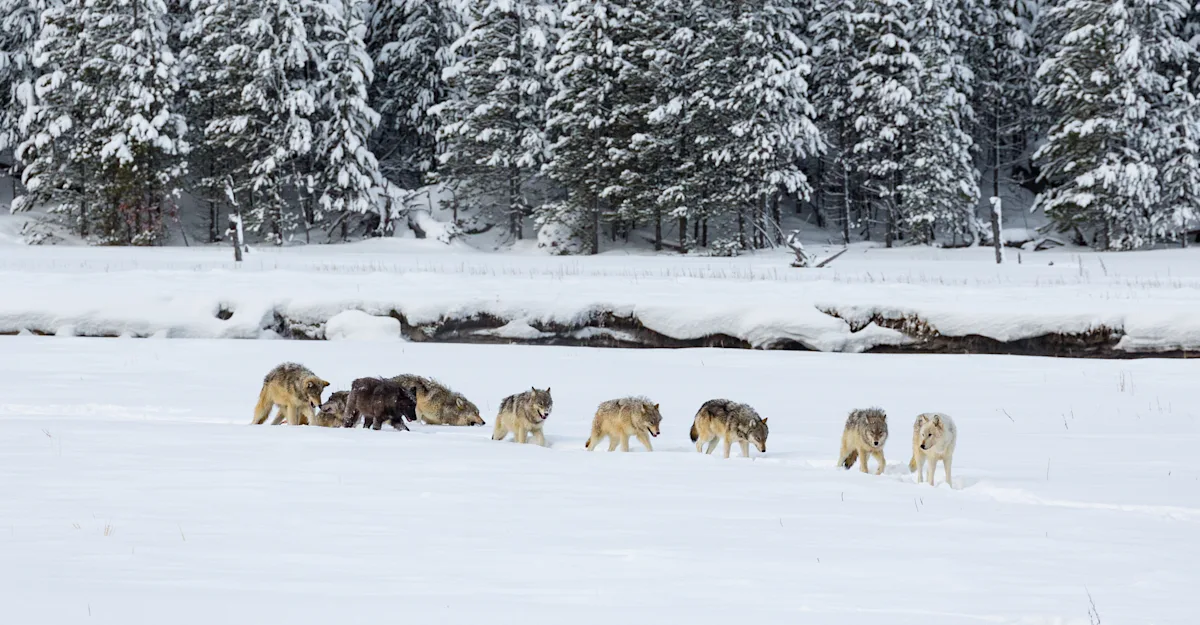
Yellowstone's Northern Range remains the best place in the world to observe wolves the wild, though they are almost always seen at a distance with the use of our guides' high-powered spotting scopes. The next two days are devoted to tracking these elusive predators alongside other more readily seen wildlife. Although wolf sightings are never guaranteed—pack movements are unpredictable and wolves tend to avoid people—our Expedition Leader is a skilled tracker and educator. We also collaborate with local researchers who provide up-to-date sighting reports, increasing our chances of locating active pack. After a full day in the field, we arrive at our hotel near Yellowstone’s northern boundary, where we spend the next two nights.
A full day is ours to scout for Yellowstone's legendary wolves and other wildlife. Reintroduced to the park in 1995 amid much controversy, the gray wolf was returned to this native ecosystem after a 70-year absence following a policy of government-sanctioned eradication. Since then, they have flourished, supported by bountiful prey including a multitude of elk. Yet much rancor continues to surround their presence, and we learn in detail from our guides about the current conditions in which wolves exist within the greater Yellowstone area. As the wolves have restored more balance to the natural ecosystem, elk numbers have dropped, and we may not be as likely to see as many wolves as visitors did several years ago. If we are especially lucky, though, we might see a pack test an elk herd for a weak or sick animal, or spot lone individuals foraging on their own. But even if the wolves remain elusive, the winter landscape is magical, and we're sure to see plenty of other wildlife native to the park.
After an exhilarating morning on safari, continue east to Cooke City for a visit to the Hartman Gallery, with a slide presentation by Dan Hartman. Dan is a local naturalist and renowned Yellowstone wildlife photographer whose wolf images are widely acclaimed. He'll share insightful observations about wolf behavior gleaned from countless hours in their presence, as well as tips for pursuing photos of wolves and other wildlife. In the waning light of mid-afternoon, we head back across the Lamar Valley for more wolf tracking, knowing our chances to see them are best at dawn and dusk.
As dawn illumines the snowy meadows of the Lamar Valley and the peaks of the Northern Range, we return once more in search of wolves. If we are fortunate to sight them, our onboard spotting scope enhances our observation of their activities from a distance without disturbing their natural behavior. Many of our Expedition Leaders have worked for years with the field researchers who track these wolves daily, and together they provide us every opportunity to find these intriguing animals in their natural surroundings. Returning to Mammoth Hot Springs and exiting the park once more, we leave Yellowstone’s frozen silence and continue up the Paradise Valley along the Yellowstone River, flanked by the Absaroka and Gallatin ranges on either side. Reaching Bozeman for a final night, we gather for a farewell dinner this evening.
If your flight schedule permits, you may enjoy exploring Bozeman on your own today. This historic Old West/New West town, with a rich mining and trapping heritage, boasts 40 individual properties on the National Register of Historic Places. It is home to Montana State University, with a thriving contemporary economy built on growing tourism and tech sectors. With a wide range of cultural and outdoor activities, Bozeman offers plenty to do. A transfer to the airport is included to meet your departing flight.