






Itinerary
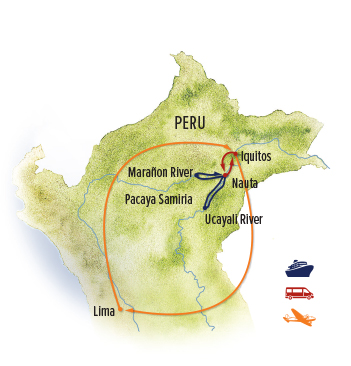
Arrive in Lima, where our local representative meets you at the airport to transfer you to our hotel. Our location near the airport provides convenient access for tomorrow morning's flight to Iquitos. Enjoy dinner on your own this evening.
From Peru's capital, we fly east across the spine of the Andes to land in Iquitos. Accessible only by air or water, this once-booming rubber town is now one of the largest cities in the Amazon Basin. Transfer to Nauta, a small riverside town on the banks of the Marañon River, one of the major tributaries of the Upper Amazon. Here, we board our deluxe riverboat, the Delfin II, chartered exclusively for Nat Hab guests. Cruising slowly upstream, bound for the Amazon headwaters, enjoy panoramic views from the open-air top deck and sip cocktails made with regional fruits and Pisco, Peru’s famous national brandy, as our Expedition Leaders provide an overview of the journey ahead. These legendary waters, known as the "river sea," thrum with small boats heading to market, while the skies overhead are animated with birdlife. Once darkness falls, head back topside to look for stars overhead in the tropical night sky.
Early risers are rewarded with abundant bird and animal life on a morning skiff excursion along Pahuachiro Creek. We set out at sunrise, when wildlife is most active in the tropics. The blackwater creek, while clear, is the color of dark tea, an effect of the tannins deposited by rich vegetation along the banks. Along this small tributary, we frequently observe a variety of monkeys including squirrel, monk saki and brown capuchin, as well as a host of birds: large-billed terns, laughing falcons, blue-gray tanagers, snowy egrets, horned screamers, tiger herons, short-tailed parrots, parakeets and perhaps the flashy scarlet macaw. It's important to know at the outset, though, that the prolific wildlife of the Amazon is skilled at hiding: It takes an expert eye to locate animals sheltered by the dense vegetation. That's where our seasoned guides come in! After breakfast, explore the Fundo Casual trail, walking deep into the forest in search of sloths, birds and more. Look closely for brightly colored poison dart frogs, leafcutter ants and other intriguing small creatures along our path.
Cruising on to Nauta Caño Creek, we explore marshes, side streams and oxbow lakes along this small river while searching for many different birds and animals. We may even spy a three-toed sloth nestled in a cecropia tree. As the sun sinks below the canopy, an exciting adventure awaits: a chance to witness the transformation of the rainforest at nightfall. An orchestra of sounds evolves as nocturnal creatures awaken, with crickets and night birds providing a percussive rhythm. In the darkness, our guides use powerful spotlights to search for wildlife. Black caiman, frogs, common potoo, black-crowned night heron, pauraques, spectacled owls and nighthawks are commonly spotted along the banks, while fishing bats swoop down to scoop fish from the water.
This morning, stop at Amazon Natural Park for a rainforest stroll. Serenaded by the wildlife symphony coming from the dense vegetation, we scout for capybara, howler and titi monkeys, tapirs, sloths and a wide range of birds. The terra firma forest is filled with layers of fascinating flora, including walking palms and trees festooned with epiphytes. Later this afternoon, as we travel farther up the Marañon River, options for exploration await. With six double sit-on-top kayaks, plus open skiffs, choose your mode for investigating a virtually unvisited section of Pacaya Samiria National Reserve, where the Yanayacu and Pucate rivers meet. Established in 1982 to preserve the exceptional biodiversity of the northern Amazon wilderness, this 5-million-acre sanctuary is Peru's largest protected area. Giant kapok and strangler fig trees along the banks shelter a multitude of wildlife, and our Expedition Leaders explain the various micro-ecosystems found here in one of the most pristine parts of the reserve. After dark, head up to the top deck to listen to the symphony of night sounds in the forest.
Awaken in the confluence of the Ucayali and Marañon rivers where they join to form the main stem of the mighty Amazon River. We explore the confluence on an early-morning skiff ride. Back on board for breakfast, we cruise into the Ucayali River to reach the mouth of a remote tributary of the Upper Amazon, the Yarapa River. Once there, board skiffs or kayaks to watch for colorful birds such as the plum-throated cotinga, and look for pink and gray river dolphins that sometimes slice gracefully through the water alongside us. These freshwater cetaceans are highly social, friendly and intelligent. According to local lore, the dolphins turn into humans during celebrations to steal handsome men or pretty women from their villages.
Later, we disembark for a short skiff ride to San Jose de Paranapura, a riverside village where we meet Indigenous residents whose culture has been present here for centuries. At the arts and crafts market, we can purchase items that support the community and empower women artisans. Sales indirectly help preserve local fauna, since income generated decreases the pull of illegal hunting. We also visit with the prestigious local shaman, known throughout the region as a healer and spiritual guide for residents living throughout the area’s remote reaches. Learn the uses for various medicinal plants sourced from the largest pharmacy in the world—the Amazon rainforest—then return to the Delfin II for dinner.
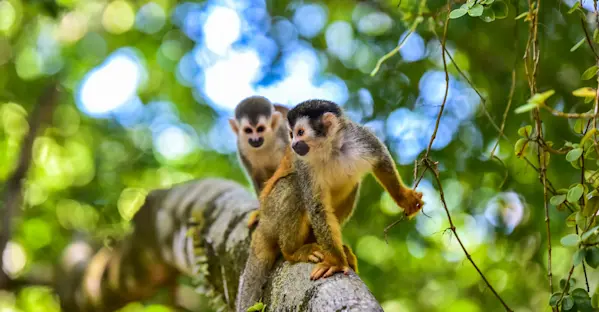
This morning we visit Belluda Caño Creek near Yanallpa, home to the Ribereño people, Indigenous dwellers in the rainforest for centuries. This small tributary is a prime location to look for pink river dolphins. Plying the water in open skiffs, we have a chance for close encounters with these rare creatures, if we're lucky. In the forest canopy above, look for saki monkeys foraging for their next meal in small family groups. Navigating small waterways off the Dorado River inside the Pacaya Samiria Reserve, we are immersed in the verdant recesses of the world's largest rainforest. As we glide slowly along, search for birds such as snail kites, festive parrots, olive-spotted hummingbirds, wood creepers and endangered scarlet macaws. Squirrel monkeys move in large, noisy troops overhead while iguanas laze in the sun. At every turn, our guides reveal the secrets of the rainforest, helping us spot creatures we would never see on our own, given the amazing camouflage of so many masterfully adapted species. After dark, scan the riverbanks from our skiffs for spectacled caiman, frogs, owls and capybara, the world's largest rodent. Keep an eye peeled, too, for owl monkeys—the world’s only nocturnal monkey—resting in the forest canopy in preparation for their next forage.
This morning, we reach the Pacaya River at the heart of the Pacaya Samiria Reserve. This vast flooded landscape, known as the "mirrored forest," covers 10,000 square miles at the headwaters of the Amazon and is home to Peru's greatest concentration of wildlife. We set out to explore this emerald realm of trees, vines, streams, lagoons and islands. Overhead, look for macaws, black-collared hawks, prehistoric hoatzin birds and capuchins, and listen for red howler monkeys with their eerie call that reverberates through the canopy for miles. We begin to get a sense of the layered richness of the reserve's mixed habitats: its 85 lakes are home to 250 fish species, while it protects 132 species of mammals (most are very elusive), 150 reptile and amphibian species, and 450 different kinds of birds. The reserve also contains the largest variety of flora in Peru, including huge bromeliads and 22 orchid species. This afternoon, take another skiff or kayak excursion into Supay Cocha, a lagoon teeming with fish. Watch for troops of squirrel monkeys, sloths and plenty of birds, including black- and white-tailed trogons and paradise tanagers.
On a morning skiff excursion along one of the tributaries of the Ucayali River, we hope to observe egrets, herons, hawks and long-legged neotropical cormorants fishing for breakfast, as wattled jacanas compete for food with spiders, and grasshoppers and butterflies hop and flutter along the edges of freshwater swamps and marshes. In the afternoon, we return to the Marañon River upstream from the confluence to visit Amazonas village. The residents are part of the Cocama ethnic group—the original inhabitants of this part of the world. During our visit, we learn about the natural dyes that the women of the village use to dye handicrafts made from rainforest materials such as palm fibers, roots, seeds and tree bark—items we can purchase from the local craft market at the end of our visit. We also meet other community members who share with us their roles in village life. Back aboard the ship, head up to the observation deck for a last night of stargazing under black Amazon skies.
Disembark in Nauta this morning, then, en route to Iquitos, stop for a tour of Acuario del Amazonas—the Aquarium of the Amazon—a research center helping to preserve the biodiversity of the Peruvian Amazon through the study and conservation of more than 300 species of ornamental fish. Ideally located in an area where natural springs flow year-round, the center is dedicated to creating a long-term balanced ecosystem that enhances the environment and serves the local economy. Through ongoing education and hands-on training, local fishermen learn to establish and maintain sustainable ornamental fish aquaculture, while local citizens about conservation principles and practices. We then fly together to Lima. For your convenience, we have booked overnight hotel rooms at a comfortable airport hotel. Relax in your own private space until your overnight flight home, or take advantage of the opportunity for a full night's stay and depart the following morning.
Please Note: This itinerary is meant as a guideline and can change due to weather conditions, internal flight schedules and river water levels. On some occasions, these conditions may require us to deviate from our intended itinerary, in which case we will provide the best available alternative. And we'll make a great adventure of it!