Email Page
Use the form below to email this page to a friend.Yellowstone: Winter Photo Expedition
Capture the Awe-Inspiring Scenery and Wildlife of Yellowstone and Grand Teton National Parks in the Silent Grandeur of Winter
Day 1: Bozeman, MontanaArrive in the New West town of Bozeman and transfer to our hotel for a welcome dinner.
Day 2: Paradise Valley / Northern Yellowstone
We depart early, following the Lewis & Clark Trail over Bozeman Pass to the banks of the Yellowstone River, where we’ll spend the morning in the Paradise Valley in search of rough-legged hawks, eagles, mule deer and pronghorn antelope. The ragged heights of the Absaroka Range provide for dramatic backdrop and great landscape photo opportunities. Continuing to Mammoth Hot Springs for lunch, we often see wintering bighorn sheep in Gardiner River Canyon. Toward evening we enter Yellowstone’s Northern Range, where we find the highest densities of wolves, coyotes, elk and bison, often vividly spotted against the snow-mantled landscape. Our day concludes with a presentation at the Hartman Gallery, famed for its outstanding photographs of Yellowstone’s wildlife. We spend the night just outside the park in Cooke City, Montana.
Day 3: Lamar Valley / Mammoth Hot Springs
As the sun breaks over the Lamar Valley, we’re up early to seize the opportunity to observe wolves in their most pristine natural environment. This broad glacial valley offers wide-open vistas of a sublime landscape and abundant wildlife. Dan Hartman, a renowned local wildlife photographer and naturalist, will join us today to share tips on capturing the best shots of the often-elusive wolves – bring your telephoto lenses! This afternoon we explore the multicolored terraces of Mammoth Hot Springs, home to a large wintering elk herd.
Day 4: Snowcoach Tour / Old Faithful
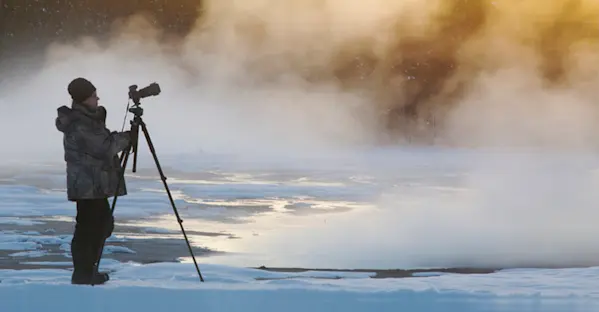
This morning we board private snowcoaches to traverse Yellowstone’s wild interior, accessible in winter only by over-snow vehicles. Its plethora of geothermal features create excellent photo subjects, as geysers spray hot steam into the air and fumaroles bubble up from the snow. On the Central Plateau we will be on the lookout to photograph large bison herds and wolves. We’ll also visit the Upper and Lower Falls of the Grand Canyon of the Yellowstone River—another fantastic photo opportunity. If it’s cold enough, the falls may freeze into a cascade of ice plunging to the canyon floor.
Day 5: Geyser Basin Exploration
Board our chartered snowcoach again to explore the geyser basins surrounding the Firehole River. This part of the park boasts the highest density of geothermal features in the world. Opportunities abound to photograph all four types: geysers, hot springs, mud pots and fumaroles. Because of the warmth provided by the steam vents and hot mud, wildlife congregate in the area during the winter, and we’ll have a chance to see and photograph trumpeter swans, bald eagles, elk and bison.
Day 6: Grand Teton National Park
Today we head south by snowcoach to Wyoming’s other scenic treasure, Grand Teton National Park. En route we stop at West Thumb Geyser Basin on the edge of Yellowstone Lake to search for and photograph moose, river otters and trumpeter swans. Crossing the Continental Divide, we drop into the Snake River Basin. The first views of the Teton spires will undoubtedly provoke a flurry of snapping shutters. More great shots await, with the jagged range providing an awesome backdrop for wildlife photos.
Day 7: Jackson Hole / National Elk Refuge
Our winter safari continues in the National Elk Refuge, home to thousands of elk, bighorn sheep and bison that winter on the floor of Jackson Hole. A horse-drawn sleigh ride provides a festive finale to our wildlife odyssey, offering close-up opportunities to photograph the park’s enormous herd of elk.
Day 8: Jackson / Flights Home
After breakfast, transfer to the airport for flights home.
Please note: Every alternate trip runs in the opposite direction, from Jackson to Bozeman.


(800) 543-8917 for Availability
Print Page
Every 1st & 3rd Tuesday of the month, starting on February 5th! 


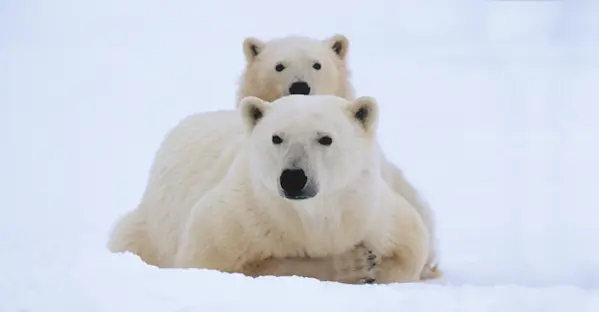
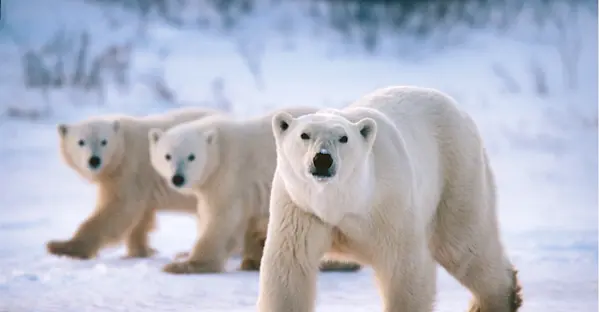
Studies suggest that two-thirds of the world’s polar bear population could be gone by 2050. And if current warming trends continue unabated, WWF scientists and other researchers believe that polar bears may disappear altogether within 100 years. WWF is intent on preventing this from happening.
Our exclusive Quality & Value Guarantee gives our travelers the confidence to make their travel plans knowing that they will have their lofty expectations met and that the fees we charge reflect the quality of the experience provided on our trips.