
Email Page
Use the form below to email this page to a friend.Family Galapagos Adventure
The Best Yacht-Based Family Adventure in the Galapagos
Note: This special itinerary was prepared on an exclusive basis by Natural Habitat Adventures. Should you choose to travel on an independent departure, your itinerary may be slightly different. Day 1: Quito, Ecuador
Upon arrival in Quito, your family is met at the airport by our local representative and transferred to the Hilton Colon, located in Quito’s central district. Dinner is on your own this evening, to enjoy one of Quito's many distinctive restaurants.
Day 2: Quito
Our Ecuador family adventure kicks off with a tour of the historic capital of Quito, founded by Spanish conquistadors in the 16th century atop a destroyed Inca city. Quito has the best preserved, least altered historic center in Latin America, earning it status as a UNESCO World Heritage Site. Our tour includes an array of impressive sites, from classic plazas to the Jesuit Church of La Compañía, with its gilded baroque interior. This evening, we gather for an orientation and welcome dinner as we prepare to depart for the Galapagos in the morning. Please note: This excursion is included on our scheduled departures on the M/Y Letty. If you are not on a scheduled Letty departure, please contact our office for additional information on available Quito activities.
Day 3: Quito / San Cristobal, Galapagos Islands
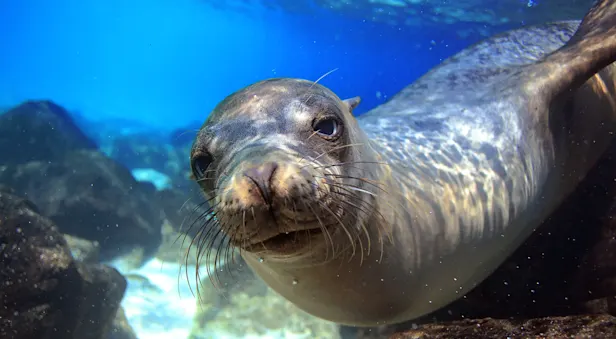
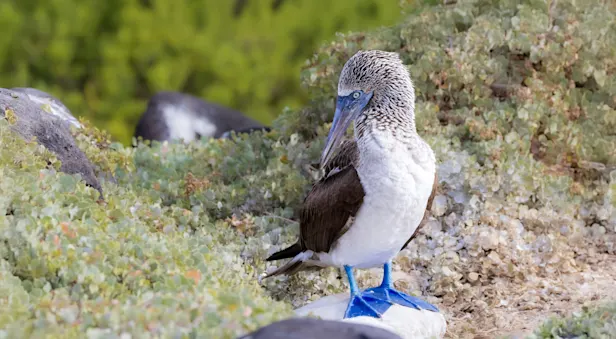
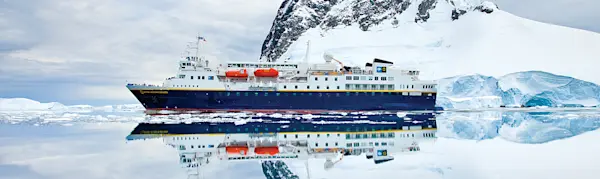
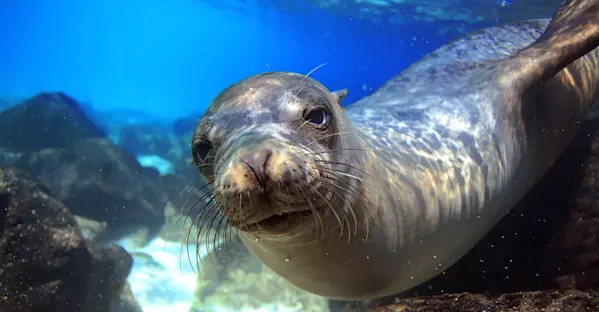
It's time to head to the islands! Fly westward to the Galapagos this morning, landing at San Cristobal where our island cruise begins. Here we'll meet our Expedition Leaders, who quickly whisk us off on an excursion to Cerro Tijeretas where we'll have our first chance to snorkel—likely with some friendly sea lions! Snorkeling is easy to learn, even for beginners, and our Expedition Leaders are by our side to help. Next, we hike to the top Frigatebird Hill for spectacular views of the coast and rooftops of the town of Puerto Baquerizo Moreno below—and we may see some of the namesake birds circling overhead. Soon it's time to head to the marina to board our yacht, in time for dinner served aboard. The sleek M/Y Letty is our home for the next week, providing comfortable cabins and 360° views from the topside observation deck. At sunset, we cruise around Kicker Rock, a lava cone formation jutting up 500 feet from the sea. Blue-footed boobies perch on its cliffs while magnificent frigatebirds soar overhead, and already we can see why Herman Melville called these "the Enchanted Isles."
Day 4: Genovesa
Genovesa Island, also called Tower, is a collapsed shield volcano whose flooded caldera attracts vast numbers of pelagic seabirds that come here to breed and nest. Inside the submerged crater we are surrounded by thousands of great frigatebirds, red-footed boobies, swallow-tailed gulls, Galapagos storm petrels and yellow-crowned night herons that rend the air with a cacophony of squawks. We anchor at Darwin Bay, formed thousands of years ago after the collapse of the volcano's roof to form a huge caldera. Surrounded by vertical cliffs, the bay is an ideal breeding site for the more than two million land and sea birds that congregate on Genovesa. Following the trail up Prince Philip's Steps, we walk among colonies of great frigatebirds and red-footed and Nazca boobies to a lava field where storm petrels nest in underground chambers and lava tubes. Late this afternoon we land at a coral beach to swim and snorkel with sea lions, which are often as curious about us as we are about them!
Day 5: Bachas Beach / Cerro Dragon
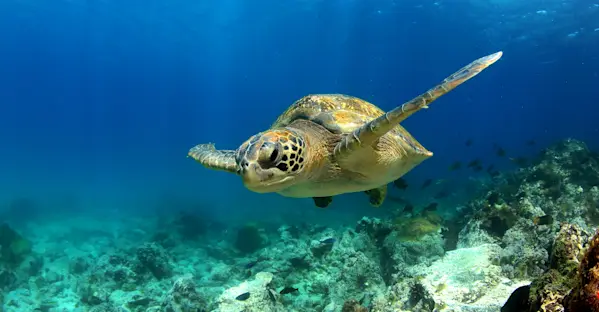
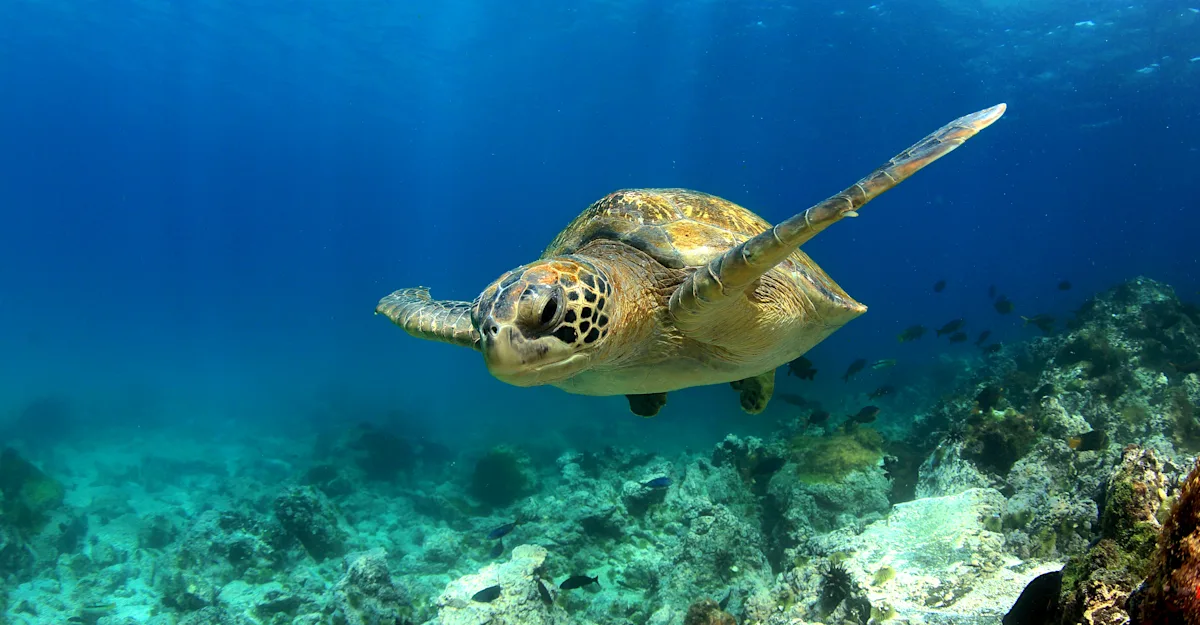
This morning we land at Las Bachas, a beautiful white sand beach on Santa Cruz. Snorkeling in the azure water reveals a kaleidoscope of fish, while the powdered coral sand is a favorite nesting site for green sea turtles, and pink flamingoes often dot the saltwater lagoons. We continue this afternoon to Cerro Dragon ("Dragon Hill"), one of the best places in the islands to see gentle, large land iguanas. Scientists have been working diligently to protect Santa Cruz's native land iguana population from invasive species, and it's not uncommon for travelers and researchers to cross paths on trails among the cacti and palo santo forest in the area. Great views are available from atop the small hill, where visitors may also see a variety of birds.
Day 6: Isabela
Isabela is the largest of the Galapagos islands, created where six volcanoes flowed together. This morning we explore Punta Vicente Roca, a small promontory on the island's northern side with two coves that lie on either side of the eroded remains of a tuff cone made of volcanic ash. We'll cruise around the point by panga (motorized raft), observing large numbers of blue-footed and Nazca boobies that nest on the sheer cliffs, while flightless cormorants are seen along the shoreline. Then we'll snorkel in one of the protected coves, laced with water-filled subterranean passages. Marine life is abundant, and friendly sea lions often approach us to play beneath the waves. At Urbina Bay this afternoon, we step ashore on a white sand beach to witness one of the best examples of geological uplift in the Galapagos, a phenomenon that occurs when molten rock beneath the surface suddenly shifts. In 1954 the shoreline was uplifted, exposing 1.6 square miles of shoreline. The coastline was driven three-quarters of a mile farther out to sea, exposing coral and stranding marine organisms on what is now shore. Urbina is also home to a colony of some of the largest land iguanas in the islands and the iconic Galapagos tortoise.
Day 7: Fernandina / Isabela
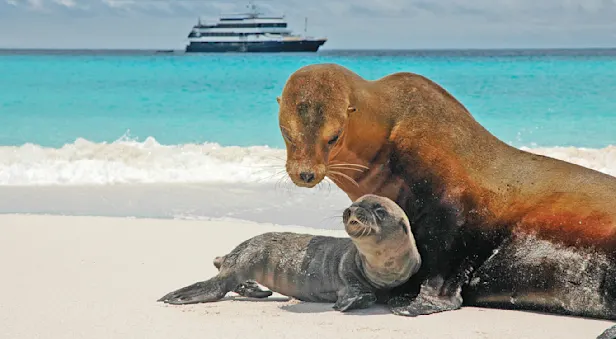
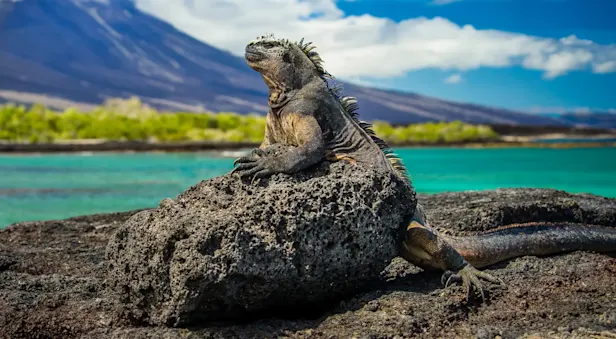
Just opposite Isabela, Fernandina is the youngest and most active volcano in the Galapagos. The rippling pahoehoe lava at Punta Espinoza is a stark backdrop for the surprising variety of life that flourishes here: flightless cormorants nest on the rocks, Galapagos hawks soar overhead, sea lions sprawl on the beach, and huge colonies of marine iguanas bask in the sun. Bright orange Sally Lightfoot crabs pepper the black rocks at water's edge, a vivid color counterpoint to the turquoise sea. A snorkeling excursion offers a good chance to see sea turtles and submerged marine iguanas feeding on algae. This afternoon we cruise across the Bolivar Channel back to Isabela, keep watch for whales and dolphins. Landing at Tagus Cove, we explore by panga, finding penguins, pelicans and graffiti dating to the 1800s when the names of ships were carved into the rock above a historic anchorage for pirates and whalers. Another snorkeling opportunity awaits, perhaps with a chance to frolic again with young sea lions.
Day 8: Rabida / Santa Cruz / NHA's Wild Tortoise Camp
Rabida is one of the most volcanically varied islands in the chain. The beaches here are deep maroon and the rock multicolored, products of lava eruptions from the multitude of spatter cones that pock the island. Marine iguanas and sea lions are often seen resting in the shade of caves, and Rabida’s saltwater lagoon is home to abundant bird life, including pink flamingos. A short trail leads to the lagoon where we may see boobies, brown pelicans nesting in the bushes, and nine species of Darwin’s finches. Excellent snorkeling opportunities also await over the reefs that fringe the island. We then we continue to Santa Cruz, the highest island in the Galapagos chain. At Black Turtle Cove, a haven for marine life, we explore the mangrove ecosystem by panga and keep an eye out for black- and white-tipped reef sharks, sea turtles, and a variety of rays that are often spotted here.
This afternoon, one of the most exciting features of our itinerary is just ahead: a unique opportunity for camping in the remote highlands of Santa Cruz, high above the Pacific Ocean. Those who wish to participate in our optional camping night will disembark and transfer by van to NHA's exclusive Wild Tortoise Camp, where accommodations are available in clever treehouse cottages or raised safari-style tent cabins. Our private camp is tucked among lush vegetation that attracts giant tortoises, and we're likely to see several wandering near camp. We rejoin our boat again in the morning for the day's activities. Please note: At times, the camp may be closed due to poor weather conditions.
Day 9: Santa Cruz / Darwin Station or Tortuga Bay
This morning we'll enjoy close-up encounters with the resident giant tortoises in their misty natural habitat in the Santa Cruz highlands. Lava tubes lace the ground, and we may get to venture into one of the caverns. Our excursion also includes a visit to Los Gemelos—"The Twins"—two deep pit craters in the scalesia forest that hold a variety of birdlife. This afternoon, choose between a wooded walk to secluded Tortuga Bay for swimming and relaxing on the long white-sand beach, or a visit to the world-famous Charles Darwin Research Station in Puerto Ayora, the main town on Santa Cruz. At the tortoise-rearing facility we'll see tiny babies bred to help increase the depleted tortoise population, a central part of the station’s conservation mission.
Day 10: San Cristobal / Quito
This morning we return to San Cristobal, one of the oldest islands in the archipelago, and drop anchor at Puerto Baquerizo Moreno, the capital of the province of Galapagos. Here we'll disembark the Letty, then visit the National Park Interpretation Center for a concluding overview of the natural and human history of the islands. At last it's time to bid farewell to the "Enchanted Isles" and fly back to Quito. On arrival we transfer to our hotel, with the rest of the day at leisure for some final shopping or exploring.
Day 11: Depart Quito
Our Family Galapagos Adventure concludes this morning with a transfer to the airport for flights home or for extensions to the Amazon rainforest or Machu Picchu.


(800) 543-8917 for Availability
Print Page
Every 1st & 3rd Tuesday of the month, starting on February 5th! 

Studies suggest that two-thirds of the world’s polar bear population could be gone by 2050. And if current warming trends continue unabated, WWF scientists and other researchers believe that polar bears may disappear altogether within 100 years. WWF is intent on preventing this from happening.
Our exclusive Quality & Value Guarantee gives our travelers the confidence to make their travel plans knowing that they will have their lofty expectations met and that the fees we charge reflect the quality of the experience provided on our trips.