Natural Habitat Adventures HomepageNatural Habitat Adventures Destinations Natural Habitat Adventures Habitat Club Natural Habitat Adventures Trip Forms Natural Habitat Adventures Travel Agents Natural Habitat Adventures Gear Store Natural Habitat Adventures About Us Natural Habitat Adventures Contact Information Request a Natural Habitat Adventures Catalog Book a Trip With Natural Habitat Adventures
Antarctica Dispatch

Antarctica Dispatch


WWF's Sybille Klenzendorf Join Sybille Klenzendorf (Director of Species Conservation, World Wildlife Fund) as she embarks on an epic journey to the ends of the Earth with Natural Habitat Adventures. Read her journal entries as she travels to Antarctica to visit the amazing wildlife waiting at the world's most remote continent.

NEWEST UPDATE

Friday, February 22, 2008 - The Privilege of Antarctica

How can I discuss the profound experience of visiting Antarctica in a way that hasn't already been done? Libraries are filled with books that describe travels to the continent, but most seem to describe it as a place to be conquered, or at least survived. Practically a whole subgenre of literature concerns the incredible survival stories from the early and not-so-early explorers; names like Scott, Mawson, Byrd, Ross, Amundsen, and of course, Shackleton, are embedded in our collective consciousness as men who challenged the continent - and who sometimes paid the ultimate price. Fortunately, however, Antarctica is being seen more recently as something greater than just a savage world to be survived.


The reasons to travel here are as diverse as those who make the journey. One can soak up the fascinating history, marvel at the stunning vistas, commune with the endless array of fascinating wildlife... and visit a vast area of the earth where human presence is still so small as to almost be insignificant. As globalization continues to shrink the planet, the wilderness experience becomes harder to find - and consequently, more important. I think for many of us, Antarctica represents one of the last places on earth where nature has absolute control, and man is merely an occasional guest. You visit Antarctica when it lets you, and one should be grateful for every privileged moment there.


My Antarctic experience starts two days out of South Georgia. Much to our disappointment (and particularly that of our on-board historian, Jonathan Shackleton), our planned landing at Elephant Island did not happen. As we approached, an extremely dense fog settled around us reducing visibility to only a couple miles. So we decided instead to continue south into the Antarctic Sound.

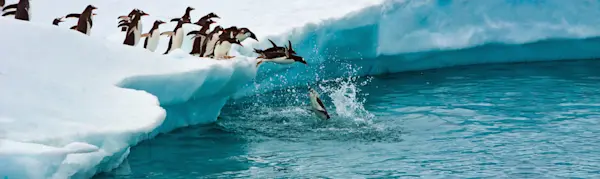
The next morning we made our first landing on Gourdin Island. Shrouded in a heavy mist, this island would probably not be considered among the world's most beautiful places in the traditional sense. However, it was not without wonder. One is first greeted by a rocky beachfront that looks positively primordial - a long expanse of sharp, black rock interspersed with small pools of water and blue ice growlers. I could imagine that it was a place very much like this where the earliest sea creatures came ashore to evolve the attributes that would let them live on land. Right now, it is owned by hundreds of Adele and Gentoo penguins, and a few hearty fur seal bulls. The "beach" then transitions to some lower hills, where nearly every square inch was covered in pink Penguin guano. One could not ask for a more graphic (and pungent) demonstration of just how important krill is to the penguin diet!


Antarctica gives, and Antarctica takes. We had to scrub a couple planned continental landings due to poor weather conditions, but on Feb 18th we finally stood on the peninsula itself in an absolutely stunning place called Neko Harbor. The approach was magnificent - we entered Andvord Bay, whose surrounding hills and mountains were completely white with snow and glaciers. In contrast to the swells in Bransfield Straight, the waters were calm and dotted with picturesque ice formations. Besides the penguins on the far shore, the atmosphere was quiet and calm. As we cruised down the Bay, a pod of rare beaked whales (we could not tell which species) - we counted at least ten -passed us on their way back out into the channel. The rhythmic surfacing and swimming in formation was beautiful to watch. What a privilege to witness such a thing!


We spent several hours walking around Neko harbor, enjoying the oftentimes hilarious antics of the Gentoo penguins. Several of us trekked up a snow-covered ridge to a spectacular overlook and admired the vast white expanse. Not long after the climb, a moderate snow started falling from the low cloud cover. This added the perfect touch to the capper of the visit: a polar bear plunge where several of my shipmates (and my husband, whom I once considered to be a relatively sane person!) took a quick swim in the iceberg-filled waters just off the beach - waters that were still liquid at zero degrees Celsius due to their salinity.


As we tried to find an anchor spot in Neko Harbor, the effects of global warming were demonstrated to us quite dramatically. Standing on the bridge next to the computerized chart system, the ship's position showed us to be on top of a glacier. In reality, however, the glacier front had receded at least 500 yards in just 20 years (since the area was surveyed). We were all reminded of how quickly things are changing - particularly in the Polar Regions.


In all, we spent four days in and around the Antarctic Peninsula and its islands. We enjoyed a spectacular sunrise cruising around Challenger Island, and were thrilled (if not a little scared) by a pair of humpbacks that surfaced not even 20 feet from our zodiacs! We then entered the active volcano whose caldera forms the "C"-shaped Deception Island - and felt the warm-to-hot waters lapping at its inner shores. We noted how its former whaling station is already half-buried by the sporadic lava flows. In a few years, perhaps there will be no sign of human presence there at all.


All too soon, it was time to leave. On our way to the Drake Passage, we enjoyed the usual stunning scenery cruising past the South Shetland Islands and through the English Channel. Many of us were apprehensive at the days ahead as the Drake is notorious for its rough seas. Our expedition leader told stories of past voyages where passengers were confined to cabins while their ships battled 60 foot swells for hours on end! We were lucky in that our seas usually didn't exceed about 15 feet, but the swells came at us from such an angle that the ship had both strong pitch and roll motions. No injuries, fortunately, but numerous drinking glasses and dinner plates found themselves crashing to the floor!


So now I'm back in Ushuaia, waiting for my flight home, and thinking about all the South Atlantic has to offer, and how precious it is. It is easy to become discouraged in the face of all the environmental challenges we face right now, but visiting areas like these remind us of the stakes in the fight for our planet. Despite the immense forces shaping our planet, each of us needs to appreciate how fragile these places can be - and how utterly dependent they are on the choices of our species.


We've estimated that each passenger on this voyage generated 1.75 tons of carbon by coming down here. During the final days across the Drake Passage, together with the Natural Habitat Staff and the passengers, we brainstormed ways of making this expenditure worth it. Natural Habitat offered this trip as a carbon-neutral, in that they purchased carbon off-sets to compensate for the ship's emissions. Many passengers also offered to evaluate their personal carbon footprint at home.


You can find some helpful hints on how to reduce your own carbon emissions and learn about what World Wildlife Fund is doing to fight climate change on our website: http://www.worldwildlife.org/climate/involved/individuals.cfm. Hopefully these writings will contribute in at least some small way to your appreciation of our planet, and serve as inspiration to take further action to preserve what's left. Just by reading this, you obviously care about the kind of world we will be leaving to our children, and you've undoubtedly already taken steps to reduce your footprint on this planet. I would encourage you to continue to the next steps and if at all possible, visit the Antarctic and other wild places (but only with responsible and fully-certified ecotourism operators!) to enhance your personal appreciation of what's at stake. And, most importantly, share your experiences and be an inspiration to others to take action. After all, we're all in this together...


I'm signing off now - thanks for accompanying me on this voyage, and I wish you safe and healthy travels.

Sybille  


Saturday, February 16, 2008 - "Of all the places..."

South Georgia IslandI've traveled to a lot of mountainous regions in my life - the Himalayas in Nepal, the Karakorum in Pakistan, the Spanish Pyrenees, the Austrian Alps, the Canadian Rockies... But of all the places I've visited, few can compare to the magnificence of South Georgia Island. I'm hard pressed to think of another place on earth that features such a spectacular combination of snow and glacier covered peaks, abundant wildlife, beautiful bays and fjords, a rich history, and very limited signs of civilization. Even the approach was spectacular - little ice "growlers" became larger "bergy bits," and then full-blown icebergs. It's hard not to admire the beauty of these stark, white, floating islands of the most interesting shapes; but one also cannot forget that they are responsible for countless ships coming to rest on the bottom of the ocean!


We started our exploration of South Georgia on Sunday, February 10 at the Grytviken settlement in King Edward Bay. This former Norwegian whaling station was operated for 60 years and before it was closed in 1964, had "processed" over 60,000 whales of all types. As I walked around the various rusting ship hulks, blubber boilers, and steamsaws, I found myself becoming quite emotional - in fact, not unlike the feelings one develops when touring a concentration camp. Grytviken was a place of highly efficient, mechanized death - now just a shadow of its former self, just rusting away. It gave me a chill to imagine the place in full operation.


But I also have to admit to mixed feelings of sorts. I'm viewing the station with the benefit of historical hindsight; at the time, the idea of a sustainable harvest was extremely new. The whalers provided food for a large numbers of people would have perished in Europe and elsewhere if it weren't for whale oil and other byproducts. I also couldn't help being impressed at the strength of the former inhabitants; these stations were a testament to humans' incredible capacity to do extremely difficult work under harsh conditions in extremely remote places. Still, I can't forget that Grytviken and the few other whaling stations around South Georgia were responsible for absolutely decimating whale and seal populations in the South Atlantic. The good news is that strict protection measures have succeeded. Seals have come back strongly; however, since whales have such long lifespans and few offspring, their populations are still far from a full recovery.


In any event, Grytviken is a fascinating and important place to visit. In addition to the old whaling station, there is a wonderful museum, chapel, and cemetery - whose most noticeable inhabitant is one Ernest Shackleton. His wife insisted that he be buried in the land he loved and after our experiences the following day, I can easily see why.

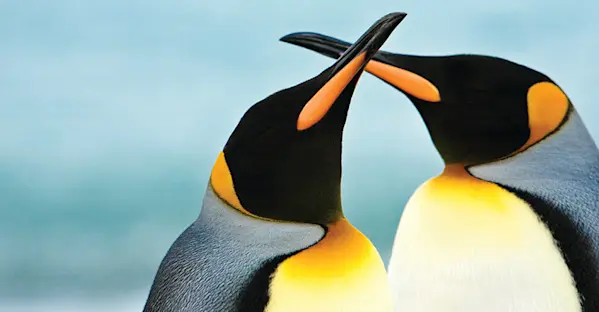
South Georiga Island is home to this avian fellowThe weather forecast for Monday, Feb 11 was unusually favorable, so we awoke at 4:45 am to prepare for our first of three landings for the day. By zodiac, we reached Salisbury Plain in the Bay of Isles before the sun was up - and witnessed the second largest concentration of King Penguins anywhere on earth. Hundreds of thousands of penguins, and thousands of fur and elephant seals went about their business as we walked among them on the beach, collectively taking thousands of pictures. Some approached us out of curiosity, but most paid us little mind. I can't think of anywhere else where I've had so many animals in sight at one time. Words and pictures just can't do justice to the experience of actually being there, and I hope many more people get to visit (in an ecologically sensitive way, of course!).

Our second landing was at Prion Island - an incredible place where Wandering Albatrosses and other seabirds nest. We followed a tight path up a small hill (a boardwalk is being constructed to minimize visitor impact on the land) and in front of a stunning panorama, viewed the nests and chicks of these magnificent birds. What sets Prion Island apart is that it is rat-free. The difference is noticeable in the concentration of nests and hatching success. In areas where rats are present, albatross chicks can get eaten alive on their nests by these invasive species. Even so, this is a very sensitive area and I was a bit wary of us even being there. But the birds showed no outward signs of distress at our presence, and I think it is important for people to experience these areas personally so they know what's at stake in the fight for their conservation.


Those two landings alone would have made the entire trip worth the effort, but we had one more adventure ahead of us that day. Led by our historian, Jonathan Shackleton, we landed at Fortuna Bay and hiked the last 5 miles of Shackleton, Worsely, and Crean's journey to the salvation of the Stromness whaling station. Along the way, Jonathan read pieces of Ernest's journal to us, and we were able to see some of the same landmarks that were described in his writings. Not only were we passing through some of the most beautiful scenery I've ever experienced, but the added history of looking at the journey through Shackleton's eyes gave it a real reverence.


Stromness whaling station is shut down and closed to the public, but one can still view the old buildings and rusting equipment from a distance. At the small beach at the end of the hike, fur seals and Gentoo penguins were in abundance. We spent some time just sitting and letting the animals investigate us - the fur seal pups were particularly curious and would come up to nip our boots. There were a couple big bulls there that watched us a bit warily, but fortunately left us alone. We returned to the ship tired, but exhilarated for having three of the most amazing experiences in one day.


We had one more day to go on South Georgia - an exploration of Larsen Harbor and the Fjord of Dragaklski on the southern end of the island. As my husband put it, "another day, another series of stunning vistas." The weather was unusually cooperative, so we motored around Larsen Harbor on zodiacs, and landed near a lovely waterfall to explore the rocks and snowfields. Following that, the weather was favorable enough for us to take the Multanovskiy up into the fjord to view the spectacular glaciers that awaited. Conditions are usually such that few expeditions are able to even enter the fjord - but we were extremely lucky in that the sun was out the entire time. Yet another experience never to forget!


As we start the 3-day sail across to the Antarctic Peninsula, we revel in South Georgia's wild beauty. It's important just knowing that places like this still exist and are relatively unspoiled. I am signing off for now - next post will be from the 7th continent!  


Saturday, February 09, 2008 - "A bit of bother..."

The last few days have gone by incredibly quickly - it's hard to believe we've been at sea for almost a week. We arrived at the Falkland Islands about a day after leaving the Beagle Channel. We rode our Zodiac boats to our first land excursion on West Point Island, where we visited a very nice rookery of black-browed albatrosses and rock hopper penguins.


Penguins in AntarcticaThe rookery was situated on a steep cliff covered with tussock grass. This type of grass grows up to 6 feet high and offered great shelter from the wind. Our path allowed us to get quite close to the birds who were not bothered at all. It was an amazing site - watching them and their young in their natural habitat. These birds live on the Falklands for the breeding season but spend the rest of the year at sea!

I could have stayed all day, but after about an hour or so of bird watching, a rather strong squall materialized and pelted us with rain, hail, and 50 knot winds. So we pulled our parka hoods tight, and headed back towards the ship. But nearly as soon as it started, it was over, and we stopped at the only homestead on the island to share some delicious tea and cakes with the lovely English couple who were its sole inhabitants.


The following day we dropped anchor in Stanley, the only major settlement and capital of the Falklands. It sure felt like a piece of Great Britain with its red phone booths, double-decker busses, and vehicles driving on the left. After a delightful fish-and-chips lunch we headed back to the Multanovskiy to get a good head start on our long journey to South Georgia.


That was two days ago, and we're still at sea. While en route, we've had several fascinating presentations by the Natural Habitat Adventure staff on seabird biology, Scotia Sea ecology, geology and plate tectonics, the importance of krill (shrimp-like invertebrates) to this ecosystem, and a history of the Falklands. I personally gave a presentation about World Wildlife Fund's worldwide conservation challenges and strategies.
 
We also enjoyed a history of the early Antarctic explorers which was wonderfully delivered by Ernest Shackelton’s cousin - Jonathan Shackelton, who is on our trip as our historian. Jonathan is a wonderfully mannered and understated Irishman, who hilariously described his cousin’s ordeal on a trip to Antarctica on board the Endurance as "a bit of bother." Never mind that it was one of the greatest human survival stories ever! He is a terrific speaker, and it's a real privilege to accompany him on this voyage.


Between lectures, we've spent a great deal of time on the top deck, bridge, and bow identifying numerous sea birds around us, and even some whale spouts in the distance. We should be able to get better views of the whales as we get closer to South Georgia - I'm quite excited about that. The seabirds are studies in grace - particularly the numerous albatrosses which are just beautiful to watch skimming the waves.

Our days at sea since Tierra del Fuego have been quite rough; we have sometimes rolled a good 20 deg from side to side, which makes standing, walking, and climbing stairs an adventure - especially if one is holding a hot cup of coffee! It's quite impressive that we have not had any burn injuries those first couple days, but I think we’re all finally starting to get our sea legs. As far as seasickness goes, I've had a couple minor bouts of nausea, but overall the patch seems to be working quite well. I have never been out on the ocean this far from land and it is an eye-opener what the early explorers might have felt like without all this high-tech gear or accurate maps. Truly inspiring.

So now it's late and I'm off to bed. We will arrive at South Georgia Island tomorrow morning, and its colorful history and spectacular scenery and wildlife will be the subject of my next post.


Monday, February 04, 2008 - Day 1

I am actually on my way - and I couldn't be more excited! Years of anticipation and hard work have finally paid off, and I’m headed to Antarctica. A world of ice and rock, water and sky, wind and cold. And, some of the richest, most unspoiled wildlife habitat on Planet Earth.

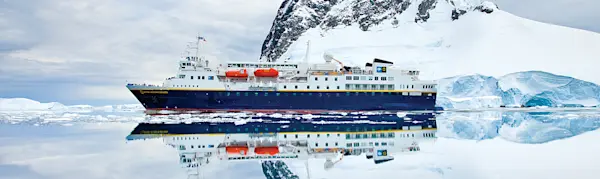
I'm writing this from my cabin in the ice-hardened, former Russian research vessel: the Professor Multanovskiy. Recently converted to passenger service, the Multanovskiy is carrying me and 74 other souls (passengers, crew, and staff) to the Falkland Islands, South Georgia, and the Antarctic Peninsula. A bear biologist by training, I am serving as the World Wildlife Fund (WWF; www.worldwildlife.org) staff representative on this voyage operated by Natural Habitat Adventures (www.nathab.com). My work as Species Director at WWF involves overseeing conservation projects all over the world, and I am here to provide perspective on global climate change impact on wildlife and how the WWF is helping to preserve this incredibly important ecosystem.


Voyage to the AntarcticWe departed from Ushuaia, Argentina, six o'clock this evening on a journey that all of us have dreamed of for the longest time. As I write this five hours later, we are just clearing the Beagle Channel and headed for the open ocean. The magnificent views from the airplane windows during the approach into Ushuaia were just the first taste of the stunning mountains and glaciers we've passed along the way. And from the upper deck of the Multanovskiy we've already spotted albatross, several species of penguins, and even a few dolphins - just in the channel alone. The prospect of seeing King and Adelie penguins, humpback whales, seals, walrus, and numerous bird species up close is a dream for any naturalist - and I’m certainly no exception.


The reason for this incredible wildlife diversity is the Antarctic convergence, the boundary between the cold waters of Antarctica and the warmer sub-Antarctic oceans. The upwelling waters form a sharp boundary characterized by change in temperature (up to 2 degrees C cooler), salinity and nutrient levels that support vast amounts of plankton, krill and with it the whole web of species. Additionally, this heat exchange between the equatorial region and the South Pole functions as an important stabilizer for the earth's climate.


So what's the catch? The rough seas and seasickness stories in the Drake Passage are legendary. I've been on small vessels in Alaska's inside passage and around the Galapagos Islands, but these seas are in a completely different league. I've come prepared with motion sickness tablets, transdermal patches, and an electrostatic wrist band - hopefully at least one of those will work. The cold could also be an issue. This evening on deck I was wearing long underwear, fleece, and my large parka, and was only just comfortable. Compared to where we're headed it's not even close to being cold yet! But the Natural Habitat staff and my fellow passengers are absolutely terrific and I'm optimistic we will forget all about the cold.


So over the next three weeks I'll try to convey not just what we are seeing, but why these things are important - and what they mean to me personally. I'll also let you know how you can help in our efforts to preserve this region. A trip to Antarctica is a tremendously special experience, and I truly hope that you get the opportunity to come see it for yourself. 

   
CARBON OFFSETTING
NHA is the world's 1st carbon neutral travel company. » More Info
FEATURED TRIP
Our Antarctica trip is a once-in-a-lifetime adventure! » Read More
NHA E-NEWSLETTER
News, travel tips and new destinations.
» Sign up today!
2008 CATALOG
Start planning your
adventure today.
» Request Catalog