


Itinerary
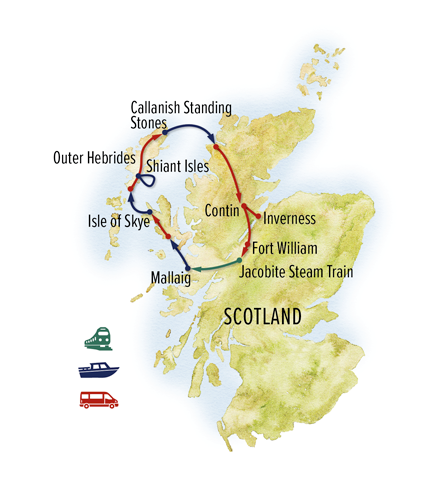
Our Scotland nature adventure begins in Inverness, the largest city and cultural capital of the Scottish Highlands. From Inverness, a transfer is included to our historic country house hotel located just outside the village of Contin, about a 30-minute drive. Coul House, a grand stone manor house built in 1821, is the centerpiece of the Coul estate established by the Mackenzie clan in 1560. Gather for an orientation and welcome dinner with our Expedition Leader this evening.
It's just a short drive this morning to the Great Glen, passing dramatic vistas of Highland peaks and valleys to arrive at famous Loch Ness, one of the largest and deepest freshwater lakes in Britain. Aboard a private high-speed RIB boat, cruise the silver loch, pausing for a panorama of ruined Urquhart Castle on a rocky promontory above the water's edge—one of Scotland’s largest medieval fortresses. Of course, we hope for a glimpse of the furtive Nessie, the water monster of legend that is the subject of more than a thousand eyewitness accounts. We’re more likely, however, to spy nesting ospreys, eagles and waterfowl. Continue to Loch Lochy for an afternoon hike, exploring the shoreline and forests that blanket the steep mountains rising above the narrow lake. Then it's time to check in to our lodge, an isolated Highland retreat on the shore of Loch Lochy, offering cozy ambience and glorious views.
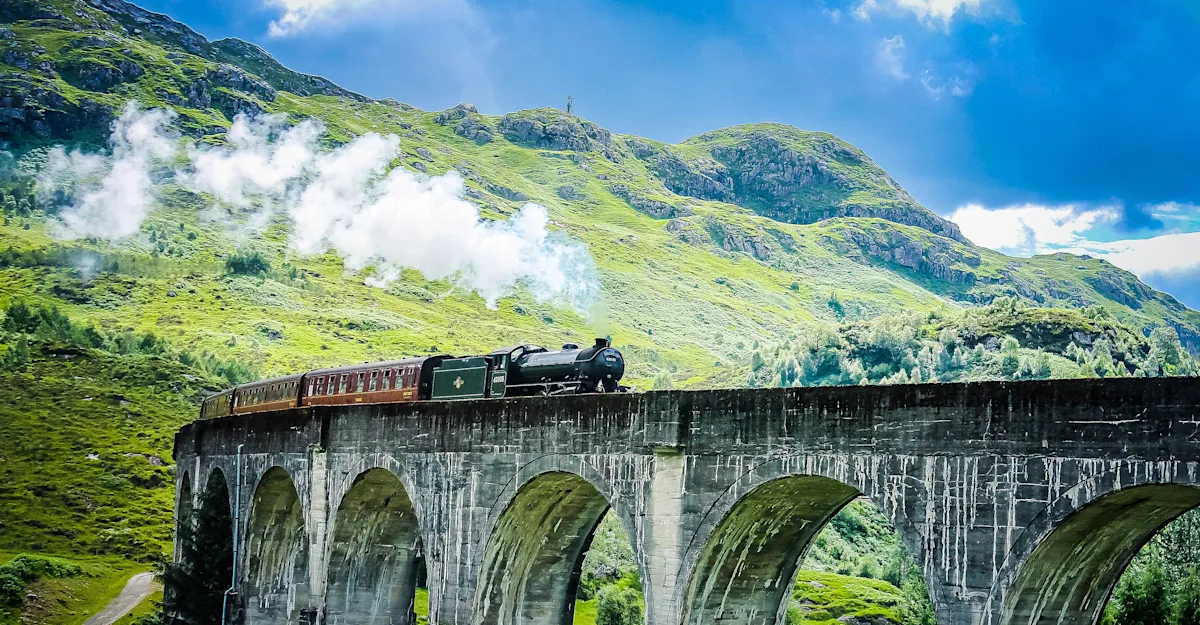
Drive a short distance to Fort William this morning where we board the Jacobite steam train with passage to Mallaig. This magnificent 42-mile one-way journey begins near Scotland's highest peak, Ben Nevis, and crosses the 21-arched Glenfinnan Viaduct (made famous as the route of the "Hogwarts Express" in the Harry Potter films) which overlooks Loch Shiel. Our rail trip concludes at Loch Nevis, the deepest seawater loch in Europe.
Once we disembark at Mallaig, board a private boat for a cruise along the Knoydart Peninsula among some of the wildest landscapes in Scotland. Sandwiched between Loch Nevis and Loch Hourn in the West Highlands, the peninsula forms the northern part of what is traditionally known as “The Rough Bounds,” due to the region's harsh terrain and remote nature. Knoydart is also known as “Britain’s Last Wilderness,” renowned for its rugged grandeur and tranquility. As we follow the craggy coast, often wreathed in clouds, keep an eye out for abundant sea life—we may see otters, dolphins, porpoises, minke whales, gray and common seals basking on rocks, and seabirds, including the majestic sea eagle. We break for lunch at the most remote pub on mainland Britain—The Old Forge, in the small village of Inverie on the south shore of the Knoydart peninsula. The building was originally built as a cottage in the 1770s, later becoming a smiddy's forge, then today a beloved community-owned pub. Our skipper then whisks us across Loch Hourn, the most fjord-like of Scotland's sea lochs, to Armadale on the Isle of Skye where we transfer to our hotel on the Sleat Peninsula, the southernmost section of the island.
More wild Scottish scenery is in store as we explore Isle of Skye. The largest island in the Inner Hebrides archipelago, Skye is known for its dramatic mountains, narrow lochs, picturesque fishing villages and medieval castles. Weather permitting, this morning we’ll take a short ferry ride to Loch Coruisk—a jewel of fresh water that sits within a ring of dark volcanic peaks. Our focus turns next to the Sleat Peninsula, a lesser-known part of the island often called “the garden of Skye” for its soft, green landscape. In contrast to more stark and rocky terrain elsewhere, here, lush vegetation meets the rugged shoreline and white sand beaches. Several hiking options await, all of which invite us to keep one eye on the sky in search of white-tailed sea eagles and the other on the sea, as we look for marine life including otters, seals, whales and dolphins. The peninsula is also one of the strongest Gaelic-speaking areas on the isle, with more than a third of residents using the ancient Celtic language.
Today we make our way north across the Isle of Skye and on to Harris in the Outer Hebrides. Stop for scenic vistas of the jagged Cuillins Mountains and take a walk in the hills before breaking for lunch in Portree, the capital of Skye. Overlooking a sheltered bay, this picturesque village is famous among photographers for its row of pastel-colored houses lining the harbor. Continuing north, we stop to admire several geological landmarks on the Trotternish Ridge, a rugged high escarpment. The Old Man of Storr, visible for miles, is a prominent rock pinnacle overlooking the sea from a steep mountainside. Kilt Rock is a 300-foot-high wall of towering columnar basalt, its multi-coloured hexagonal pillars resembling the pleats of a tartan kilt. The Quiraing may be grandest of all, formed by a massive landslide on the ridge that created high cliffs, terraced plateaus and sharp rock outcrops. At the port town of Uig, board the ferry to Tarbert on the Isle of Harris, cruising in the gleaming light of evening. We’ll have dinner onboard the ferry before arriving at our hotel in the heart of this small harborside town.
Lying on the far northwest edge of Scotland in the Outer Hebrides, the Isle of Harris is a windswept landscape of mountains and moorlands, crofts, lochs, meadows and white sand beaches fronting the turquoise North Atlantic. Its craggy coast, defined by cliffs and secret coves, offers nesting habitat for myriad seabirds. In high summer, discover the wildflower meadows that burst into color on the machair, a sparse veneer of green atop the sand. The single-lane “Golden Road” winds along the east coast of Harris among miniature fjords and tiny hamlets with Viking and Gaelic names. A highlight today is a private boat trip to the Shiant Isles, one of the world's most famous seabird colonies. Located between Skye and Lewis, these columnar basalt islands are known in Gaelic as Na h-Eileanan Seunta, or the "Enchanted Isles." Though this tiny island group is uninhabited by humans, it is home to hundreds of thousands of seabirds, including a quarter-million puffins—2% of the entire global population. Some 7% of all razorbills in the U.K. also breed here, along with colonies of guillemots, cormorants, shags and great skuas. We often see seals lounging on the rocks, too.
Sept/Oct departures only: Fall trips typically will not visit the Shiant Islands, since the seabirds will have departed by this time. Instead, a private boat cruise will offer an alternate route, tracing the rugged Harris coastline east of Tarbert Marina, passing several remote and deserted villages, with views of the Shiant Isles offshore. As we cruise, scour the waves in hopes of seeing dolphins and whales from the boat before returning to our hotel for teatime.
This morning we head north to explore Lewis, which is actually connected by land to Harris, with the two island portions divided by a mountain range. Along the way, we pass through traditional rural settlements and stop at a weaving shop where world-famous Harris tweed is produced. We have an exclusive opportunity to chat with a local artisan who weaves the renowned woolen fabric, which has been made by individual weavers in their homes on Harris and Lewis since 1846.
Next, we visit one of Scotland's most intriguing archaeological sites, the Callanish Standing Stones. This 5,000-year-old ring of 13 gneiss pillars is arranged in a cruciform pattern around a 14-foot central monolith. Erected on the west coast of Lewis in the late Neolithic era, predating Stonehenge, the stones were a focus for ritual activity during the Bronze Age. Several other stone circles, arcs and alignments are also visible from the main site. Historians estimate the site was abandoned around 1,000 B.C. and ultimately buried beneath a thick layer of peat turf, not unearthed until 1857. We also visit a museum dedicated to historic crofting life in the Hebrides—small-scale farming and food production—before continuing to Stornoway, where we board the ferry back to the mainland. The 2.5-hour crossing is an opportunity to look for dolphins and whales from the observation deck. On arrival in Ullapool, return to Coul House Hotel where our journey began.
Within the serene depths of Glen Affric National Nature Reserve this morning, enjoy a canoeing excursion offering an intimate perspective on the rugged beauty of the Central Highlands. On a gentle paddle in Loch Beinn a' Mheadhoin, we are surrounded by native Caledonian pinewoods, a portion of the Affric Highlands rewilding project that is restoring a huge sector of this globally unique forest that once covered much of interior Scotland. The region is home to the majestic Scottish red deer, pine marten and red squirrels, plus golden eagles and osprey, which we may spy flying overhead. This afternoon, gather with the group for a festive farewell event. Afterward, return to Coul House to prepare for early morning departures.
Our Scottish sojourn comes to a close after breakfast this morning as we transfer to Inverness to meet departing flights.